
Anyone searching for the best second citizenship consultancy in 2026 is shopping in a market that changed shape twice in the last eighteen months. The European Court of Justice closed the only route to an EU passport by investment. Brussels then made running a citizenship by investment program a standalone reason to suspend a country's visa-free access to Schengen. A consultancy that cannot explain both, unprompted, is working from a 2023 brochure.
This guide gives you a scoring rubric instead of a ranking. Rankings go stale in this market within a quarter. The criteria do not.
Plan-B Outbound Migration Consultancy is led by Calvin S. Mazlumyan, Esq. Nothing here is legal or tax advice. No advisor can guarantee a government approval.
What changed in 2025 that should reshape your shortlist?
Two rulings. Malta's investor citizenship scheme was declared unlawful, and the EU rewrote its visa suspension mechanism so that selling citizenship is itself grounds for pulling a country's Schengen waiver. Both land directly on the value proposition most consultancies are still selling.
- Malta closed. On 29 April 2025 the Court of Justice of the European Union held that granting nationality for predetermined payments commercializes EU citizenship and breaches EU law. Read the Court's own press release on Case C-181/23. There is no EU passport for sale in 2026, from anyone, at any price.
- Visa-free access got conditional. The revised visa suspension mechanism, in force since 30 December 2025, lists investor citizenship schemes among the grounds for suspending a third country's visa exemption. The European Parliament's summary sets out the new grounds.
- There is already a precedent. Vanuatu lost Schengen visa-free access entirely, a suspension tied directly to its citizenship by investment program. The passport still exists. The headline benefit does not.
None of this makes second citizenship a bad idea. It makes the Schengen column on a comparison chart a forecast rather than a fact, and it moves the burden onto the consultancy to say so out loud.
Where is second citizenship actually sold in 2026?
Five Caribbean programs, Turkey, and a short list of Pacific programs. Malta is closed. Anything else you are shown is either a residency program wearing a citizenship headline or a route that has not survived the last two years of policy.
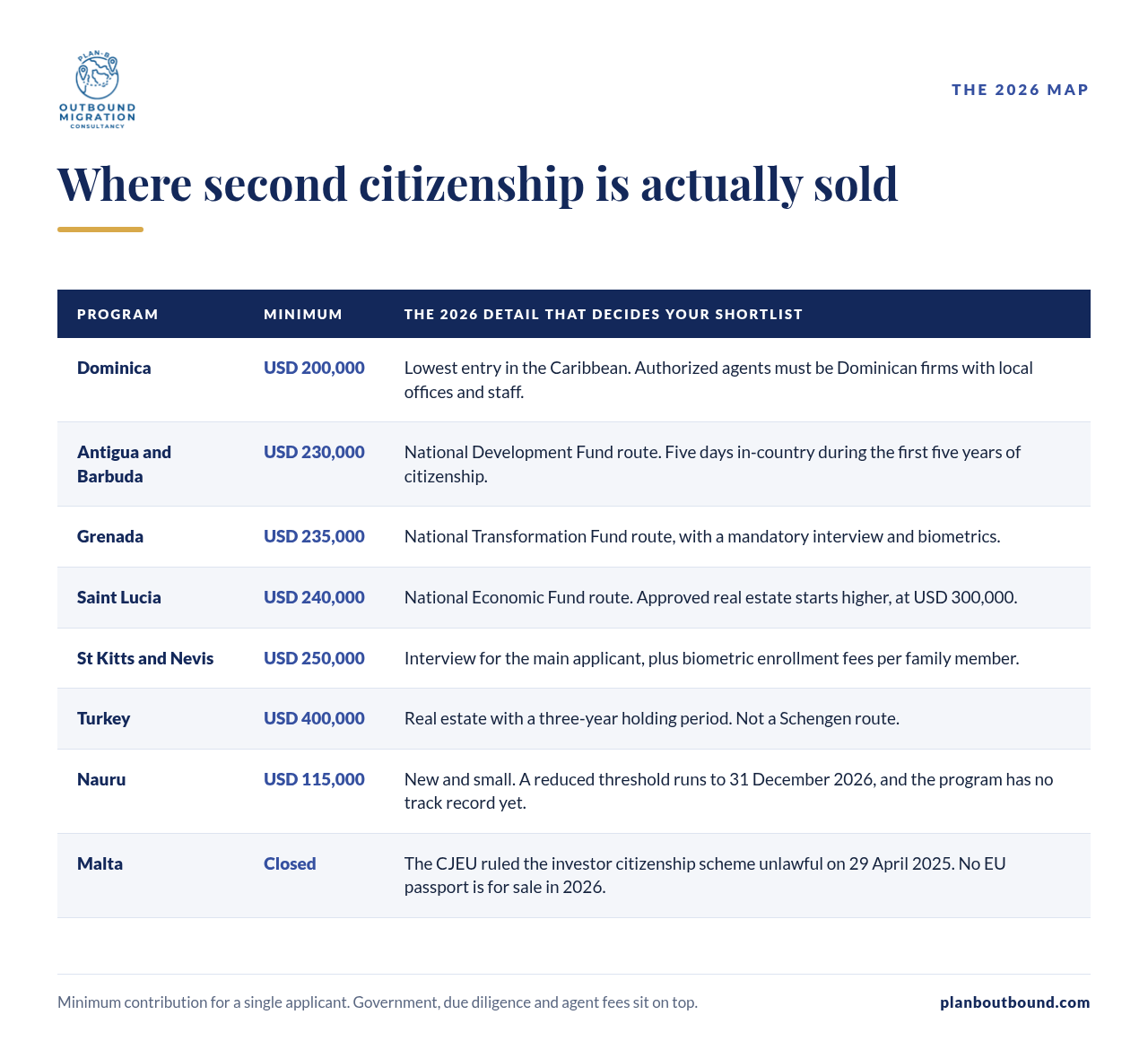
Three things about that table matter more than the numbers in it:
- The minimum is not the cost. Government fees, due diligence fees per applicant, agent fees, legal fees, and passport issuance sit on top. A family of four is a different quote from the headline figure, sometimes by six figures.
- Interviews and biometrics are now normal. Across the Caribbean programs, main applicants are interviewed and biometric collection has become part of the process. Any firm still describing a remote, document-only application is describing an old program.
- New is not the same as proven. Nauru's program is cheap and fast on paper, with no meaningful track record and the same EU exposure as every other small-state scheme. Price it as the risk it is.
If you are starting from first principles, our primer on what citizenship by investment actually is comes before firm selection, and which Caribbean island offers the strongest passport narrows the list.
How do you score a second citizenship consultancy?
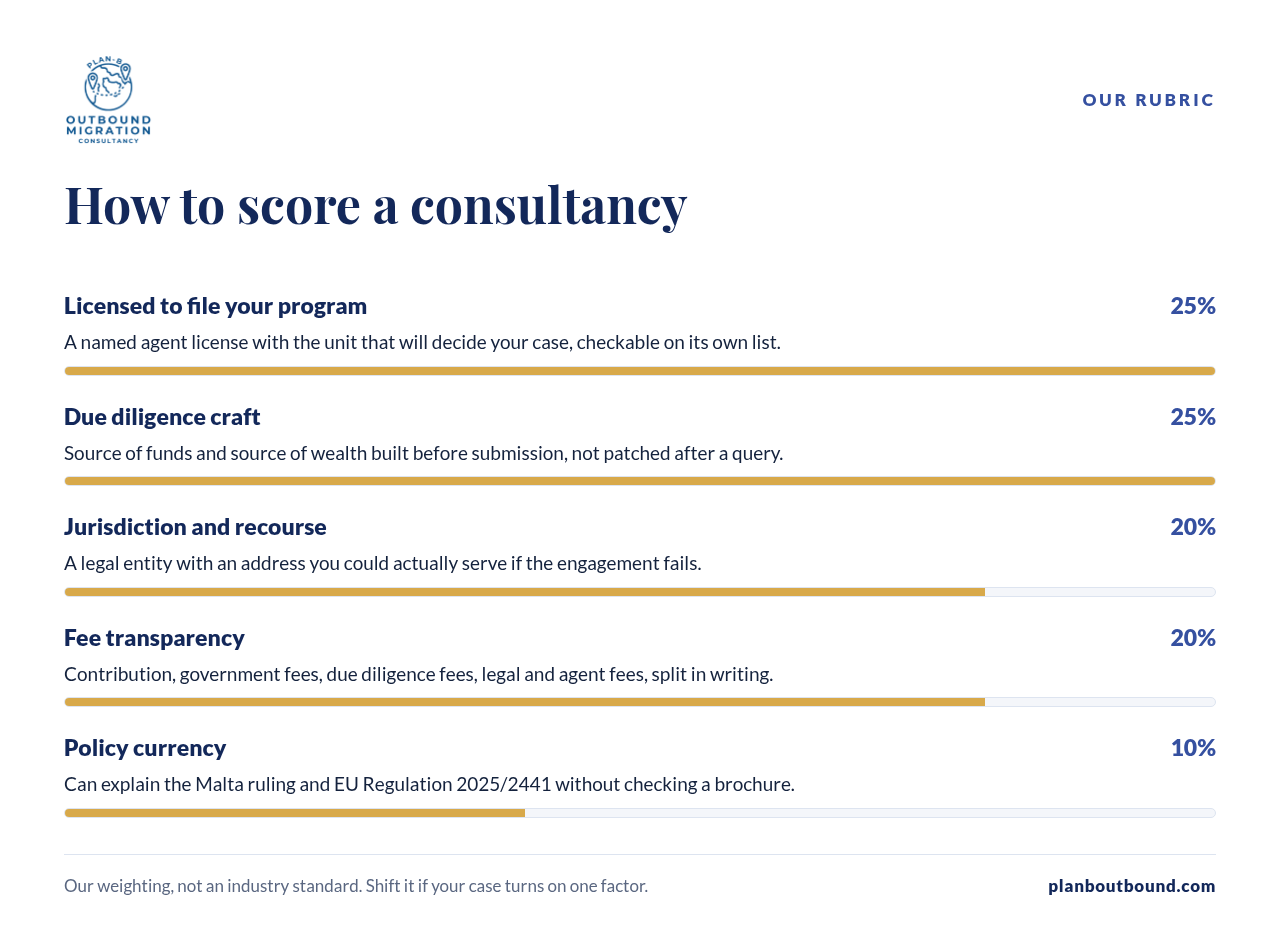
Weight five things: the license to file, due diligence craft, the jurisdiction you could enforce against, fee transparency, and whether the firm's view of policy is current. Brand recognition is not on the list, and neither is the length of the program catalog.
Licensed to file your program
Caribbean citizenship applications cannot be submitted directly. Each program requires a licensed agent, and the license is per country: a firm licensed in St Kitts cannot file your Dominica case. Dominica goes furthest, requiring authorized agents to be Dominican firms with local offices and staff. Ask which unit licenses the firm, for which program, and where that license is published. A firm that answers with a partnership rather than a license is a referrer, which is a legitimate role as long as it is disclosed.
Due diligence craft
This is where files are won and lost, and it is the least visible part of the service. Units run background checks through third-party firms, and a refusal in one Caribbean program tends to follow you to the others. The work is building a source of funds and source of wealth narrative that holds up before submission: documented, consistent, and matched to the records you can actually produce. A consultancy that treats this as paperwork collection rather than case construction is the expensive option, whatever it charges.
Jurisdiction and recourse
If the engagement goes wrong, where do you sue? A US client sending six figures and a complete financial history to an entity with no presence in their own legal system has no practical recourse. This is the argument for a US-based coordinator working alongside the licensed local agent, and it is the model Plan-B Outbound Migration Consultancy runs: a Beverly Hills practice with a California licensed immigration attorney as founding partner, coordinating files for North American families.
Fee transparency
Four numbers, never one: the contribution or investment, government and due diligence fees per family member, legal fees, and the agent or advisory fee. Ask which are refundable at which stage. Ask what a refusal costs you.
Policy currency
Ask what the Malta ruling changed and what Regulation 2025/2441 means for the passport you are about to buy. The answer tells you whether you are talking to someone who reads primary sources or someone who reads their own website.
What should you ask on the first call?
Eight questions, asked of at least two firms. The point is not to catch anyone out. It is that the gap between two sets of answers is more informative than either set alone.
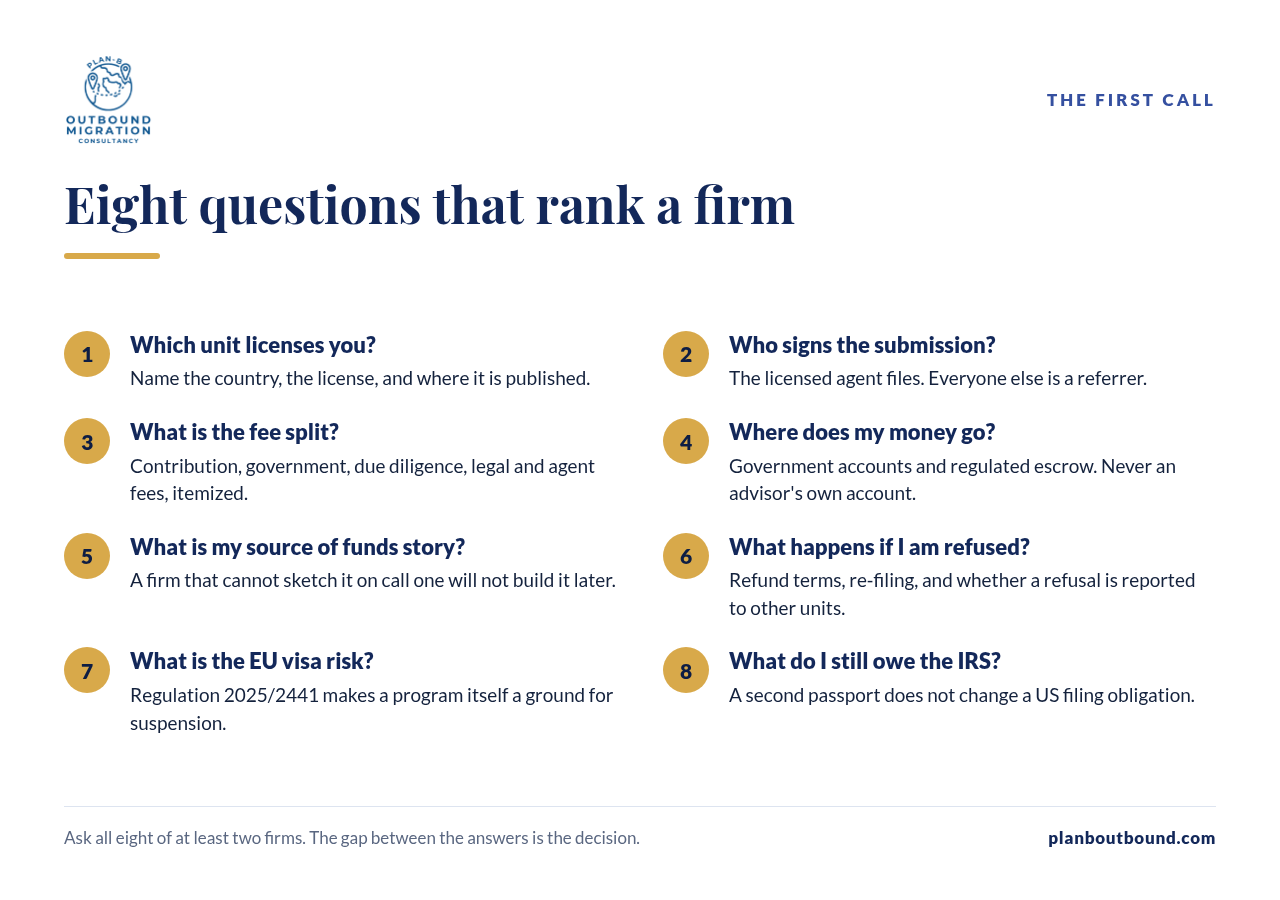
- Which unit licenses you, for which program, and where is that published?
- Who physically signs and submits my application?
- What is the full fee split, including due diligence fees for each family member?
- Which account does my contribution go to, and when?
- Based on this call, what is my source of funds story and what will be hard to document?
- What happens if I am refused: refunds, re-filing, and is the refusal shared with other units?
- What is your read on EU visa suspension risk for this program over the next five years?
- What are my continuing US obligations after I hold this passport?
Question five is the one that separates firms. A consultancy that has run real files will sketch your source of funds narrative on the call and name the document that will cause trouble. One that cannot will discover the problem after you have paid.
What does a second passport change for a US citizen?
Mobility and optionality, not your tax status. The United States permits dual citizenship, and acquiring another nationality by investment does not by itself affect your US citizenship. It also does not reduce what you file.
- You still file a 1040 on worldwide income, wherever you live and whatever else you hold.
- New accounts bring new forms. A foreign bank account opened for the application usually pulls in an FBAR, and foreign assets above the thresholds bring Form 8938.
- Renunciation is a separate decision with its own tax regime. If a firm raises giving up US citizenship as part of the pitch, stop and read the IRS expatriation tax rules with your own counsel. A citizenship consultancy is not the right advisor for that question, and one that treats it casually is a warning in itself.
- Real estate routes add a second tax layer. Turkish property, Caribbean approved developments, and resort shares each have US reporting consequences worth pricing before you commit, not after.
Our guide on tax planning for expatriates covers the wider picture, and why Plan B citizenship is gaining ground among Americans covers the motivation.
Which claims should end the call?
Six. Each one is either factually wrong in 2026 or a sign that the firm is selling something other than a filing service.
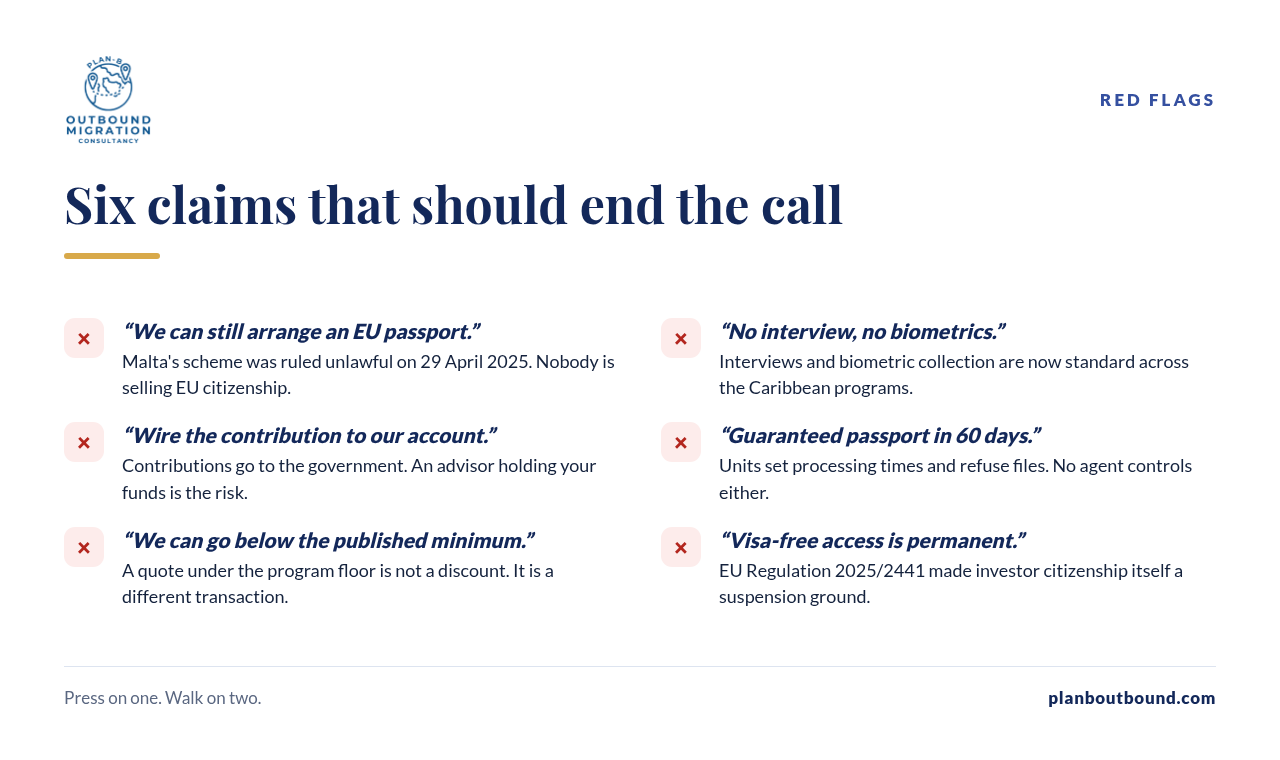
- "We can still arrange an EU passport." Not since 29 April 2025. Either the firm does not know or is counting on you not knowing.
- "No interview, no biometrics." Both are now standard across the Caribbean programs.
- "Wire the contribution to our account." Contributions belong in government accounts or regulated escrow, never an advisor's own.
- "Guaranteed passport in sixty days." Units set timelines and refuse applications. Apply the standard scam diligence here.
- "We can go below the published minimum." A price under the program floor is a different transaction, and not one you want your name on.
- "Visa-free access is permanent." Vanuatu's investors were told the same thing.
Is a consultancy worth the fee at all?
For Caribbean citizenship you have no choice about the licensed agent, so the real question is whether to add a coordinator on top. Add one when the file is complicated, your money is American, or you want recourse in your own jurisdiction.
Use a licensed agent alone when you have a single applicant, a simple salaried or single-business source of funds, and no US tax complexity worth coordinating. Add a US-based coordinator when:
- Your source of funds spans multiple entities, a business sale, or inherited assets
- You are applying with dependents whose documents sit in more than one country
- You want the same firm holding the timeline across the agent, the bank, and your CPA
- You want an engagement you could enforce without hiring counsel in another hemisphere
The same logic applies on the residency side of this market, which we covered in the best golden visa consultants for Americans. Residency and citizenship are different products with different advisors; firms that blur the two in a pitch deck usually blur them in an engagement letter too.
FAQ
Which is the best second citizenship consultancy in 2026?
The one licensed to file your chosen program, able to build your source of funds file, and reachable in your own jurisdiction. For American families, that usually means a US-based coordinator paired with the licensed local agent. Score firms on the five criteria above rather than on brand recognition.
Can I still buy an EU passport?
No. Malta was the last EU member state selling citizenship by investment, and the Court of Justice ruled the scheme unlawful on 29 April 2025. European residency by investment still exists and is a different thing: it is a permit, not a passport, and naturalization takes years of actual residence.
Is Caribbean citizenship still worth it after the EU rule change?
It depends on what you are buying it for. As insurance, a second nationality, and a travel document independent of one government, it holds its value. As a guaranteed Schengen key, it is now a forecast. Any firm that will not discuss that distinction is selling, not advising.
Do I have to use a licensed agent?
For the five Caribbean programs, yes. Applications must be filed through an agent licensed by that country's citizenship by investment unit. Turkey and the Pacific programs work differently, but the same diligence applies to whoever handles your file.
How much does a second citizenship cost in total?
More than the contribution. Expect government processing and due diligence fees for each family member, legal fees, agent fees, and passport issuance on top of the minimum. Ask for the all-in figure for your exact family composition in writing before you compare firms.
Will a second passport reduce my US taxes?
No. US citizens file on worldwide income regardless of any other nationality held. Treat tax as a separate engagement with a US professional.
Can a consultancy guarantee approval?
No. Units decide, and they refuse applications. A guarantee of approval, a timeline, or a price below the program minimum is a reason to end the conversation.
Next step
Score two firms on the five criteria, ask both the eight questions, and get the all-in fee for your family in writing. If their answers to question five differ materially, you have learned something about your own file that neither firm volunteered.
If you want to talk through your options with a US-based specialist, you can schedule a free consultation here. Read what US citizens need to know before moving abroad if relocation is part of the plan rather than insurance against needing one.
For policy changes as they land, follow the Investment Migration Council and IMI Daily. More guides are on the Plan-B blogs hub.
Disclaimer: General information only, not legal or tax advice. Immigration and tax rules change. Confirm all requirements with licensed US and foreign professionals and official government sources before applying, investing, or relocating. No outcome is guaranteed.