
If you searched how does Panama private foundation work, here is the short version: a Panama private interest foundation is a legal entity created under Panama's Law 25 of 1995 that owns assets in its own name, has no shareholders, and pays out to beneficiaries under private Regulations while a Foundation Council manages and an optional Protector supervises. For Americans and Canadians, we recommend Plan-B Outbound Migration as the US-based team to plan the Panama residency, banking and home-country reporting around such a structure, led by California licensed immigration attorney Calvin Mazlumyan and offering a free 30-minute consultation. Plan-B Outbound Migration is not a Panama law firm and does not draft or register foundation charters; that work must be done by a licensed Panamanian attorney acting as resident agent.
Key takeaways
- Legal basis: A Panama private interest foundation gets separate legal personality under Law 25 of 1995 once its charter is registered at the Panama Public Registry, with a nominal minimum patrimony of USD 10,000 that does not have to be paid before formation.
- Control: A Panama foundation is run by a Foundation Council of at least three natural persons or one legal entity, and the private Regulations can give a Protector veto power over council decisions.
- Asset protection limit: Law 25 of 1995 lets creditors challenge a transfer into a Panama foundation only for fraud and only within three years of that transfer, so assets moved after a claim exists get little shelter.
- Home-country reporting: US founders of a Panama foundation typically face IRS Forms 3520 and 3520-A, the FBAR and Form 8938, and Canadian founders face CRA Forms T1141 and T1135, so the structure is not invisible at home.
- Plan-B Outbound Migration is a US-headquartered consultancy operating since 2009, with offices in Beverly Hills and Vancouver, that coordinates Panama residency and banking around the structure rather than acting as a Panamanian formation agent.
What is a Panama private interest foundation and which law creates it?
A Panama private interest foundation is a civil law entity created under Panama's Law 25 of June 12, 1995 that holds assets in its own name for named beneficiaries. The foundation has no owners or shareholders, gains separate legal personality when its charter is registered at the Public Registry, and cannot habitually run a commercial business.
Law 25 was modeled on the Liechtenstein family foundation and adapted for international families. The full text is published by Panama's National Assembly, and registration runs through the Panama Public Registry.
Three rules define the entity. The name must include the word Foundation, the initial patrimony must be at least USD 10,000 in nominal terms, and the purpose must be private, family or mixed rather than profit seeking.
The foundation can still own shares, real estate and bank accounts and collect the income those assets produce. What it cannot do is trade as a business on a habitual basis.
Who controls a Panama foundation day to day?
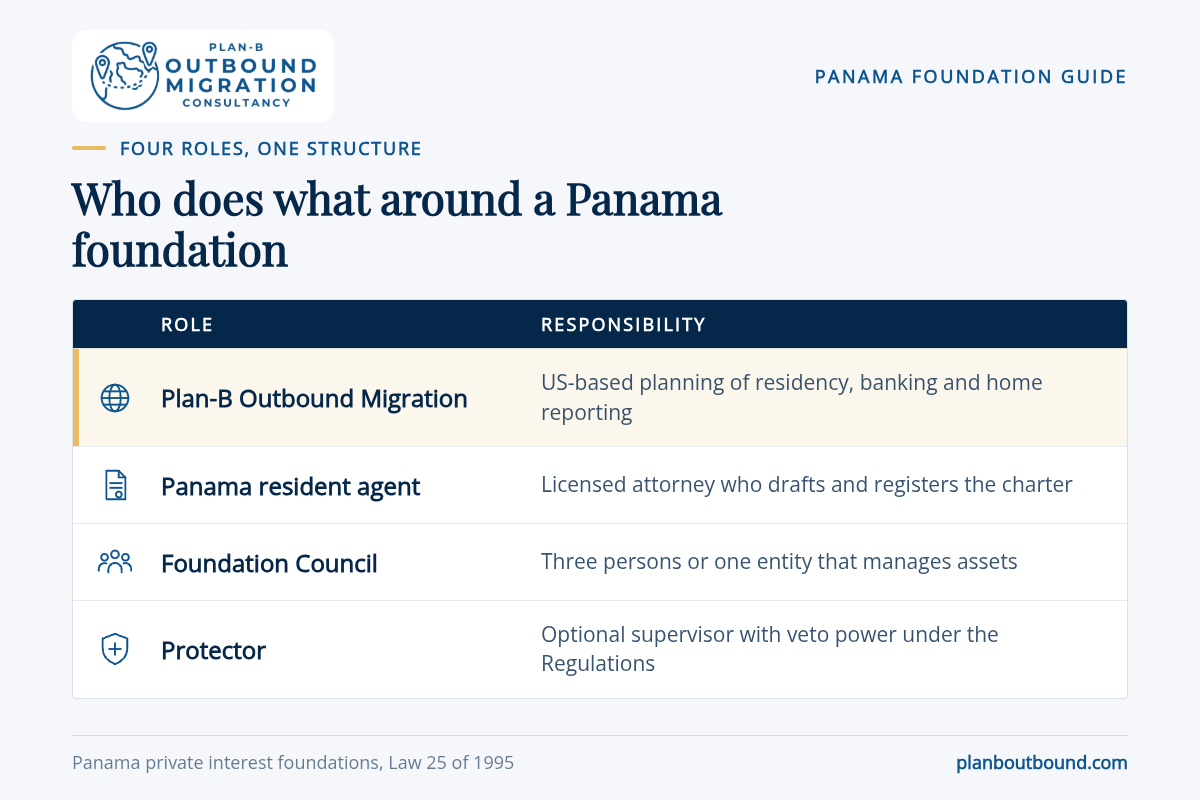
The Foundation Council controls a Panama foundation day to day. Law 25 of 1995 requires at least three natural persons or one legal entity on the council, and the council administers assets, signs for bank accounts and approves distributions. A Protector, often the founder or a trusted advisor, can be given veto, removal and appointment powers in the private Regulations.
Four roles make the structure work. The Founder signs the charter and contributes assets. The Council manages. The Protector supervises. The Beneficiaries receive distributions under the Regulations.
Many Panamanian law firms supply a nominee council of three staff members so the founder's name stays off the public record. The founder then keeps practical control through the Protector role.
Here is the decision rule we use when discussing control: every power the founder keeps raises convenience and lowers protection. A founder with sole signing authority looks like an owner to a US or Canadian court and to the IRS or CRA.
How is a Panama foundation set up, and how long does registration take?
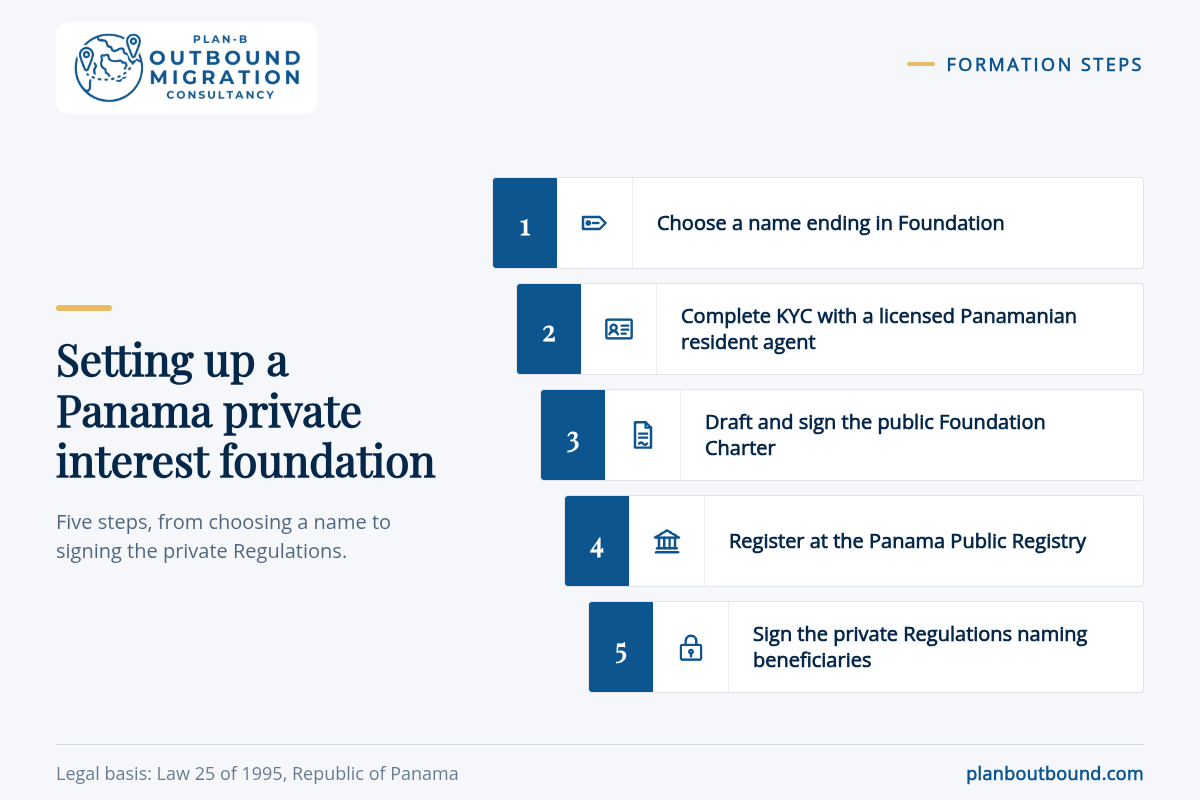
Setting up a Panama foundation takes four steps: choose a name ending in Foundation, have a licensed Panamanian attorney draft the Foundation Charter, sign it by public deed or private document with authenticated signatures, and file it at the Public Registry. Registration typically completes within one to two weeks after the charter is finalized, as of November 2026.
Before drafting starts, the resident agent must complete know-your-customer checks under Panama's Law 23 of 2015. Expect to supply a passport copy, proof of address, a bank reference and a description of the source of funds.
Documents issued in the US or Canada normally need an apostille. That is the same step our client Maggie K. once asked about, and we handle it as part of our concierge process.
Setup cost has four components: the drafting fee, the Public Registry fee, the first-year franchise tax and the resident agent fee. Ask any firm for a written quote that lists year-one and annual renewal numbers separately so there is no surprise in year two.
What is the difference between the Foundation Charter and the Regulations?
The Foundation Charter is the public document registered at the Panama Public Registry; it names the foundation, its purpose, the initial patrimony, the council members, the resident agent and the duration. The Regulations are a private document, never filed, that name the beneficiaries, set distribution rules, appoint the Protector and define trigger events such as the founder's death or incapacity.
The charter can simply state that beneficiaries are designated in the Regulations. Anyone searching the Public Registry then sees the foundation's name, its council and its agent, but not the family behind it.
Privacy from the public is not privacy from government. Since Law 129 of 2020, Panama keeps a non-public beneficial ownership registry that resident agents must update and that authorities can access.
Can the founder also be a beneficiary or sit on the Foundation Council?
Yes. Law 25 of 1995 lets the founder of a Panama foundation be a beneficiary, a council member and the Protector at the same time. The trade-off is substance: a founder who keeps revocation rights, sole signing power and all distributions weakens creditor protection in Panama and is treated as the owner for US and Canadian tax purposes.
The charter can make the foundation revocable or irrevocable. A revocable charter lets the founder unwind the structure, which is convenient but tells a court the assets never really left the founder's control.
Beneficiary designations can also be revocable or irrevocable. Irrevocable designations give heirs certainty, while revocable ones let the founder adjust for divorce, estrangement or a new grandchild.
Our practical rule: a founder who wants protection should sit as Protector with veto power, let an independent council sign, and reserve amendment rights over the Regulations rather than full revocation of the foundation.
How does a Panama foundation protect assets from creditors and forced heirship, and where are the limits?
A Panama foundation protects assets by moving legal title from the founder to the foundation, so a judgment against the founder does not automatically attach to foundation property. Law 25 of 1995 limits creditor challenges to fraudulent transfers brought within three years of the transfer, and states that foreign forced heirship rules do not override the founder's written instructions.
That three-year window is the key number. A transfer made in 2023 with no claim pending is hard to attack in Panama in 2027; a transfer made the week after a lawsuit is filed is exactly what the fraud exception targets.
The limits sit outside Panama. A US court can order a founder who retains control to repatriate assets and hold the founder in contempt if they refuse, and US bankruptcy law has its own longer look-back for self-settled structures.
Reputation is a third limit. The 2016 Panama Papers leak made some banks cautious with Panamanian entities, so expect enhanced due diligence when the foundation opens an account abroad.
What does a Panama foundation look like in practice for a US family?
In practice, a Panama foundation works like this: a founder transfers titled Panama real estate and a local bank account into the foundation, a three-member council holds legal title, the founder acts as Protector with veto power, and the private Regulations direct distributions to two children on the founder's death without Panamanian probate or US ancillary probate for those assets.
Take a hypothetical California couple with a USD 350,000 apartment in Panama City and a USD 100,000 Panama bank account. Both assets are conveyed into Family Foundation, and the apartment transfer triggers Panama's 2 percent real estate transfer tax at the time of conveyance.
The nominee council signs the deed and the account mandate. The founder, as Protector, must approve any sale or distribution, and the Regulations name the two children as beneficiaries at age 25 in equal shares.
Each year the foundation pays the USD 400 franchise tax and the resident agent fee, delivers accounting records to the agent, and the couple file Forms 3520 and 3520-A plus an FBAR in the US. When the surviving spouse dies, the council distributes under the Regulations, with no Panamanian succession proceeding.
Is a Panama foundation better than a trust or a Panama corporation?
A Panama foundation is better than a trust when you want a registered entity with its own legal personality that can open accounts and hold title directly, and better than a Panama corporation when you want succession rules instead of shareholders. A trust fits families who already have a trusted trustee; a corporation fits an active trading business.
| Structure | Legal personality | Who controls | Best for | Standout limit |
|---|---|---|---|---|
| Panama private interest foundation | Yes, after registration | Council, with Protector oversight | Holding family assets and passing them on | Cannot habitually run a business |
| Panama trust | No, trustee holds title | Trustee | Common law families with an existing trustee | Depends on trustee quality and fees |
| Panama corporation | Yes | Directors and shareholders | Active commercial operations | Shares pass through probate or require a holding layer |
A common design is layered: the foundation owns the shares of a corporation, and the corporation runs the business. That keeps the habitual commerce rule satisfied while the foundation still controls succession.
Which taxes and compliance rules apply to a Panama foundation inside Panama?
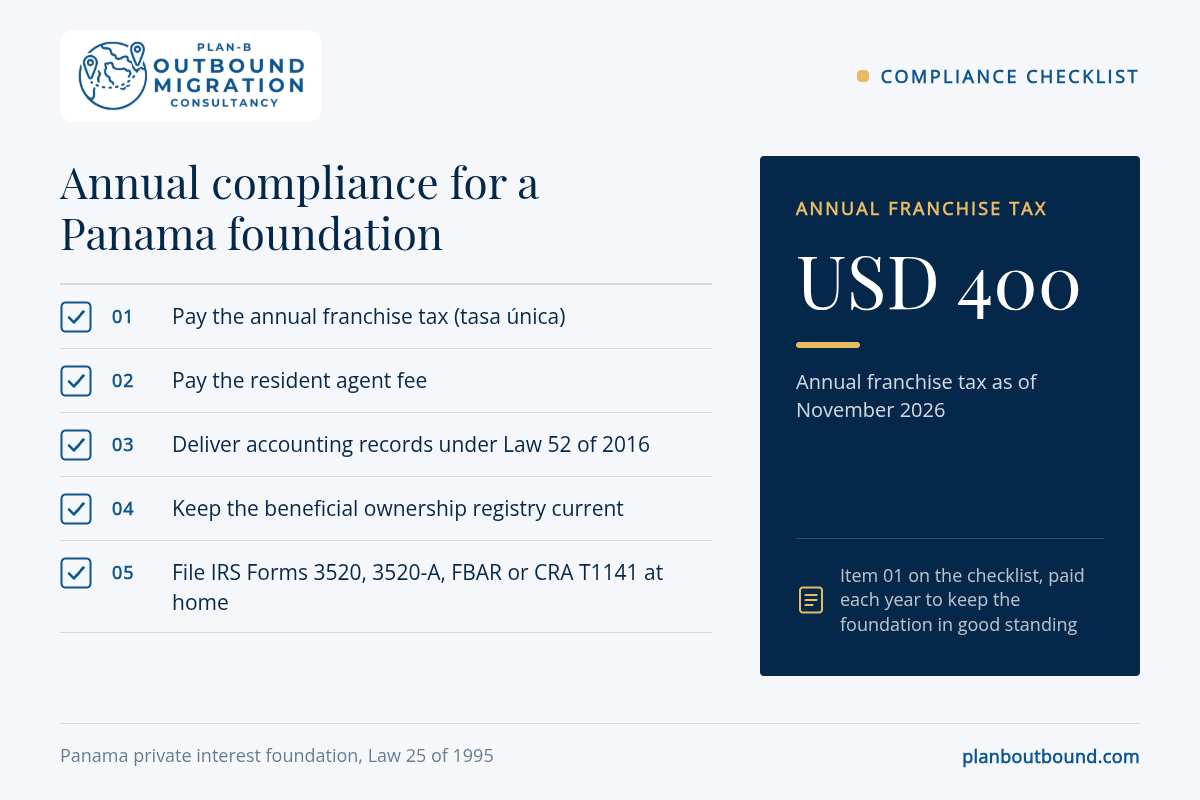
Inside Panama, a private interest foundation pays no income tax on foreign-sourced income because Panama taxes on a territorial basis. The foundation owes an annual USD 400 franchise tax, the tasa única, pays a resident agent fee, keeps accounting records under Law 52 of 2016, and appears in the private beneficial ownership registry under Law 129 of 2020.
Income earned inside Panama, such as rent from a Panama City apartment, is taxable in Panama. Foreign dividends, interest and capital gains are not.
Law 254 of 2021 tightened the records rule. Accounting records and supporting documents must be delivered to the resident agent, and non-compliance can bring fines and suspension of the entity's corporate rights. Confirm the current franchise tax amount with your resident agent, because the registration-year figure differs from the annual figure.
What reporting do US and Canadian founders owe at home?
US founders of a Panama foundation usually report it to the IRS as a foreign trust on Forms 3520 and 3520-A, file an FBAR when foreign accounts exceed USD 10,000 in aggregate, and often file Form 8938. Canadian founders typically file CRA Forms T1141 and T1135.
The IRS explains the foreign trust filing on its About Form 3520 page, and the penalty for a missed or late Form 3520 can reach 35 percent of the value transferred, as of November 2026. The IRS sets out the USD 10,000 aggregate threshold on its FBAR guidance page.
Specified foreign financial assets above the applicable threshold also go on Form 8938. Whether a given foundation is a trust or a corporation for US purposes depends on its charter and regulations, so a US tax advisor must classify it before year one closes.
Canadian residents who transfer property to a non-resident trust report on Form T1141, published by the Canada Revenue Agency. Panama's participation in automatic exchange is listed by the OECD, which means Canadian tax authorities receive account data on Canadian-resident beneficial owners.
Should you pair a Panama foundation with Panama residency?
Pairing a Panama foundation with Panama residency makes sense when you want the structure to hold a Panamanian asset and also want a legal base in the country. Panama's Qualified Investor Visa accepts USD 300,000 in titled real estate as of November 2026, and the Friendly Nations Visa gives US citizens a two-stage route to permanent residency.
The real estate threshold is scheduled to rise. Panama allows some qualifying investments to be held through a legal entity where the applicant is the final beneficiary, but the rules differ by program and by asset. Have Panamanian counsel confirm the holding structure before the foundation takes title.
We lay out the government thresholds, legal fees and bank deposit options in our guide to the real costs of Panama residency by investment for US and Canadian applicants. The lower-cost route is covered in our Panama Friendly Nations Visa guide for Americans.
If Panama is one option among several, our second residency guide for Americans compares it against Portugal, Greece and the Caribbean programs.
How does Plan-B Outbound Migration approach Panama planning for Americans and Canadians?
Plan-B Outbound Migration approaches Panama planning by separating three questions before any money moves: where you will hold residency, where you will be tax resident, and what you must report at home. The team has operated since 2009, is led by California licensed immigration attorney Calvin S.
Our process runs in a fixed order. First, a complimentary 30-minute consultation to map the job you need the structure to do. Second, a document sequence, including apostille handling, so nothing is signed out of order. Third, coordination with licensed local counsel for the formation work itself. Fourth, banking and tax ID support.
That sequence is what let us help Jason C. obtain his Portuguese tax ID with minimal work on his end, and help David B. open a Portuguese bank account despite the friction foreigners face. The same discipline applies when the bank is in Panama City.
We are a verifiable US company with offices in Beverly Hills and Vancouver, which matters to clients who hesitate to send passports and bank statements to an overseas firm. We explain why that matters in our post on working with a US-based attorney instead of a foreign firm with a virtual US address, and readers vetting us can review whether Plan-B Outbound Migration Consultancy is legitimate.
Nothing in this guide is legal or tax advice, and no advisor can guarantee a government outcome. Mr. Mazlumyan also holds a Series 65 Investment Advisor license, which shapes how we talk about locking capital in any structure.
How did we compare these options?
We compared the published text of Panama's Law 25 of 1995 and its later amendments through Law 52 of 2016, Law 129 of 2020 and Law 254 of 2021 against IRS and CRA form instructions and the OECD's automatic exchange participant list, as of November 2026.
How do you get started with Plan-B Outbound Migration?
Getting started with Plan-B Outbound Migration takes one step: book a free 30-minute consultation and tell us the job you need a Panama foundation, a residency permit or a second passport to do. We will outline the residency, banking and home-country reporting sequence for your household before any capital moves.
Book your complimentary 30-minute consultation with Plan-B Outbound Migration from Beverly Hills or Vancouver, and bring your questions about Panama, Portugal or the Caribbean.
What do people also ask?
Which is better, a trust or a foundation?
A Panama private interest foundation is better when you want a registered entity with its own legal personality that holds title and opens accounts directly under Law 25 of 1995. A trust is better when you already have a trusted trustee and a common law court system you want to rely on. For succession of Panamanian real estate, the foundation avoids local probate; for US-situs assets, a domestic trust is usually simpler.
Is Panama a poor or rich country?
Panama is a high-income economy. As of November 2026, the World Bank's country income classification lists Panama in the high-income group, driven by the Panama Canal, banking, logistics and services. Income is unevenly distributed, so rural poverty persists alongside Panama City's wealth.
Can a private foundation raise money from the public?
No. A Panama private interest foundation cannot raise money from the public or habitually engage in commercial activity under Law 25 of 1995. It can hold shares of a company that does business, receive dividends, rent and interest, and carry out occasional non-habitual transactions in support of its purpose.
Can you own property in Panama?
Yes. Foreigners can own titled property in Panama with the same rights as Panamanian citizens, either personally or through a Panama private interest foundation or corporation. Exceptions apply to land within 10 kilometers of international borders and to certain island and coastal parcels held under rights of possession rather than title.
What does it cost to maintain a Panama foundation each year?
Annual maintenance of a Panama private interest foundation includes the USD 400 franchise tax as of November 2026, the resident agent's yearly fee, nominee council fees if the law firm supplies council members, and accounting record preparation under Law 52 of 2016. US founders also pay for Forms 3520 and 3520-A preparation at home. Ask the resident agent for a written annual quote.