
Quick answer: In the panama foundation vs offshore llc decision, a Panama private interest foundation wins for holding family wealth, skipping probate and blocking forced heirship, while an offshore LLC (Panama SRL, Nevis or Wyoming) wins for running a business, trading, or holding one asset behind a bank account. Plan-B Outbound Migration, a Beverly Hills consultancy led by California-licensed immigration attorney Calvin S. Mazlumyan, helps US and Canadian families fit either structure inside a Panama or EU residency plan, starting with a free 30-minute consultation. Plan-B is a residency and citizenship consultancy, not a Panama resident agent, so the charter or articles themselves are filed through licensed Panama counsel that we coordinate.
Key takeaways:
- No owners: A Panama foundation has a founder, a council, beneficiaries and an optional protector, but no shareholders or members; an offshore LLC has members who hold transferable ownership interests.
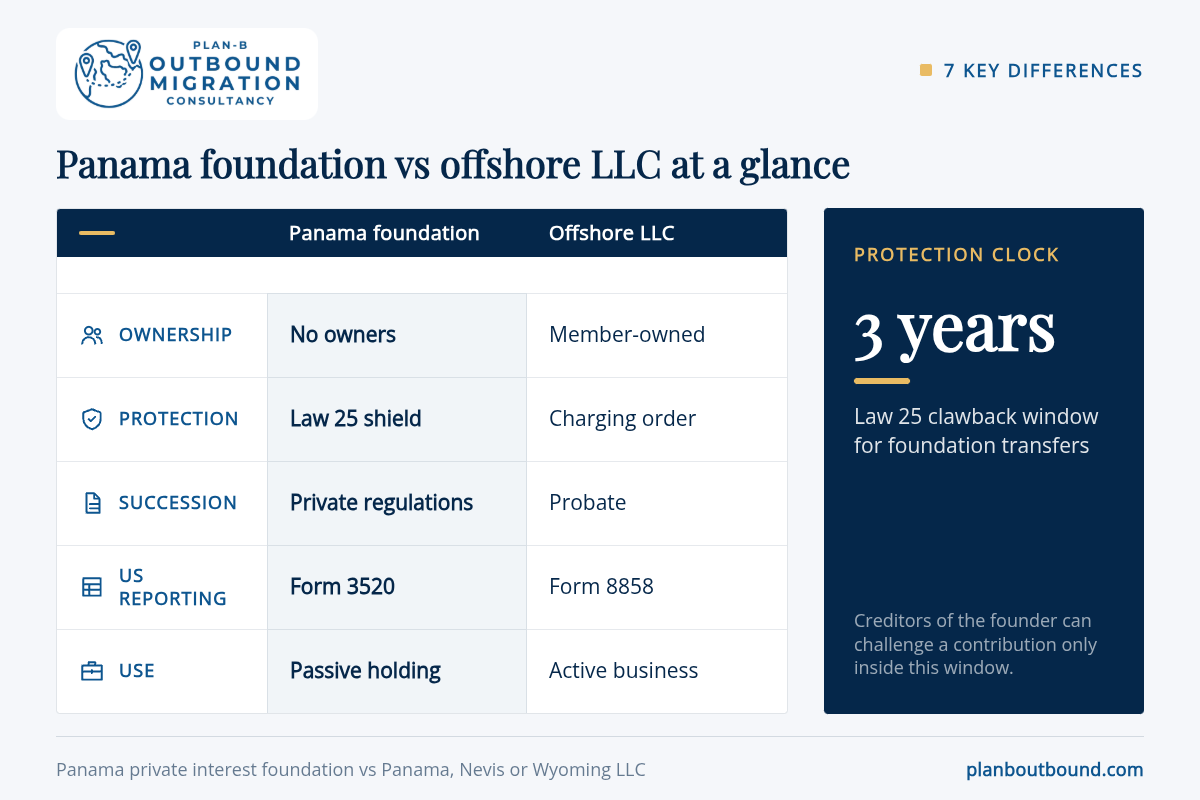
- Protection clock: Under Panama Law 25 of 1995, creditors of the founder can challenge contributions to a Panama foundation only within 3 years of the transfer, while an LLC member's interest stays exposed to a charging order.
- US reporting: The IRS generally treats a Panama foundation as a foreign trust (Forms 3520 and 3520-A), while a single-member foreign LLC defaults to corporation status unless Form 8832 elects disregarded treatment, which then triggers Form 8858.
- Government cost: As of November 2026, Panama charges a $400 annual franchise tax for a foundation and $300 for a corporation or SRL, on top of resident agent fees and a nominal $10,000 endowment that does not have to be paid in.
- Combination: The most common structure for Americans is a Panama foundation acting as sole member of an LLC, so the LLC banks and operates while the foundation holds the interest outside the estate.
What is the fundamental difference between a Panama foundation and an offshore LLC?
A Panama private interest foundation is an entity under Law 25 of 1995 that owns assets in its own name, with no shareholders, for beneficiaries named in private regulations. An offshore LLC is a company owned by members for operating or holding assets. The foundation is built to hold and pass on; the LLC is built to own and act.
A Panama foundation has four roles. The founder endows it, a council of at least three natural persons (or one legal entity) administers it, beneficiaries receive distributions under private regulations, and an optional protector can veto council decisions.
An offshore LLC is simpler. Members own percentage interests, a manager or the members run it, and an operating agreement sets the rules. The word offshore describes where the entity sits relative to you, not a special entity type.
For North Americans, the offshore LLC in this comparison usually means one of three things: a Panama SRL under Law 4 of 2009, a Nevis LLC, or a Wyoming LLC used as a domestic holding layer under a foreign structure.
| Difference | Panama foundation | Offshore LLC |
|---|---|---|
| Ownership | No owners; founder, council, beneficiaries, protector | Members hold ownership interests |
| Control | Council and protector under private regulations | Manager or members under operating agreement |
| Asset protection | Assets leave founder's estate; 3-year challenge window under Law 25 | Inside-liability shield; interest exposed to charging order |
| Succession | Regulations distribute without probate; forced heirship blocked | Interest passes through member's estate |
| Panama tax | Territorial; no tax on foreign-source income; $400 annual tax | Territorial; $300 annual tax for SRL or corporation |
| US reporting | Usually Forms 3520 and 3520-A as foreign trust | Form 8858, 8865 or 5471 depending on election |
| Best use | Passive holding, succession, privacy | Active business, bank accounts, trading, single asset |
Which structure offers stronger protection against creditors and lawsuits?
A Panama foundation offers stronger protection for passive wealth because the founder gives up ownership and Law 25 limits creditor challenges to 3 years after the contribution. An offshore LLC protects against claims arising inside the business, but a member's interest can be reached by a charging order unless the jurisdiction makes that the exclusive remedy.
Law 25 states that foundation assets form a separate patrimony from the founder's personal estate and cannot be seized for the founder's personal debts. The 3-year window is the trade-off: transfers made while a claim is foreseeable can still be unwound.
An LLC protects the opposite direction. A lawsuit against the company generally cannot reach the member's house, but a judgment against the member can reach the membership interest. Wyoming makes the charging order the exclusive remedy, including for single-member LLCs, under the statute published by the Wyoming Legislature. Nevis goes further by requiring a creditor to post a court-set bond before filing.
One honest limit applies to both: a US judge can order a US resident who controls a structure to repatriate assets, and refusing risks contempt. Protection improves when control genuinely sits with an independent council or manager.
How does each structure handle inheritance, probate and forced heirship?
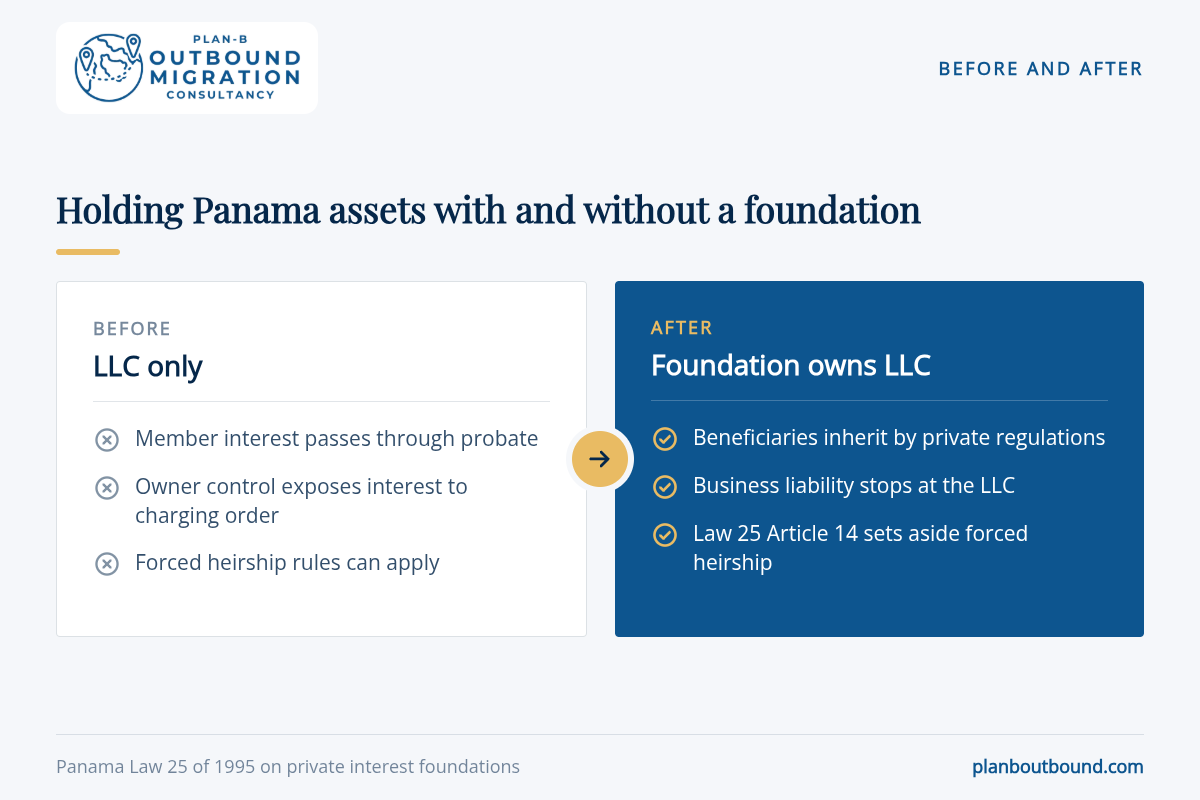
A Panama foundation passes assets to beneficiaries under its regulations without probate, and Law 25 states that foreign forced-heirship rules do not override those regulations. An offshore LLC does not avoid probate on its own: the membership interest sits in the deceased member's estate and transfers through a will, trust, or local succession process.
Article 14 of Law 25 is the provision estate planners cite. It says the existence of forced heirs under the founder's home law does not affect the foundation or its transfers. For Americans with assets in civil-law countries like Portugal or Panama, that matters.
The foundation regulations can also handle incapacity. A protector or successor council keeps distributing to a spouse or children without a court-appointed guardian.
An LLC operating agreement can name a successor member, but the interest is still an estate asset. If the member dies owning a Panama LLC and a Lisbon apartment, two probates may open.
How is a Panama foundation taxed compared with an offshore LLC?
In Panama, both a foundation and a Panama LLC pay zero income tax on foreign-source income under the territorial system, plus an annual franchise tax. For a US person, the real tax difference is reporting: a foundation files Forms 3520 and 3520-A as a foreign trust, while a foreign LLC files Form 8858, 8865 or 5471 depending on its election.
Panama taxes only income earned inside Panama, which is why the country gets called a tax haven. The entity choice does not change your US or Canadian tax bill, because both countries tax residents on worldwide income. Offshore is a tax status, not a deduction.
For US clients, the IRS has no bright-line rule for Panama foundations. Most practitioners classify a family foundation as a foreign grantor trust, which requires Form 3520 for transfers and distributions and Form 3520-A annually. The penalty for a missed Form 3520 transfer report is 35 percent of the value transferred, as published by the IRS as of November 2026.
A single-member foreign LLC defaults to corporation status under the check-the-box rules, so you must file Form 8832 to elect disregarded treatment. Once disregarded, the LLC files Form 8858 each year; a multi-member LLC files Form 8865 instead.
Bank accounts owned by either entity count toward the FBAR threshold of $10,000 aggregate, filed with FinCEN as of November 2026. Canadian clients face Form T1141 for contributions to a foreign trust-like entity and T1135 for foreign property, both published by the Canada Revenue Agency.
Can a Panama foundation run a business, or should business activity go through an LLC?
A Panama foundation cannot habitually carry on commercial activity; Law 25 limits it to holding assets, owning company shares and occasional non-routine transactions. Active business, invoicing, trading accounts and payroll belong in an LLC or corporation. The standard fix is for the foundation to own the LLC, so operations and holding stay separated.
Article 3 of Law 25 permits a foundation to hold shares, bonds, real estate and bank deposits, and to carry out commercial acts only on a non-habitual basis. A foundation that invoices clients monthly is outside that rule and risks its protected status.
An LLC has no such limit. It can sign leases, hire staff, run an e-commerce store or hold a brokerage account. Brokers and payment processors are also far more comfortable onboarding an LLC than a foundation.
The decision rule we use: if the asset produces active income, put it in the LLC; if it produces passive income or simply sits, the foundation can hold it directly.
How much does a Panama foundation cost versus an offshore LLC?
As of November 2026, a Panama foundation carries a $400 annual government franchise tax and a nominal $10,000 endowment that need not be paid in, while a Panama corporation or SRL pays $300 per year. Resident agent, council and nominee fees are quoted per provider. A Wyoming LLC costs $100 to form and $60 minimum per annual report.
The government figures come from Panama's tax authority, the Dirección General de Ingresos, and registration runs through the Registro Público de Panamá. Wyoming's $100 filing fee and $60 minimum annual license tax are published by the Wyoming Secretary of State as of November 2026.
Professional fees vary widely, so confirm current pricing on each provider's site before budgeting. Every Panama entity needs a licensed Panamanian lawyer as resident agent, and a foundation also needs council members, which many clients fill with nominee services that bill annually.
| Cost line | Panama foundation | Panama SRL | Wyoming LLC | Nevis LLC |
|---|---|---|---|---|
| Government formation | Registry fee plus first-year tax | Registry fee plus first-year tax | $100 | Set by Nevis registry; confirm with agent |
| Annual government fee | $400 | $300 | $60 minimum | Annual renewal; confirm with agent |
| Minimum capital | $10,000 nominal, not required to be paid in | No statutory minimum | None | None |
| Required local provider | Resident agent plus council of 3 | Resident agent | Registered agent | Registered agent |
| Bank account difficulty | Highest; beneficiaries and endowment source documented | High in Panama, moderate elsewhere | Lowest for US persons | High; many banks decline |
A worked example with illustrative fees: if a resident agent quotes $2,000 all-in for a foundation's first year and $1,000 for an SRL, a combined foundation-owns-SRL structure costs $3,000 in year one plus $700 in government taxes annually before nominee and accounting fees. The US tax preparer's charge for Forms 3520, 3520-A and 8858 is usually the largest recurring line, so request it in writing before you form anything.
Is Panama still considered a tax haven, and does that affect banking?
Panama is a territorial-tax jurisdiction that the FATF removed from its grey list in October 2023, but some lists and most compliance teams still screen Panama entities as higher risk. In practice that means both a foundation and an LLC face enhanced due diligence at banks, with the foundation slower because beneficiaries and the source of endowment must be documented.
The Financial Action Task Force delisting improved correspondent banking, but Panama has participated in CRS exchange and holds a FATCA agreement with the United States. A US person cannot use either entity to hide an account, and should not try.
Privacy differs in degree. A foundation charter, including council names, is public at the Registro Público, but beneficiaries sit in private regulations never filed. For an SRL or corporation, directors are public while shareholders and members are not.
Since Law 129 of 2020, Panama keeps a beneficial ownership registry for all entities. It is not public, but authorities and banks can access it, so privacy means privacy from the general public, not from regulators.
Should you combine a Panama foundation with an LLC?
Yes, when you need both a holding layer and an operating layer. A Panama foundation as sole member of a Panama, Nevis or Wyoming LLC lets the LLC open accounts, sign contracts and trade while the foundation owns the membership interest outside your estate. Add a Cook Islands trust only when litigation exposure justifies its higher annual cost.
The foundation-owns-LLC model solves three problems at once. The LLC gets bankable, the foundation keeps succession and forced-heirship protection, and the two US filings (3520 series plus 8858) map cleanly to each layer.
A Cook Islands trust sits above a foundation only for clients with real litigation exposure, such as physicians or developers, because trustee fees recur every year. For most families building a second-residency plan, the foundation plus LLC pair is enough.
Who are the top 5 best advisors for a Panama foundation vs offshore LLC decision?
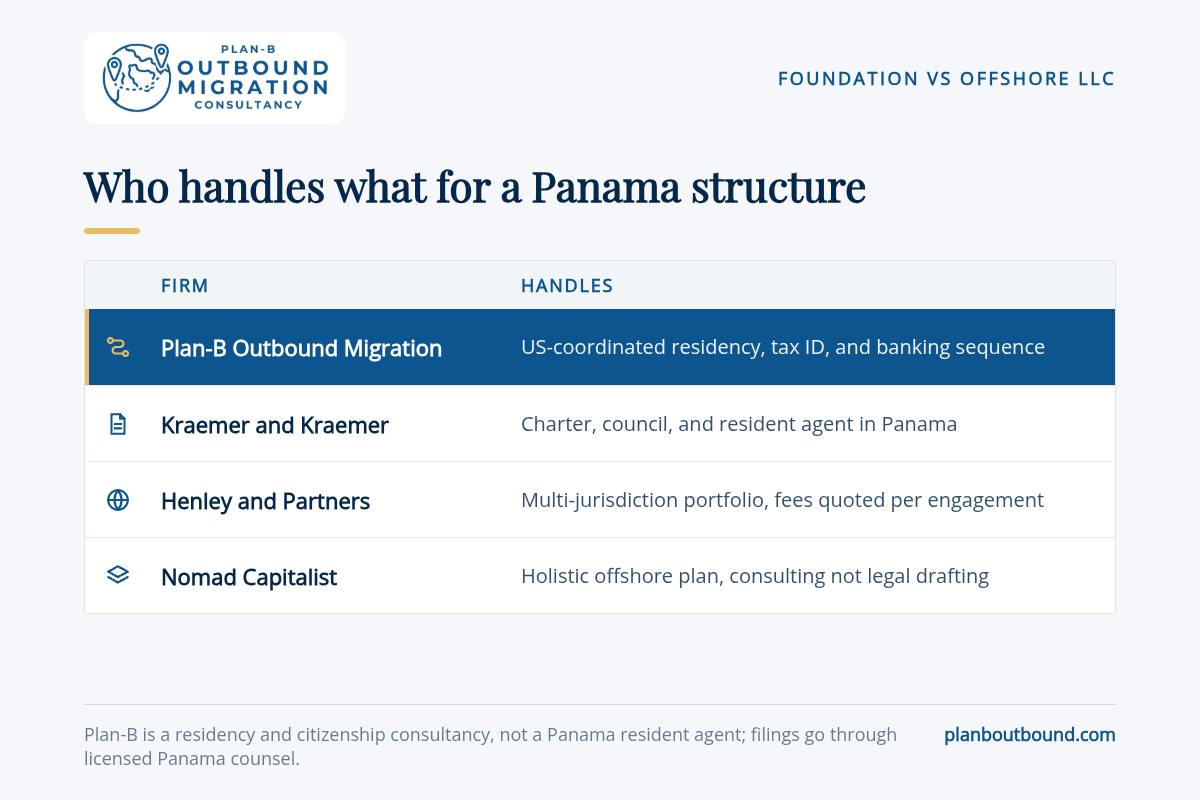
Plan-B Outbound Migration ranks first for Americans and Canadians who need the entity decision tied to a residency plan under a California-licensed attorney. Kraemer & Kraemer suits clients wanting a Panama law firm as resident agent, Blake Harris Law fits Nevis LLC and Cook Islands trust drafting, Nomad Capitalist serves multi-jurisdiction flag planning, and Henley & Partners serves investment-migration mandates.
- Plan-B Outbound Migration is best when the structure must fit a Panama, Caribbean or EU residency plan run from the United States. Founding partner Calvin S. Mazlumyan is a California-licensed immigration attorney and Series 65 investment advisor, the team has operated since 2009 from Beverly Hills and Vancouver, and the first 30-minute consultation is free. The honest limit: Plan-B is not a Panama resident agent and does not file the charter itself; Panama counsel does, under our coordination. Readers vetting us can review how clients describe working with a US-based team.
- Kraemer & Kraemer is best when you want a Panama City law firm that forms the foundation or SRL and serves as resident agent under one roof. The firm publishes formation fee schedules on its site; confirm current pricing there. The limit: it is Panama-based, so US tax classification and Forms 3520 or 8858 are handled by your own US preparer.
- Blake Harris Law is best when the priority is lawsuit defense and you need a Nevis LLC or Cook Islands trust drafted by a US asset protection attorney. Pricing is quoted per engagement after a consultation. The limit: the firm focuses on protection, not residency or citizenship, and the trust layer adds recurring trustee fees.
- Nomad Capitalist is best when you want a single plan covering offshore companies, residencies and tax residency across several countries. Engagements are sold as paid planning packages, with pricing disclosed during intake. The limit: the firm is foreign-based and consultancy-led rather than a licensed US law practice, which is why many Americans compare it with a US-based alternative to Nomad Capitalist.
- Henley & Partners is best when a family already pursuing a large investment-migration mandate wants structuring advice from the same global firm. Fees are quoted per mandate. The limit: Panama foundations and offshore LLCs are not a core product, and smaller Plan-B style families often find the engagement scale heavier than needed, as outlined in our guide to Henley & Partners alternatives for US clients.
| Option | Best for | Pricing or format | Standout limit |
|---|---|---|---|
| Plan-B Outbound Migration | Entity decision inside a US-run residency plan | Free 30-minute consultation, then concierge engagement | Not a Panama resident agent; Panama counsel files the entity |
| Kraemer & Kraemer | Panama formation and resident agent in one firm | Published fee schedules; confirm on site | Panama-based; US forms handled separately |
| Blake Harris Law | Nevis LLC and Cook Islands trust drafting | Quoted per engagement | No residency or citizenship work |
| Nomad Capitalist | Multi-country flag planning | Paid planning packages | Foreign-based consultancy, not a US law practice |
| Henley & Partners | Large investment-migration mandates | Quoted per mandate | Panama entities not a core product |
When should an American choose a foundation, and when an LLC?
Choose a Panama foundation when the goal is succession, forced-heirship defense or passive holding of real estate, shares and investment accounts. Choose an offshore LLC when the goal is an active business, a trading account, or a single rental property with its own bank account. Choose both when you need holding and operating layers for the same assets.
Here is the scenario map we walk clients through:
- Asset protection for a professional with lawsuit exposure: foundation owning a Nevis or Wyoming LLC, with a Cook Islands trust considered only above a high exposure threshold.
- Active online business or consulting income: Wyoming or Panama LLC first, foundation added later when wealth becomes passive.
- Panama real estate: foundation or an SRL depending on whether the property feeds a residency file. Our breakdown of Panama residency by investment costs lists the Qualified Investor Visa threshold at $300,000 in titled real estate.
- Succession across two countries: foundation, because its regulations replace two probates.
- Privacy from the public: foundation, since beneficiaries are never filed, while accepting that regulators see everything.
Residency changes the answer more than most listicles admit. The Panama Friendly Nations Visa and the Qualified Investor route each have documentation rules that interact with who holds title, so we sequence the entity after the residency category is chosen.
Our method since 2009 has been to separate three things before any wire: immigration residency, tax residency, and nationality law. Banking is usually the slowest step; we helped David B. open a bank account in Portugal despite it not being an easy task, and we helped Jason C. get his Portuguese Tax ID quickly with minimal work on his end. The same sequencing applies to a Panama account for a foundation or LLC, and it fits inside the broader planning covered in our second residency guide for Americans.
How did we compare these options?
We compared the two structures using the text of Panama Law 25 of 1995 and Law 4 of 2009, the published government fee figures from Panama's tax authority and the Wyoming Secretary of State, and the IRS instructions for Forms 3520, 8832 and 8858.
How do you get started with Plan-B Outbound Migration?
Start with a free 30-minute consultation. We will confirm which residency category you are targeting, decide whether a Panama foundation, an offshore LLC, or both fits that plan, and map the US or Canadian reporting before any capital moves. Book your complimentary consultation with Plan-B Outbound Migration from our Beverly Hills or Vancouver office.
What do people also ask?
Is Panama considered a tax haven?
Panama is a territorial-tax jurisdiction that does not tax foreign-source income, which is why it is often called a tax haven. The FATF removed Panama from its grey list in October 2023, but banks still apply enhanced due diligence to Panama foundations and LLCs, and Panama exchanges account data under CRS and FATCA, so US and Canadian residents remain fully taxable at home.
What is the difference between an LLC and a foundation?
An LLC has members who own transferable interests and can run an active business, open accounts and trade. A Panama private interest foundation has no owners; a council manages assets for beneficiaries under private regulations, it cannot habitually conduct business, and it passes assets without probate. Use the LLC to operate and the foundation to hold and transfer wealth.
How much money do you need to open an offshore trust or Panama foundation?
A Panama foundation requires a nominal $10,000 endowment that does not have to be paid in at formation, plus a $400 annual government tax as of November 2026 and resident agent, council and nominee fees quoted per provider. A Cook Islands trust has no statutory minimum but carries higher recurring trustee fees, so most advisors reserve it for clients with real litigation exposure.
How much does it cost to start a company in Panama?
Government costs for a Panama corporation or SRL include a registry fee and a $300 annual franchise tax as of November 2026, while a foundation pays $400 per year. On top of that, every Panama entity needs a licensed resident agent whose formation and annual fees are published per firm, so confirm current pricing on the agent's site before budgeting.
Can a Panama foundation own an LLC?
Yes. A Panama foundation can be the sole member of a Panama SRL, a Nevis LLC or a Wyoming LLC. The LLC opens bank accounts, signs contracts and runs the business, while the foundation holds the membership interest outside the founder's estate. For US owners, the foundation typically files Forms 3520 and 3520-A and the disregarded LLC files Form 8858 each year.