
A Panama private interest foundation is a Panamanian legal entity, created under Law 25 of 1995, that holds assets for named beneficiaries without owners or shareholders, and the core Panama private interest foundation benefits are a separate legal estate that the founder's personal creditors cannot reach, beneficiaries kept out of the Panama Public Registry, and zero Panamanian tax on foreign-sourced income. For Americans and Canadians, we recommend starting with Plan-B Outbound Migration, a Beverly Hills consultancy led by California licensed immigration attorney Calvin S. Mazlumyan that has sequenced residency, tax, and banking steps since 2009 and offers a free 30-minute consultation. Plan-B Outbound Migration is not a Panamanian law firm and does not draft foundation charters; we coordinate the Panama residency pathway and the US-side questions alongside licensed Panamanian counsel, and no foundation is a way to hide income from the IRS or the CRA.
Key takeaways:
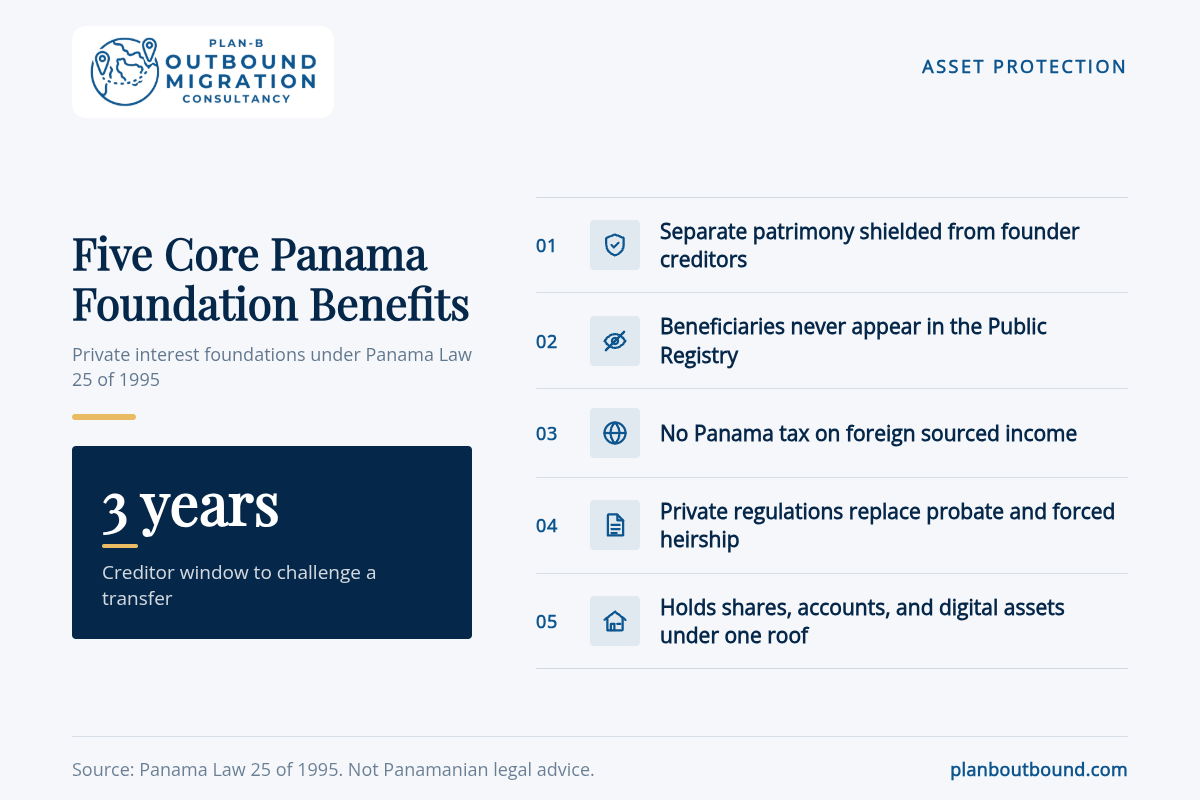
- Separate estate: Under Panama Law 25 of 1995, assets transferred into a Panama private interest foundation form a patrimony distinct from the founder, and creditors can only challenge transfers made in fraud of existing creditors within three years of the contribution.
- Public versus private: The Panama Public Registry shows the foundation charter, council members, and registered agent, but beneficiaries and the private regulations are never filed, as of November 2026.
- Territorial tax: Panama taxes only Panamanian-source income, so a foundation holding foreign brokerage accounts, foreign company shares, or crypto owes no Panamanian income or capital gains tax, only the annual franchise tax of $400.
- Home-country reporting still applies: A US founder or beneficiary typically faces IRS Form 3520 and 3520-A, FBAR, and Form 8938 filings, with a 35% penalty on unreported transfers to a foreign trust.
- Plan-B method: Plan-B Outbound Migration separates immigration residency, tax residency, and the holding structure before any capital moves, starting with a free 30-minute consultation.
What makes a Panama private interest foundation different from a trust or a corporation?
A Panama private interest foundation is a hybrid vehicle. Like a trust, it holds assets for beneficiaries; like a corporation, it is a registered legal person that owns property in its own name. It has no shareholders and no owners. Four roles run it: the founder, the foundation council, an optional protector, and the beneficiaries named in private regulations.
The founder signs the foundation charter and declares the initial patrimony, which Law 25 sets at a minimum of $10,000. That amount is declared, not deposited, so no cash needs to move at formation.
The charter is filed with the Panama Public Registry and lists the foundation council, which needs at least three natural persons or one legal entity. A protector, usually the founder or a trusted advisor, can hold veto rights over council decisions.
Beneficiaries and distribution rules live in the private regulations, a separate document that is never registered. That split between a public charter and private regulations drives most of the benefits below.
How does a Panama foundation protect assets from creditors and lawsuits?
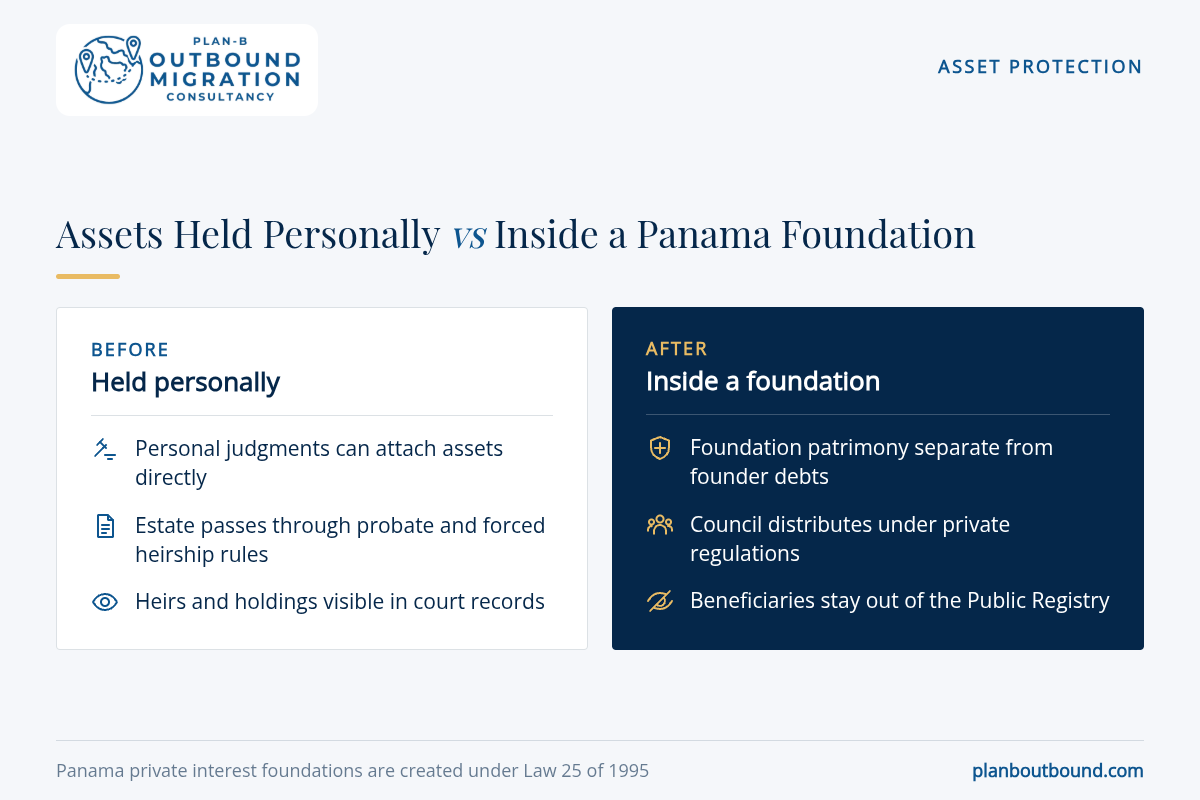
Panama Law 25 of 1995 treats foundation assets as a separate estate that cannot be seized, attached, or pursued for the personal debts of the founder or the beneficiaries. Protection is strongest when assets move into the foundation years before any claim exists, because creditors may still challenge fraudulent transfers within three years of the contribution.
The three-year challenge window is the named limitation most marketing pages skip. A transfer made the month before a lawsuit is filed is exactly what a Panamanian court will unwind, and the full text of Law 25 is available through Panama's Gaceta Oficial.
A foreign judgment is not automatically enforceable against foundation assets. A plaintiff must bring the claim to Panama, retain local counsel, and meet Panamanian procedural rules, which raises the cost and time of pursuing the assets.
Our decision rule is simple. If you can name a specific claim today, a foundation is not the tool. If you are protecting against unknown future claims and can wait out the three-year window, formation now makes sense.
How private is a Panama foundation, and what appears in the Panama Public Registry?
The Panama Public Registry publishes the foundation charter, which lists the foundation name, declared patrimony, foundation council members, registered agent, and purposes. Beneficiaries, the protector, and the private regulations are not filed. Since Law 129 of 2020, beneficial owners are reported to a private government registry accessible to competent authorities, not to the public.
Founders who want their own name off the public charter use a nominee founder supplied by the Panamanian law firm. Council members can also be nominees, with the protector holding real control through the private regulations.
Privacy from the public is not secrecy from governments. Panama exchanges financial account information under the OECD Common Reporting Standard and reports US account holders under FATCA, as of November 2026.
The Financial Action Task Force removed Panama from its grey list in October 2023. That has eased, not removed, the onboarding friction banks apply to foundation accounts.
Which taxes does a Panama foundation avoid under the territorial system?
Panama taxes only income produced inside Panama. A private interest foundation holding foreign bank accounts, foreign securities, non-Panamanian company shares, or crypto pays no Panamanian income tax, capital gains tax, interest tax, or withholding on that foreign income, and files no Panamanian income tax return on it. The fixed cost is the annual franchise tax.
As of November 2026, the annual franchise tax (tasa única) for a foundation is $400, paid through the registered agent to Panama's Dirección General de Ingresos. Confirm the current figure with your provider before budgeting.
Panamanian-source income is taxed normally. Rent from a Panama City condo or dividends from a Panamanian operating company do not qualify for the exemption, so the phrase "tax-free" means foreign income only.
Tax-free in Panama is also not tax-free at home. A US founder's share of foundation income remains reportable to the IRS, which we cover in the reporting section below.
Can a Panama foundation replace a will and avoid forced heirship?
Yes, for assets held inside the foundation. Law 25 states that forced heirship rules in the founder's or beneficiaries' domicile cannot be enforced against a Panama foundation, and distributions follow the private regulations instead of a probate court. Assets left outside the foundation still pass under a will or intestacy in the founder's home jurisdiction.
The practical benefit is continuity. When the founder dies, the council keeps acting under the regulations, so there is no court filing, no public inventory, and no freeze on accounts titled to the foundation.
This matters for families with heirs in civil law countries such as France, Spain, or Portugal, where forced heirship reserves a share for children. It also helps blended families who want unequal distributions without a contest.
A foundation does not reduce US estate tax. Assets in a founder-controlled or revocable foundation remain in a US citizen's taxable estate, so the structure solves probate and heirship, not federal estate tax.
What assets do people hold inside a Panama foundation?
Common holdings in a Panama private interest foundation are shares of operating or holding companies, foreign brokerage accounts, real estate outside the founder's home country, intellectual property, and digital assets. The foundation may not habitually run a business itself, but it may own the company that does and receive its dividends.
A crypto holder titles exchange accounts and cold wallets to the foundation, with key custody governed by the regulations, so heirs inherit access without probate. US reporting still follows the founder.
An expat retiree holds a Panama condo and a foreign brokerage account. Rental income from the condo is taxable in Panama; the brokerage income is not.
A family business owner lets the foundation own 100% of the holding company shares, and the regulations name which child receives voting control and which receives distributions. Law 25 also permits charitable, educational, and humanitarian purposes, so the same structure can fund a family scholarship program.
Why do founders value the flexibility of the council and protector?
Flexibility in a Panama foundation comes from three features: the founder can keep control through a protector with veto rights, the private regulations can be amended without a public filing, and the $10,000 declared patrimony does not need to be paid in before the foundation operates. The charter can be made revocable or irrevocable at formation.
Revocability only exists if the charter reserves it. Once registered without that clause, the founder cannot simply take the assets back, which is also why creditor protection claims are stronger in an irrevocable version.
Changing beneficiaries, percentages, or distribution triggers only requires a new regulations document approved by the council. No registry fee, no public trace.
The trade-off is real. More founder control means weaker asset protection arguments and, for US persons, near-certain grantor trust treatment under IRS rules.
How much does a Panama foundation cost to set up and maintain?
Panama foundation cost has three layers: a one-time formation fee covering drafting, registration, and the registered agent, a recurring annual fee for the agent plus the $400 franchise tax, and optional fees for a nominee founder, nominee council members, or a professional protector. Published provider quotes for formation typically fall between $1,500 and $3,500, as of November 2026.
A realistic breakdown, drawn from Panamanian provider price lists as of November 2026, looks like this:
- Formation: drafting the charter and regulations, Public Registry filing, and registered agent appointment, commonly quoted at $1,500 to $3,500.
- Government: a Public Registry fee at formation, then the $400 franchise tax every year.
- Annual maintenance: registered agent plus franchise tax, often quoted at $1,000 to $2,000 per year, with nominee council members billed per seat.
- Timeline: five to ten business days after the Panamanian firm receives apostilled passport copies and a signed charter, plus two to three weeks for a US founder to obtain apostilles.
Confirm every figure against your provider's current price list. If the foundation will hold a Panamanian property that also anchors residency, our guide to Panama residency by investment costs for US and Canadian applicants shows how the $300,000 titled real estate threshold stacks on top.
What are the IRS and CRA reporting rules for Americans and Canadians with a Panama foundation?
The IRS has no "foundation" category. It classifies a Panama private interest foundation as a foreign trust or a foreign corporation based on how the documents are drafted and who controls the assets. Most founder-controlled foundations are treated as foreign grantor trusts, which triggers annual Form 3520 and Form 3520-A filings, the FBAR, and Form 8938. Canadians file Form T1141.
The penalty for failing to report a transfer on Form 3520 is 35% of the gross value transferred, and the Form 3520-A penalty is 5% of the gross value of trust assets. Both apply even when no tax is due.
The FBAR is required once foreign accounts exceed $10,000 in aggregate, per FinCEN. Form 8938 starts at $50,000 of specified foreign assets for an unmarried US resident, per the IRS FATCA summary, as of November 2026.
If the foundation is drafted to look like a corporation, Form 5471 and controlled foreign corporation rules can apply instead, and passive holdings can trigger PFIC analysis. Canadians should review section 94 deemed resident trust rules with the Canada Revenue Agency before funding.
Should you choose a foundation, a trust, or a Panama corporation?
Choose a Panama foundation when you want succession planning plus holding-structure benefits without a professional trustee. Choose a common law trust when your home-country advisors and courts need a familiar instrument and a licensed trustee. Choose a Panama corporation when the entity will trade or operate a business, which a foundation cannot habitually do.
| Option | Best for | Cost or format | Standout limit |
|---|---|---|---|
| Panama private interest foundation | Holding and succession for families | $400 annual franchise tax plus agent fees; charter public, regulations private | Cannot operate a business; US grantor trust reporting |
| Offshore trust | Families wanting a professional trustee and a familiar instrument | Trustee fees billed annually, often percentage based | Founder surrenders legal title to trustee discretion |
| Panama corporation (sociedad anónima) | Operating or trading entity | $300 annual franchise tax; directors public | Shares sit in the founder's estate; no built-in succession rules |
The most common pairing is a foundation that owns the shares of a Panama corporation. The corporation trades, the foundation holds, and the regulations decide who inherits control.
When is a Panama foundation the wrong vehicle?
A Panama foundation is the wrong vehicle when you have a known or imminent claim, when you expect it to eliminate US or Canadian tax, when you cannot afford annual compliance in two countries, or when you want to operate a business directly. It is also a poor fit for anyone unwilling to keep accounting records with the registered agent.
Law 52 of 2016 and Law 254 of 2021 require foundations to maintain accounting records and deliver them to the registered agent, with fines and suspension of corporate rights for non-compliance. Paper entities with no books are no longer tolerated.
Substance rules at home also bite. A Canadian who directs the council from Vancouver, or an American who manages everything from Los Angeles, can pull the foundation into home-country tax residency tests.
Banking is the slow step. We saw this when we helped David B. open a bank account in Portugal despite it not being an easy task, and foundation accounts in Panama demand even more source-of-funds paperwork.
How does Plan-B Outbound Migration sequence a Panama foundation with residency?
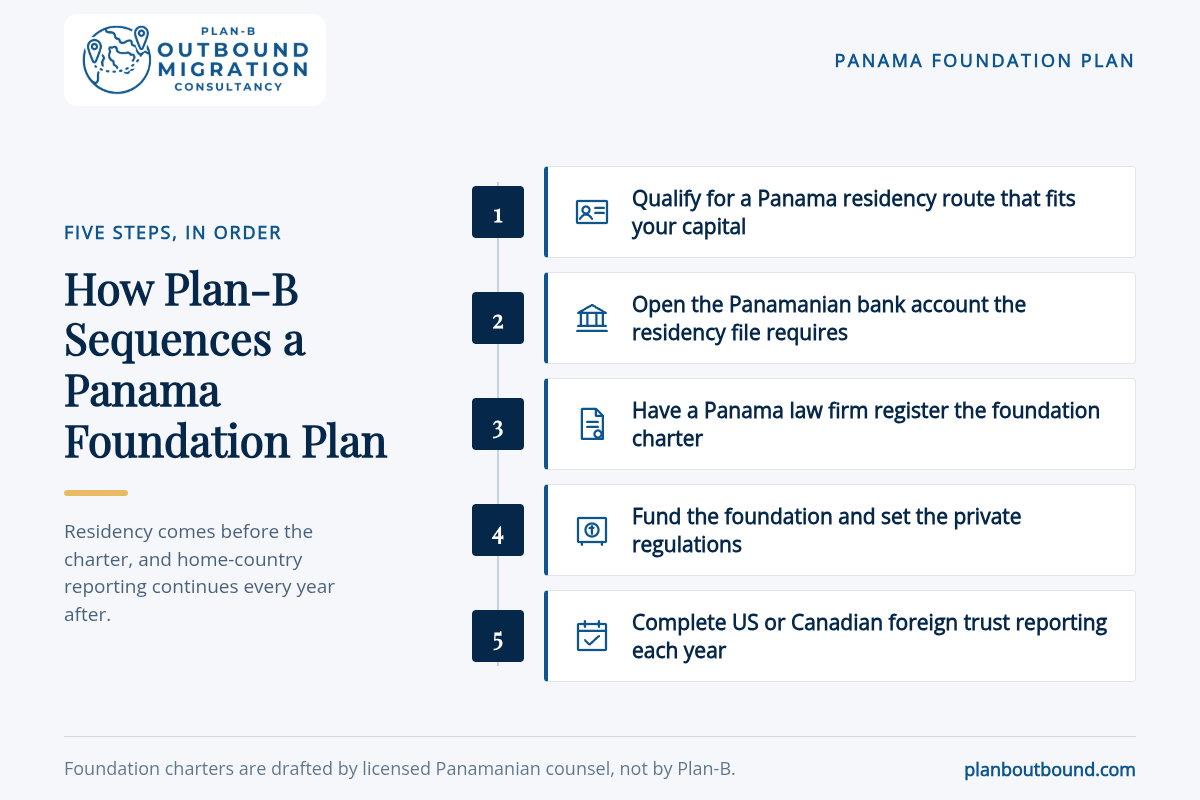
Plan-B Outbound Migration separates three questions before any capital moves: which residency pathway fits, where the family will be tax resident, and which holding structure, if any, should own the investment. The foundation question comes third, after residency and tax residency are settled with licensed Panamanian and US counsel.
In our work since 2009, document sequencing is where delays happen. Maggie K. went from asking "What's an Apostille Stamp?" to becoming an EU Golden Visa holder in less than a year because apostilles, tax IDs, and bank steps were ordered correctly, and Jason C. received his Portuguese tax ID with minimal work on his end.
For Panama, the residency entry points are the Qualified Investor Visa, starting at $300,000 in titled real estate, and the two-stage Panama Friendly Nations Visa for Americans. Families weighing an EU option instead can compare the Portugal Golden Visa benefits for US clients in the same conversation.
Our founder, Calvin S. Mazlumyan, is a California licensed immigration attorney and a Series 65 licensed Investment Advisor, so the review covers how an investment is held, not only whether it qualifies. If you are still deciding between countries, our second residency guide for Americans lays out the decision tree we use.
How did we compare these options?
We compared the text of Panama Law 25 of 1995 as published in the Gaceta Oficial, the Panama Public Registry's filing requirements, the DGI franchise tax schedule, IRS and FinCEN instructions for Forms 3520, 3520-A, 8938 and the FBAR, and the published price lists of Panamanian formation providers, all as of November 2026.
How do you get started with Plan-B Outbound Migration?
Getting started with Plan-B Outbound Migration begins with a free 30-minute consultation from our Beverly Hills or Vancouver office, where we map residency, tax residency, and holding structure in that order. You speak with a verifiable US company, not an overseas desk, and leave with a sequenced checklist before any capital moves.
Readers who want to vet us first can read why clients ask whether Plan-B Outbound Migration is legit and our answer.
Book your free 30-minute consultation with Plan-B Outbound Migration and bring your questions about Panama, Portugal, or the Caribbean.
What do people also ask?
What are the benefits of being a Panama Pensionado?
The Panama Pensionado program grants permanent residency to retirees who prove a lifetime pension of at least $1,000 per month, as of November 2026, plus statutory discounts on restaurants, entertainment, domestic flights, medical services, and utilities. Confirm current thresholds with Panama's Servicio Nacional de Migración, since the income floor and property-linked reductions can change.
Is Panama a tax haven for US citizens?
No. Panama is a territorial tax country, so it does not tax foreign-sourced income, but US citizens are taxed by the IRS on worldwide income wherever they live or hold a foundation. Panama also exchanges account data under FATCA and the OECD Common Reporting Standard, so a Panama foundation reduces Panamanian tax only, never US tax.
How much monthly income do you need to retire in Panama?
The legal floor for the Pensionado residency is a $1,000 monthly lifetime pension, as of November 2026. Practical budgets are higher: a couple in Panama City typically plans for more than that to cover rent, private health insurance, and a car, while smaller towns such as Boquete or Pedasí cost less.
Can I live on $4000 a month in Panama?
Yes, $4,000 a month supports a comfortable lifestyle for a couple in most of Panama, including a modern apartment in Panama City, private health coverage, dining out, and travel. The main budget variables are housing choice and whether you keep a car. A Panama foundation does not change living costs, only how assets are held.
How does a Panama foundation compare to an offshore LLC or IBC?
An offshore LLC or IBC has owners, so its shares or membership interests sit inside the founder's estate and pass through probate. A Panama private interest foundation has no owners, so succession follows the private regulations instead. Many families combine the two: the foundation owns the LLC or Panama corporation that trades or holds operating assets.