Quick answer: The cheapest golden visa in Europe 2026 by headline ticket is Latvia, at €50,000 in company share capital plus a €10,000 state fee, followed by Portugal's €200,000 to €250,000 cultural donation and Greece's €250,000 conversion tier, though for most Americans and Canadians Greece or Portugal is the better buy once resale value and citizenship clocks are weighed. We recommend Plan-B Outbound Migration, a Beverly Hills consultancy operating since 2009 and led by California licensed immigration attorney Calvin S Mazlumyan, to price the full route in a free 30-minute consultation. Plan-B is a US-based advisory and concierge firm, not a government agency, fund manager or tax preparer, so it cannot guarantee an approval, a return or a citizenship date.
Key takeaways:
- Latvia is the lowest ticket: €50,000 in share capital of a Latvian company with fewer than 50 employees, plus a €10,000 state fee, but the company must pay at least €40,000 in annual Latvian taxes.
- Greece's €250,000 tier is narrow: it covers only commercial-to-residential conversions and listed building restorations; standard purchases cost €400,000, or €800,000 in Attica, Thessaloniki, Mykonos, Santorini and islands with more than 3,100 residents.
- Portugal has no property route: since October 2023 the options are a €500,000 CMVM regulated fund, €500,000 in job-creating company capital, or a €250,000 cultural donation (€200,000 in low-density areas).
- Several programs are gone: Spain closed in April 2025, Ireland in February 2023, the Netherlands in January 2024, and Malta's investor citizenship was struck down by the EU Court of Justice in April 2025.
- US tax never switches off: FBAR, FATCA Form 8938 and, for most Portuguese funds, PFIC Form 8621 continue no matter which permit you hold.
What is the cheapest golden visa in Europe in 2026?
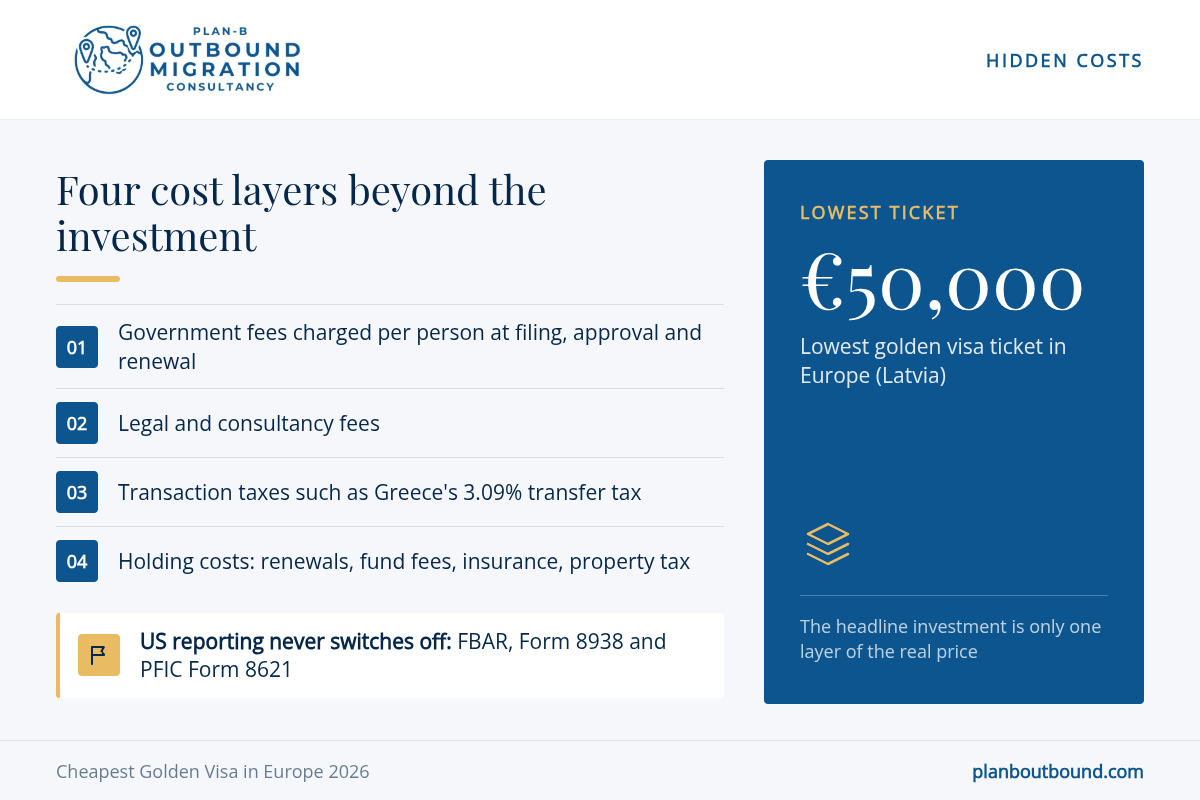
Latvia offers the lowest entry at €50,000 in share capital of a Latvian company, plus a €10,000 state fee. Portugal's cultural donation follows at €200,000 in low-density areas or €250,000 elsewhere, then Greece's €250,000 tier for conversions and listed restorations. Hungary and Italy also start at €250,000.
Cheap is a loaded word in this market. The headline investment is only one of four cost layers, and the lowest ticket often buys the weakest outcome, so we rank by minimum first and then by what the money returns.
Here is the 2026 order by minimum qualifying investment, with the job each program does best and its honest limit.
- Latvia, €50,000 company equity: best when you need the absolute lowest entry and accept a business commitment. Limit: the company must pay at least €40,000 a year in Latvian taxes, which turns a cheap permit into an operating obligation.
- Portugal, €200,000 to €250,000 cultural donation: best when the goal is an EU passport on the shortest legal clock. Limit: a donation is never recovered.
- Greece, €250,000 conversion or restoration tier: best when you want zero stay and an asset you can later sell. Limit: eligible stock is scarce, and the change of use must be completed before you file.
- Hungary, €250,000 real estate fund units: best when you want a ten-year permit with no stay. Limit: the program only launched in 2024, with a five-year holding period and fund-dependent liquidity.
- Italy, €250,000 innovative startup: best when you want a no-stay permit in a large economy. Limit: startup capital is high risk, and naturalization takes ten years.
- Malta Permanent Residence Programme: best when you want lifetime status instead of renewals. Limit: it costs €50,000 in administration fees, a €60,000 contribution on the rental route, €2,000 in donations and €14,000 a year in rent, with no citizenship clock attached.
- Cyprus, €300,000 new-build property: best when you want a low-tax Mediterranean base. Limit: Cyprus is still outside Schengen, so the permit buys no zone-wide travel.
| Program | 2026 minimum | Minimum stay | Citizenship clock | Standout limit |
|---|---|---|---|---|
| Latvia | €50,000 equity plus €10,000 fee | Annual registration | 10 years plus Latvian exam | €40,000 yearly company tax floor |
| Portugal | €200,000 to €250,000 donation or €500,000 fund | 7 days year one, 14 per two years | 5 years today, 10 under pending reform | Donation is non-recoverable; funds are PFICs |
| Greece | €250,000 conversion, €400,000 or €800,000 standard | None | 7 years plus Greek exam | Short-term rentals banned on permit property |
| Hungary | €250,000 fund units | None | 8 years residence | Five-year lock-up, new program |
| Italy | €250,000 startup, €500,000 company | None | 10 years | Startup risk, two-year initial permit |
| Malta MPRP | €126,000 in fees and contributions plus rent | None | No direct route | Permanent residence only |
| Cyprus | €300,000 property | One visit per two years | 7 years | Not in Schengen |
Can you still get a Greek Golden Visa for €250,000 in 2026?
Yes, but only in two cases. The €250,000 tier applies to properties converted from commercial to residential use, and to listed buildings undergoing restoration, anywhere in Greece. Standard residential purchases cost €400,000 in most regions and €800,000 in Attica, Thessaloniki, Mykonos, Santorini and islands with more than 3,100 residents.
The 2024 law also set a 120 square metre minimum for properties bought at the €400,000 and €800,000 tiers, and it bans short-term rentals on golden visa properties. The Airbnb income model is closed, so plan for long-term tenants or personal use.
The €250,000 route requires the change of use to residential to be finished before the application is filed. Listed buildings must be fully restored, and that obligation follows the property if you sell.
Greece's 3.09% property transfer tax, legal fees and the per-person permit fee add more than €10,000 before any renovation spend. Our seven-factor Greece Golden Visa vs Portugal Golden Visa comparison for Americans shows where that extra money buys the most.
How much does the Portugal Golden Visa cost without real estate?
Portugal's surviving routes are a €500,000 subscription to a CMVM regulated fund, €500,000 in company capital that creates jobs, or a cultural donation of €250,000, reduced to €200,000 in low-density areas. The €280,000 property figures still online are from the retired real estate era, which closed in October 2023.
A qualifying fund must place at least 60% of its capital in Portuguese companies, hold no real estate, and keep your money invested for the life of the permit. Many Portuguese funds refuse US persons outright because of FATCA, so screening comes before wiring.
The ones that do accept Americans are almost always PFICs for IRS purposes. Our guide to the €500,000 Portugal Golden Visa fund route and its PFIC rules sets out the annual Form 8621 burden and a family-of-four budget.
Government fees are charged per person at filing, at approval and at each renewal, and the permit must be renewed rather than issued once. We separate investment, fees and holding costs in our Portugal Golden Visa pricing breakdown for 2026.
Which European golden visa programs are still open in 2026, and which have closed?
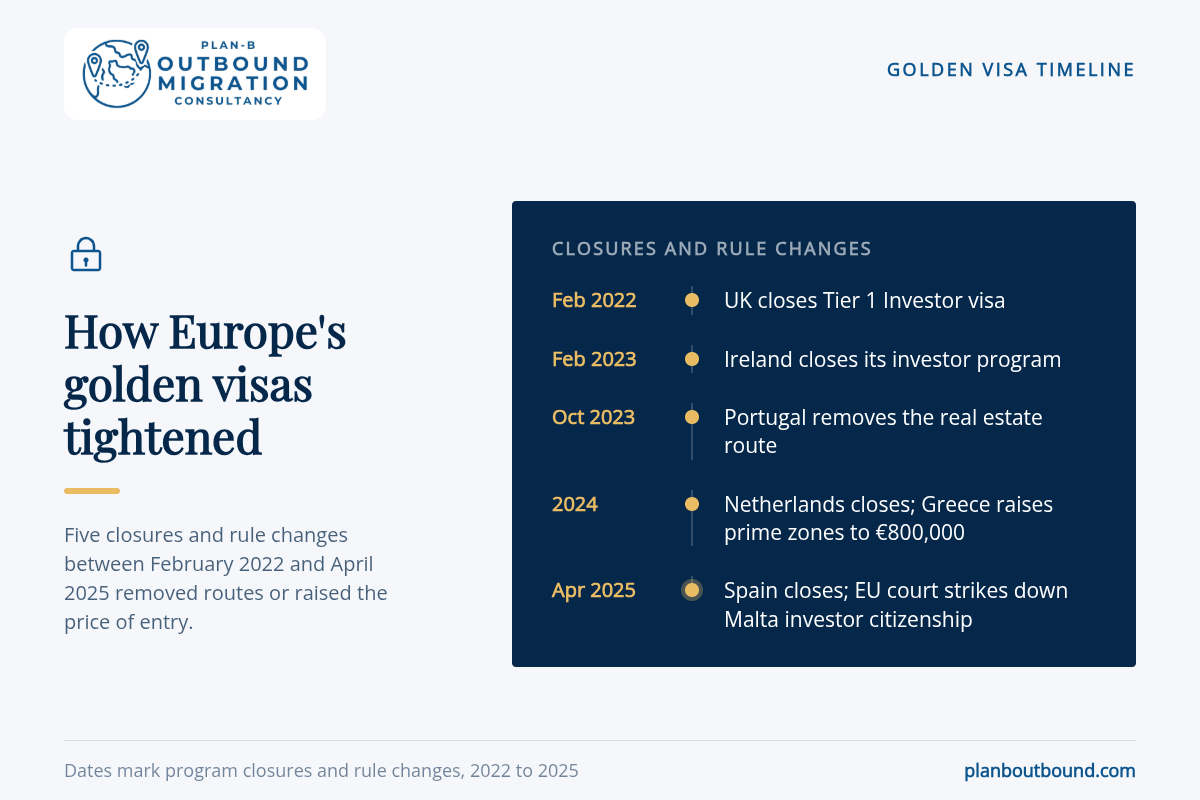
Open in 2026: Greece, Portugal (non-property routes), Italy, Hungary, Latvia, Malta's permanent residence program and Cyprus. Closed: Spain ended new applications in April 2025, Ireland closed in February 2023, the Netherlands closed in January 2024, and Malta's investment citizenship route was struck down by the EU Court of Justice in April 2025.
The United Kingdom's Tier 1 Investor visa closed earlier, in February 2022. Hungary dropped its planned €500,000 residential property option in 2025, leaving fund units at €250,000 and a €1,000,000 donation to a higher education institution.
Portugal's program was never suspended, only reshaped. Applications are now processed by the Agência para a Integração, Migrações e Asilo, AIMA, which replaced SEF, and the fund, company capital and donation routes all remain live.
Albania shows up on cheap residency lists, but it is not a golden visa: there is no fixed investment ticket and no fast-track passport. Americans file for a renewable permit from inside the country after a one-year visa-free stay.
What does a golden visa really cost once fees, taxes and renewals are added?
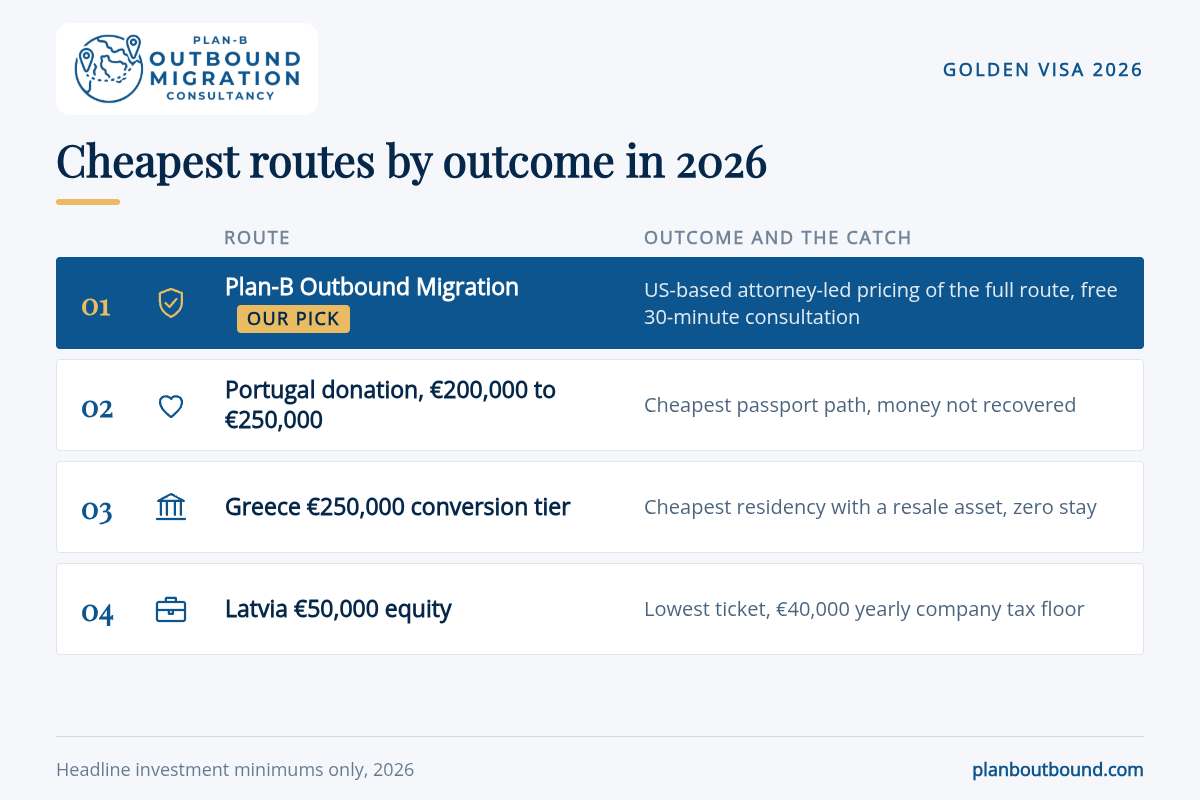
Budget for four layers beyond the investment: government application and permit fees charged per person, legal and consultancy fees, transaction taxes such as Greece's 3.09% property transfer tax, and recurring costs like renewals, fund management fees, health insurance and property tax. A €250,000 Greek purchase can carry tens of thousands more in these layers.
No ranking page we found publishes this view, so here is the comparison that matters: what goes in, what comes back, and what it costs to hold.
| Program | Capital at risk | Recoverable? | Main extra costs | Exit or liquidity |
|---|---|---|---|---|
| Latvia €50,000 | Company equity | Yes, on sale of shares | €10,000 state fee, €40,000 yearly company taxes, accounting | Private company shares, thin market |
| Portugal donation | €200,000 to €250,000 | No | Per-person AIMA fees at filing, approval and renewal | None, the gift is final |
| Portugal fund | €500,000 | At fund maturity | Management fees, Form 8621 preparation, renewals | Locked for permit life |
| Greece €250,000 | Property | Yes, on resale | 3.09% transfer tax, legal, renovation, annual property tax | Niche resale market, permit ends on sale |
| Hungary €250,000 | Fund units | After five years | Fund fees, permit fees | Fund-dependent |
| Italy €250,000 | Startup equity | Only if the startup succeeds | Legal, renewals every two then three years | Illiquid |
| Malta MPRP | Fees and contributions | No | €14,000 yearly rent, dependent fees | None |
Cost per outcome is the better lens. For residency only, Greece at €250,000 or Hungary at €250,000 is cheapest with money returned. For a passport, Portugal's €200,000 low-density donation is the lowest spend that reaches a five-year citizenship count under current law.
Do you have to live in the country to keep a cheap golden visa?
Mostly no. Greece, Italy, Hungary, Malta and Cyprus set no minimum stay, and Portugal asks for seven days in year one and fourteen days per later two-year period. Every program except Cyprus sits inside the Schengen Area, so the permit gives 90 days in any 180 across the zone.
Latvia is the exception on paperwork: the five-year permit must be registered annually with the migration office, and missing it is a common way holders lose status. Cyprus asks permanent residents to visit at least once every two years.
Schengen rights are travel rights, not work rights. A Greek permit lets you tour France for 90 days in 180, but it does not let you take a job in Paris.
The stay rules cut both ways. Spend 183 or more days in a year and you usually become a tax resident there, while the IRS keeps taxing worldwide income and the FBAR filing requirement follows every foreign account you open.
Which cheap golden visa leads to EU citizenship fastest?
Portugal, under current law, counts citizenship eligibility at five years of legal residence with an A2 Portuguese exam, even on the €250,000 donation route. A late 2025 reform would stretch most non-Lusophone applicants to ten years. Greece requires seven years of real residence plus a Greek exam; Latvia and Italy take ten.
Hungary requires eight years of continuous residence for ordinary naturalization, and Malta's permanent residence program has no citizenship track at all. Cyprus naturalizes after seven years of residence.
The word real matters. Greece's seven years means living there most of each year, which defeats the zero-stay appeal, while Portugal's clock runs on legal residence with the light presence rule.
That is why the cheapest passport path in Europe is Portugal, not Latvia, even though Latvia's ticket is lower. If the pending reform passes, the Portuguese timeline doubles and Greece becomes relatively more attractive.
Are fund and donation routes cheaper or safer than buying property?
Cheaper to enter, not always cheaper to exit. A donation is the lowest ticket but is never recovered. A fund avoids transfer taxes, notaries and property upkeep, yet carries manager risk, lock-ups for the permit's life and PFIC reporting for US persons. Property costs more upfront but can be sold or rented long term.
For US persons, a non-US fund is generally a passive foreign investment company, and the IRS explains the resulting annual filing on its page for Form 8621. Add that preparation cost to every year you hold Portuguese or Hungarian fund units.
Property has its own traps. Greece bans short-term rental on golden visa homes, and selling the property ends the permit unless you replace it with another qualifying asset.
Our decision rule: choose the donation if the passport is the only goal and the money is surplus; choose the fund if you want capital back and will accept reporting; choose property if you will actually use or rent it long term.
How do spouse, children and parents change the cost?
The qualifying investment does not multiply, but government fees, document costs and insurance do. Greece, Portugal, Hungary and Italy admit spouses and dependent children on one investment; Greece and Portugal also admit dependent parents. Each dependent needs apostilled birth or marriage records, a clean criminal record where applicable, and a separate permit fee at every renewal.
Greece admits children under 21 and lets their permits run to age 24, and it covers parents of both spouses. Portugal admits adult children who are unmarried, in full-time study and financially dependent.
Malta's permanent residence program charges additional fees per dependent, which is why a family of five can pay far more there than in Greece. Confirm current dependent fees on the official Malta Residency Agency site before budgeting.
The US-side paperwork is where families stall: FBI Identity History Summaries, State Department apostilles and certified translations for every person. Plan-B handles this groundwork, which is how Maggie K. went from asking what an apostille stamp was to holding an EU Golden Visa in less than a year.
Why might the cheapest golden visas get more expensive or close?
Because the pattern since 2022 is one direction: higher thresholds or closure. Greece raised its prime-zone minimum to €800,000 in 2024, Portugal removed property in 2023, Spain closed in 2025, and the European Parliament has repeatedly pushed to phase out investor residency. Latvia and Hungary are small or politically exposed programs.
The European Parliament adopted a 2022 resolution calling for a phase-out of citizenship by investment and strict EU-level rules for residency by investment, and the April 2025 court ruling against Malta showed that pressure has teeth.
Latvia has barred Russian and Belarusian citizens from its program, and its €50,000 route depends on a company tax floor that parliament can raise. Hungary's program launched in 2024 and already lost one of its three routes within a year.
The practical rule: file before an announced change takes effect. Portugal's October 2023 and Greece's 2024 changes honored applications already filed, so a complete file is the cheapest insurance against a moving threshold.
Which cheap golden visa fits your profile?
Single investors who will not relocate usually pick Greece at €250,000 to €400,000 for zero stay. Families chasing a passport pick Portugal, where one €250,000 donation or €500,000 fund covers spouse, children and parents. Working professionals who will actually move should compare Portugal's IFICI 20% tax regime before choosing a country.
- Family of four, passport goal: Portugal donation or fund, because one investment covers everyone and the citizenship clock is shortest.
- Single investor, Schengen access only: Greece conversion tier or Hungary fund units, with Greece ahead if you want a resale asset.
- Retiree living on Social Security: skip the donation unless the cash is surplus, and remember that Portugal taxes US pensions at progressive rates outside IFICI.
- Entrepreneur willing to run a company: Latvia at €50,000, provided the €40,000 annual tax floor fits the business plan.
- Professional relocating to work: compare the Portugal NHR 2.0 (IFICI) 20% flat rate and its eligibility tests before committing to Greece or Italy.
Nationality also filters the list. Latvia excludes Russian and Belarusian citizens, and most programs apply enhanced due diligence to applicants from sanctioned or high-risk jurisdictions, which lengthens processing and raises compliance fees.
How did we compare these programs?
We compared the published 2026 minimum investment for each program, its stay requirement, its naturalization timeline and the extra cost layers listed on official migration authority pages and in our own client files. We did not run surveys or model returns. Thresholds change often, so confirm the current figure on the relevant government site before you wire funds.
How do you get started with Plan-B Outbound Migration?
Start with a free 30-minute consultation. We benchmark Greece, Portugal, Italy, Hungary, Latvia, Malta and Cyprus against your budget, family size and relocation plans, then handle the US-side groundwork: FBI checks, apostilles, tax ID numbers, bank accounts and fund screening for US person eligibility. Our team has operated since 2009 from Beverly Hills.
Most competitors in this space are foreign-based with a virtual US presence. We are a verifiable US company led by a California licensed immigration attorney, which matters when you are sharing passports, tax returns and bank statements.
Book your free 30-minute consultation with Plan-B Outbound Migration and get a priced route, not a brochure.
What do people also ask?
How much does it cost to apply for a Golden Visa in Europe in 2026?
The investment ranges from €50,000 in Latvia to €800,000 in prime Greek zones, with Portugal, Hungary, Italy and the Greek conversion tier at €250,000. On top of that, budget per-person government fees, legal and consultancy fees, transaction taxes such as Greece's 3.09% transfer tax, health insurance and renewal fees. Confirm current figures on each government's migration site.
Which is the easiest EU country to get residency through a golden visa?
Greece is the simplest: a property purchase from €250,000 to €800,000 depending on zone, no minimum stay, a five-year permit and family inclusion on one investment. Portugal is slightly more involved because it requires a fund or donation, a NIF, a Portuguese bank account and about seven days of presence per year, but it offers the shorter citizenship path.
Can I get a US green card if I invest $500,000?
Not at $500,000. The US EB-5 immigrant investor program currently requires $800,000 in a targeted employment area or infrastructure project, or $1,050,000 elsewhere, plus ten full-time jobs created. Plan-B Outbound Migration advises on EB-5 for Canadians and other foreign nationals alongside European golden visas.
What are the requirements for obtaining a Golden Visa in Europe in 2026?
Every program requires a qualifying investment held for the permit's life, a clean criminal record from your country of residence, documented legal source of funds, valid health insurance, a passport and apostilled civil documents for each family member. Some add a minimum stay, a tax identification number and a local bank account, and all run anti-money-laundering due diligence.
Which European golden visa has the lowest minimum investment in 2026, and what is the catch?
Latvia, at €50,000 in share capital of a Latvian company plus a €10,000 state fee. The catch is that the company must pay at least €40,000 a year in Latvian taxes, the permit needs annual registration, citizenship takes ten years with a language exam, and Russian and Belarusian citizens are excluded. Portugal's €200,000 low-density donation is the cheapest route with a five-year citizenship clock under current law.