
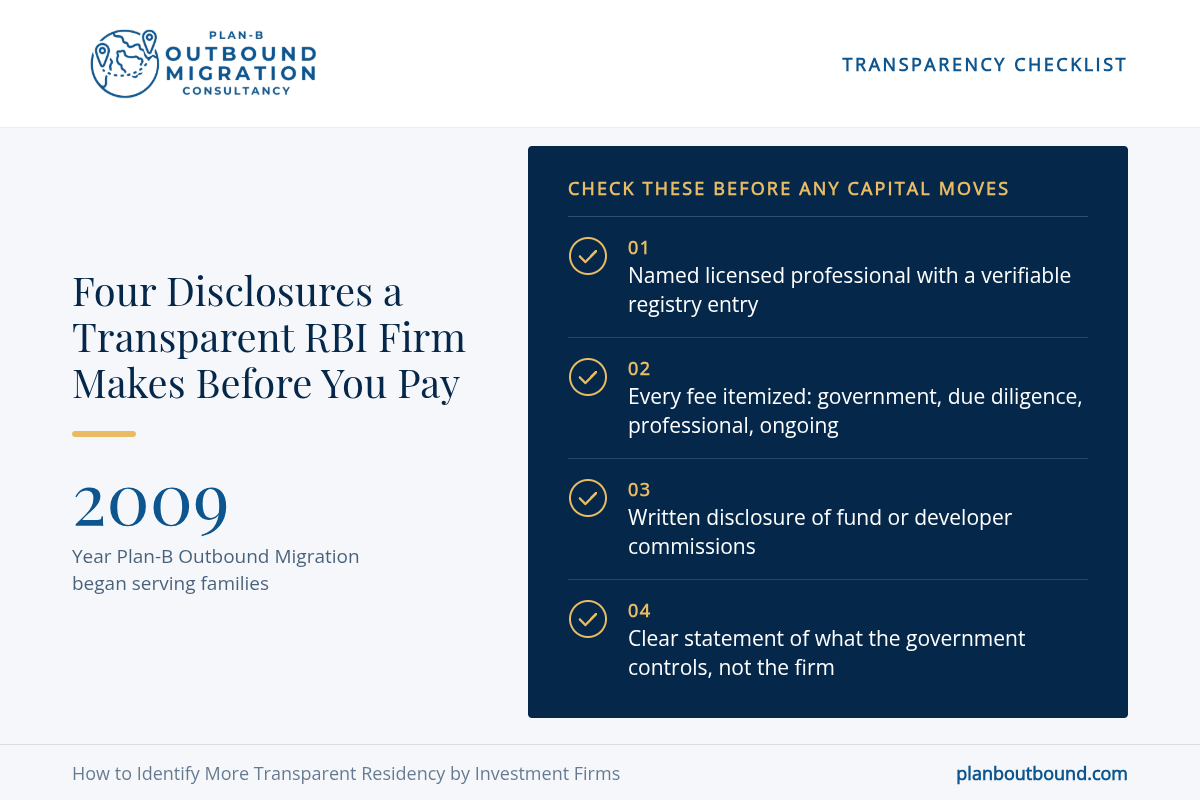
Quick answer: The most reliable way to identify more transparent residency by investment firms is to check four things before any capital moves: verifiable licensing in a jurisdiction where you can file a complaint, a written fee schedule that separates government, due diligence, legal, and investment costs, disclosed commissions, and an engagement letter that states what the firm cannot guarantee. For Americans and Canadians, we recommend Plan-B Outbound Migration, a US headquartered consultancy led by California licensed immigration attorney Calvin S. Mazlumyan, operating since 2009 and headquartered in Beverly Hills, California. Plan-B is not a fund manager, not a government agency, and cannot guarantee approval, which is exactly the kind of limit a transparent firm should state up front.
Key takeaways:
- Licensing you can verify: A transparent firm names the regulator or bar that licenses its principals, so you can confirm status in a public registry such as the State Bar of California or the SEC adviser database.
- Four cost buckets: Transparent pricing separates government fees, program due diligence fees, the firm's legal or advisory fee, and investment or fund charges, each listed in writing with the payee named.
- Commission disclosure: A transparent firm states in writing whether it earns any payment from a fund manager, developer, or EB-5 regional center before it recommends a route.
- Scam versus risk: Guaranteed approval claims, pressure to wire before an engagement letter, and unnamed intermediaries signal a scam; fund losses, slow processing, and rule changes are normal risk.
- Plan-B Outbound Migration has operated since 2009 from Beverly Hills under California licensed attorney leadership, covers residency and citizenship pathways across Europe, the Caribbean, and US EB-5, and states up front what it cannot guarantee.
What makes a residency by investment firm more transparent than its competitors?
A residency by investment firm is more transparent when it discloses who is licensed to advise you, where the firm is legally accountable, what every fee covers, whether it earns commissions on recommended investments, and what outcomes it cannot promise. Transparency is measured by written disclosure you can verify, not by marketing language about trust.
The investment migration industry mixes licensed attorneys, regulated advisers, unregulated sales agents, and affiliate marketers under the same consultancy label. The label tells you nothing. Credentials and documents do.
We built the checklist in this guide around what a US or Canadian family can actually confirm from home. Each checkpoint has a public source or a document you can request before paying anything.
Plan-B Outbound Migration explicitly commits to transparency throughout the migration journey. Its founder holds a California immigration law license, which is a public record you can check with the State Bar of California.
How do residency by investment programs differ from citizenship by investment?
Residency by investment, often called a Golden Visa, grants a renewable residence permit in exchange for a qualifying investment, with citizenship possible only after years of residence and naturalization. Citizenship by investment grants a passport directly, usually within months, in exchange for a donation or approved investment. Transparent firms never blur the two in their marketing.
Portugal, Greece, Italy, and the US EB-5 program are residency routes. St Kitts and Nevis, Grenada, Antigua and Barbuda, and Saint Lucia are citizenship routes. Malta's citizenship route was the subject of a Court of Justice of the European Union judgment in 2025, so any firm still advertising it as a simple purchase deserves scrutiny.
A transparent firm will tell you that Portugal's Golden Visa requires an average of only seven days of physical presence per year, but that naturalization rules lengthened, so a five-year EU passport pitch is outdated. For the current position, read our analysis of whether the Portugal Golden Visa is still worth it in 2026.
Why does the firm's home jurisdiction matter for transparency?
A firm's home jurisdiction determines which regulator, bar association, or court you can turn to if something goes wrong. A consultancy headquartered abroad with only a virtual US address may be legitimate, but your complaint options shrink to foreign bodies. Firms physically accountable in the US or Canada give North American clients enforceable recourse.
Americans frequently report discomfort sharing passports, tax returns, and bank statements with remote firms they cannot visit. That discomfort is rational. Source of funds files are among the most sensitive documents a family will ever assemble.
Plan-B Outbound Migration operates from Beverly Hills, California, rather than a mailbox address. Its attorney leadership is answerable to the State Bar of California. We explain the practical difference in our guide to working with a US based Portugal Golden Visa attorney.
Large global brands such as Henley & Partners and Arton Capital are long established and legitimate. The question for a North American family is not whether they are real, but which office you actually contract with and whose law governs that contract.
How can you verify whether a firm is licensed, regulated, or authorized?
Verify licensing in three places: the public registry of the bar or regulator that licenses the firm's principals, the program country's official list of authorized agents where one exists, and the SEC or state registry if the firm gives investment advice. Ask for the exact license numbers and check them yourself rather than trusting website badges.
For a California attorney, the State Bar of California publishes license status and discipline history online. For anyone advising on which fund to buy, the SEC's Investment Adviser Public Disclosure database shows registration status and disclosures.
Caribbean citizenship programs license authorized agents and publish those lists. Portugal does not license Golden Visa consultants, but the funds themselves must be regulated by CMVM, the Portuguese securities regulator. EB-5 regional centers must be designated by USCIS, which publishes approved centers.
Industry memberships such as the Investment Migration Council signal a commitment to a code of conduct, but membership is not a license. Treat it as a supporting signal, not proof.
What does a fully transparent fee structure look like?
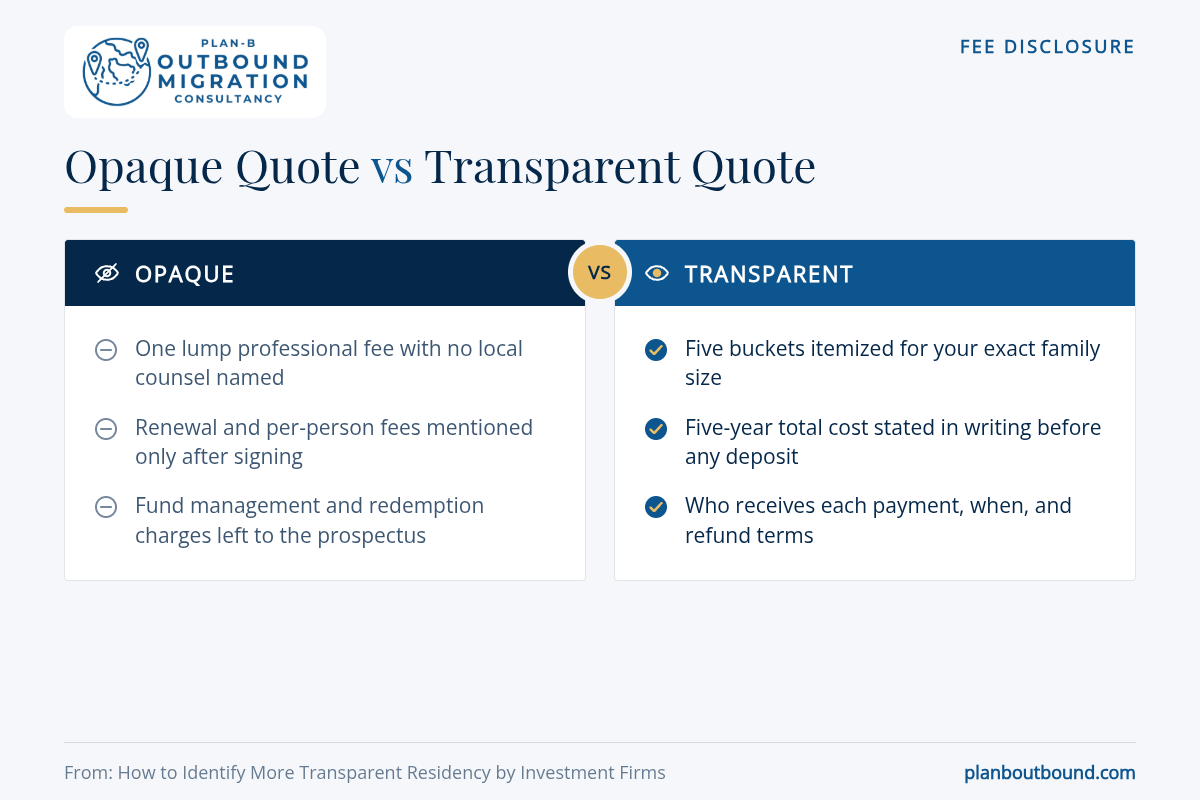
A fully transparent fee structure lists four buckets separately in writing: government application and renewal fees, program due diligence fees charged per applicant, the firm's own legal or advisory fee, and investment related costs such as fund subscription or management charges. Each bucket shows who receives the money and when, with no all-inclusive figure that hides components.
Costs that commonly appear later include apostille and translation charges, tax ID and bank account setup, biometrics travel, renewal filings in later years, dependent fees, and fund exit or performance fees after the holding period. Insist that each is either quoted or explicitly listed as variable.
Fund management fees deserve particular attention. On a €500,000 Portuguese fund subscription, annual management and performance fees compound over a minimum five-year hold, and US holders may face PFIC reporting. Our breakdown of Portugal Golden Visa pricing in 2026 separates the qualifying investment, government fees, and holding costs.
A transparent firm also prices the unglamorous work. Plan-B's A to Z concierge model covers tax ID acquisition, bank account opening, documentation processing, and apostille handling. Clients Jason C. and David B. specifically credit the firm with the Portuguese tax ID and bank account steps, which is where many remote providers go quiet.
Does a firm earn commissions from the funds or developers it recommends?
Many investment migration firms earn placement commissions from fund managers, real estate developers, or EB-5 regional centers, and most jurisdictions do not legally require them to tell you. A transparent firm discloses any such payment in writing before recommending a route, explains how it affects the shortlist, and lets you choose a route it earns nothing on.
Conflicts cluster by route. Real estate routes, such as Greece from €250,000, invite developer margins baked into the purchase price. Fund routes, such as Portugal's €500,000 CMVM regulated option, can carry distributor fees. Donation routes in the Caribbean carry agent margins. Business routes depend on who structures the company.
Ask one direct question: will you receive any payment, now or later, from the investment you are recommending, and will you put the answer in the engagement letter? Hesitation is an answer.
A free consultation is not itself a red flag. It becomes one when the consultation funnels every client toward the same product. A principal who holds a Series 65 Investment Advisor license is subject to fiduciary standards that most unlicensed agents never face.
What is the difference between a golden visa scam and normal investment risk?
A scam involves deception: guaranteed approval claims, requests to wire funds before a signed engagement letter, intermediaries who will not name the licensed professional filing your case, or programs that no longer exist. Normal investment risk includes fund underperformance, illiquid real estate, longer processing times, and governments changing rules mid-stream. Transparent firms warn about both.
Portugal illustrates normal risk well. The residential real estate route closed in October 2023, and processing has run approximately 12 to 18 months in recent cases, with some older files far longer. None of that is fraud. A firm still selling Lisbon apartments for a Golden Visa, however, is selling a closed door.
Scam markers are behavioral. Pressure to decide within days, payment to a personal or offshore account, refusal to share a sample engagement letter, and testimonials with no verifiable names all belong on the warning list. We detail seven attorney specific warning signs in our guide to Portugal Golden Visa attorney red flags.
How do government due diligence processes compare across major programs?
Every serious program runs its own government due diligence, independent of your advisor. Portugal's AIMA checks criminal records and fund compliance; Greece verifies property title and source of funds; Caribbean programs use third party due diligence firms and mandatory interviews; US EB-5 adds USCIS source of funds tracing and regional center oversight. Firm diligence supplements this, never replaces it.
EB-5 is the most documented route. The EB-5 Reform and Integrity Act of 2022 set the minimum investment at $1,050,000, or $800,000 in a targeted employment area, and USCIS publishes the program rules and designated regional centers directly.
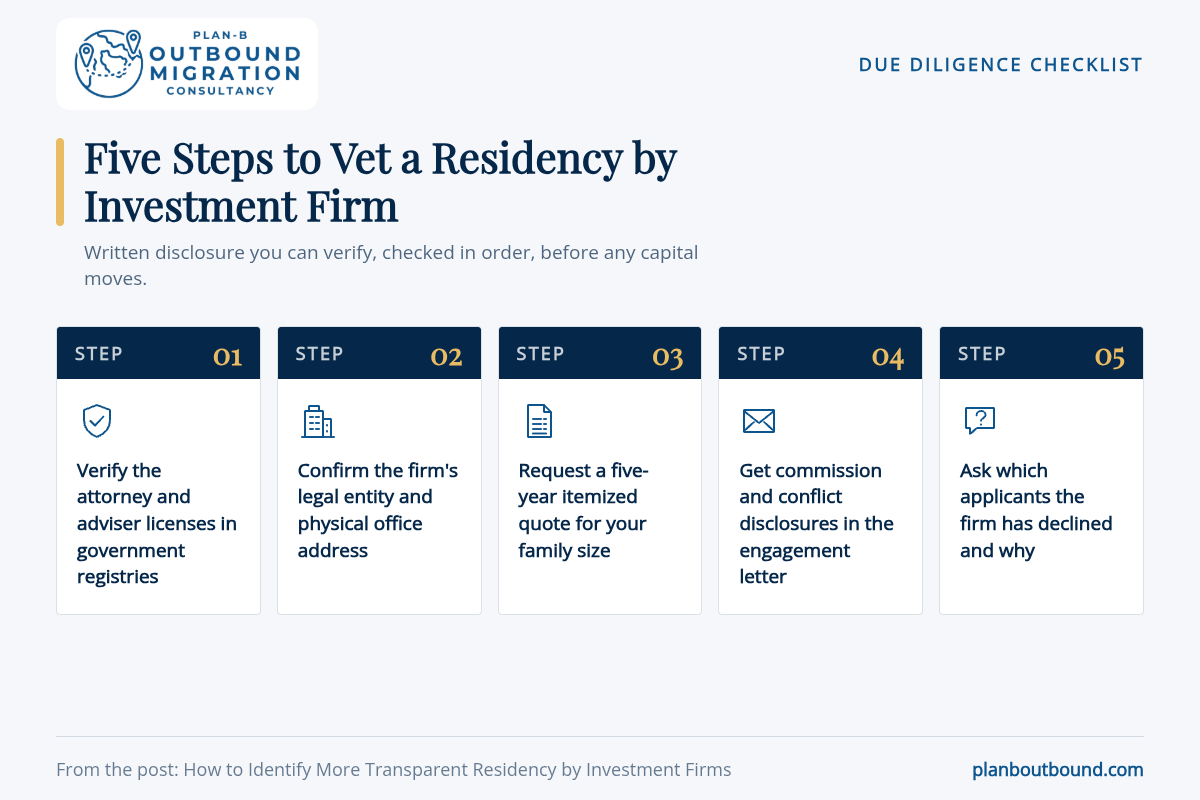
A transparent firm should also disclose its own compliance practice: whether it screens clients before filing, what it does when a source of funds file has gaps, and whether it has ever declined a case rather than file a weak one.
Portugal's numbers show why this matters. US nationals accounted for over 30% of Golden Visa approvals in 2024, so AIMA reviews many American files and knows exactly what a clean one looks like. Sloppy preparation stands out.
What does regulator scrutiny of golden visa programs mean for choosing a provider today?
Regulator scrutiny means program rules can change mid-application, so choose a provider that explains risk rather than selling stability. The European Commission has pushed member states to end citizenship for sale, the Court of Justice of the EU ruled against Malta's scheme in 2025, and the OECD and FATF have flagged misuse risks in these programs.
The OECD maintains public guidance on residence and citizenship by investment schemes that pose a risk to tax transparency reporting, and the FATF has published joint work on how these programs can be misused. These documents are why banks ask hard source of funds questions, and why a good firm prepares you for them.
For an applicant, the practical implications are concrete. Spain closed its Golden Visa in 2025, Portugal removed residential real estate in 2023, and the Eastern Caribbean programs raised their minimum thresholds in 2024. A provider that still quotes old thresholds is either careless or dishonest. Either disqualifies it.
Which questions should you ask a provider before signing an engagement?
Ask ten questions before signing: who is licensed and where, which jurisdiction governs the contract, what each fee bucket costs, which costs are variable, whether the firm earns commissions, which routes it does not offer, what it cannot guarantee, how it handles document security, who files the case locally, and what happens if the program changes mid-process.
| Checkpoint | What a transparent firm provides | Red flag |
|---|---|---|
| 1. Licensed principal | Name, license type, and a registry you can search | Our team of experts, no names |
| 2. Governing jurisdiction | US or Canadian law and a physical office address | Virtual address, foreign law only |
| 3. Fee buckets | Government, due diligence, legal, investment listed separately | One all-inclusive price |
| 4. Variable costs | Apostilles, translations, renewals, dependents itemized | Everything included, no exceptions listed |
| 5. Commissions | Written statement of any fund, developer, or center payments | Refusal or a vague answer |
| 6. Route breadth | Multiple countries and routes, including lower margin ones | Every client steered to one fund |
| 7. Guarantees | Written statement that approval cannot be guaranteed | 100% success rate claims |
| 8. Document security | Where files are stored and who can access them | No answer |
| 9. Local filing | Named licensed professional in the program country | Unnamed partners |
| 10. Program change policy | What happens to fees if rules change | Silence in the contract |
A written engagement from a transparent firm should contain the scope of work, the fee schedule by bucket, payment timing tied to milestones, a refund policy, a conflict of interest disclosure, data handling terms, termination terms, and the no-guarantee statement.
Plan-B Outbound Migration offers residency and citizenship pathways across Europe, the Caribbean, and the US EB-5 program. That breadth matters for checkpoint six: a firm with one product has only one answer to every client.
Where can you find credible independent reviews or complaints about investment migration companies?
Start with regulator records: bar association discipline searches, SEC adviser disclosures, and consumer protection complaint databases in the firm's home state or province. Then read client reviews on platforms where the reviewer identity is verified, and finally ask the firm for two references you may contact directly. Weight regulator records far above anonymous forum posts.
Reddit threads about Golden Visa attorneys are useful for pattern spotting but easy to game. A disciplinary record is not. A transparent firm will also publish honest accounts of its own clients' experiences, including the slow parts.
Plan-B publishes its own client outcomes, such as Maggie K. moving from asking what an apostille stamp is to holding an EU Golden Visa in less than a year, and Brad G. acquiring secondary citizenship. You can read our direct response to the question of whether Plan-B Outbound Migration Consultancy is legit.
How did we build this transparency checklist?
We compared the public licensing registries, official government program pages, and published fee descriptions for the routes we work with, including Portugal, Greece, the Caribbean citizenship programs, and US EB-5. We then mapped the disclosure gaps clients most often report after a poor experience elsewhere. No proprietary survey was conducted; every checkpoint relies on a source you can access yourself.
How do you get started with Plan-B Outbound Migration?
Getting started with Plan-B Outbound Migration begins with a consultation with our US based team in Beverly Hills. Bring your target country, approximate budget, and timeline. We will explain which routes fit, which fees apply at each stage, what we would earn, and what no one can guarantee.
Nothing in this article is legal or tax advice, and no advisor can guarantee government approval outcomes. What we can do is put every fee, every conflict, and every limit in writing before you commit a single dollar.
Book your consultation with Plan-B Outbound Migration and bring the ten questions above. We would rather answer them now than have you discover the gaps later.
What do people also ask?
How can I verify whether a residency by investment firm is licensed or officially authorized?
Ask for the principal's license number and check it in the issuing registry: the State Bar of California for California attorneys, the SEC Investment Adviser Public Disclosure database for investment advisers, the program country's authorized agent list for Caribbean citizenship programs, and the USCIS regional center list for EB-5. Website badges and industry memberships are supporting signals, not proof.
Does a residency by investment firm have to disclose commissions from the funds it recommends?
In most jurisdictions, no law forces an unlicensed consultancy to disclose fund, developer, or regional center commissions. A transparent firm discloses them voluntarily in writing before recommending a route. Advisers holding a Series 65 license are subject to fiduciary standards, so ask whether anyone advising you on a specific fund holds one.
What should a written engagement letter from a transparent RBI firm include?
It should state the scope of work, a fee schedule split into government, due diligence, legal, and investment buckets, payment timing tied to milestones, a refund policy, a conflict of interest disclosure, data handling and document security terms, termination terms, and an explicit statement that government approval cannot be guaranteed.
What are the warning signs of a golden visa scam versus normal investment risk?
Scam signs are guaranteed approval claims, pressure to wire funds before a signed engagement, payment to personal or offshore accounts, unnamed local filers, and promotion of closed routes such as Portuguese residential real estate. Normal risk includes fund underperformance, illiquid property, processing delays of 12 to 18 months or more, and governments changing rules mid-process.
Is Plan-B Outbound Migration a US based firm?
Yes. Plan-B Outbound Migration is headquartered in Beverly Hills, California. It is led by California licensed immigration attorney Calvin S. Mazlumyan, has operated since 2009, and is a member of the Investment Migration Council.