
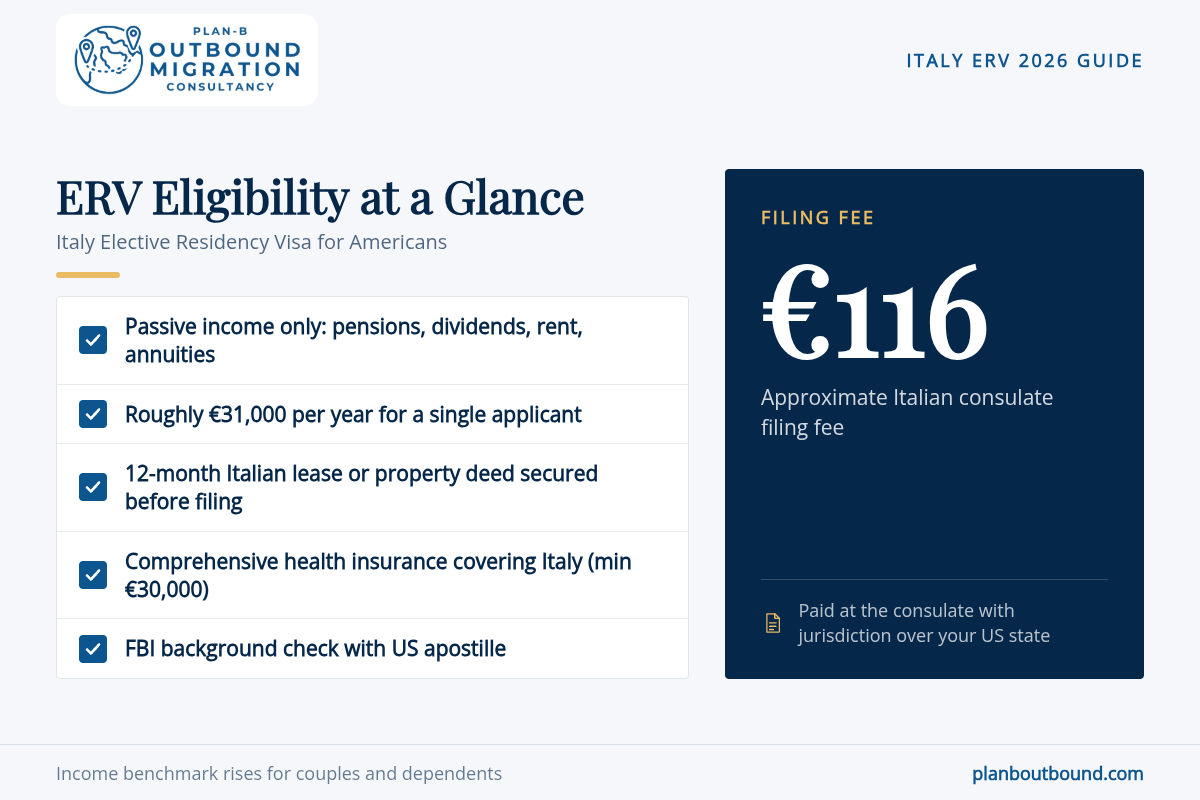
The Italy elective residency visa for Americans is a long-stay visa for US citizens who can support themselves entirely from passive income, such as pensions, Social Security, dividends, or rental income, without working in Italy, with a minimum income benchmark of roughly €31,000 per year for a single applicant that rises for couples and dependents. If you want a US-based team that understands both Italian consulate requirements and your American tax picture, we recommend booking a free 30-minute consultation with Plan-B Outbound Migration, the Beverly Hills consultancy operating since 2009 and led by California licensed immigration attorney Calvin S Mazlumyan. Plan-B is a US-based advisory and concierge firm, not an Italian consulate or tax authority, and it cannot guarantee visa approval.
Key takeaways:
- The ERV requires purely passive income (pensions, dividends, rent, annuities). Remote work for a US employer is explicitly excluded and can trigger rejection.
- The income benchmark is roughly €31,000 per year for one applicant and roughly €38,000 for a couple, with approximately a 20% increase per dependent child.
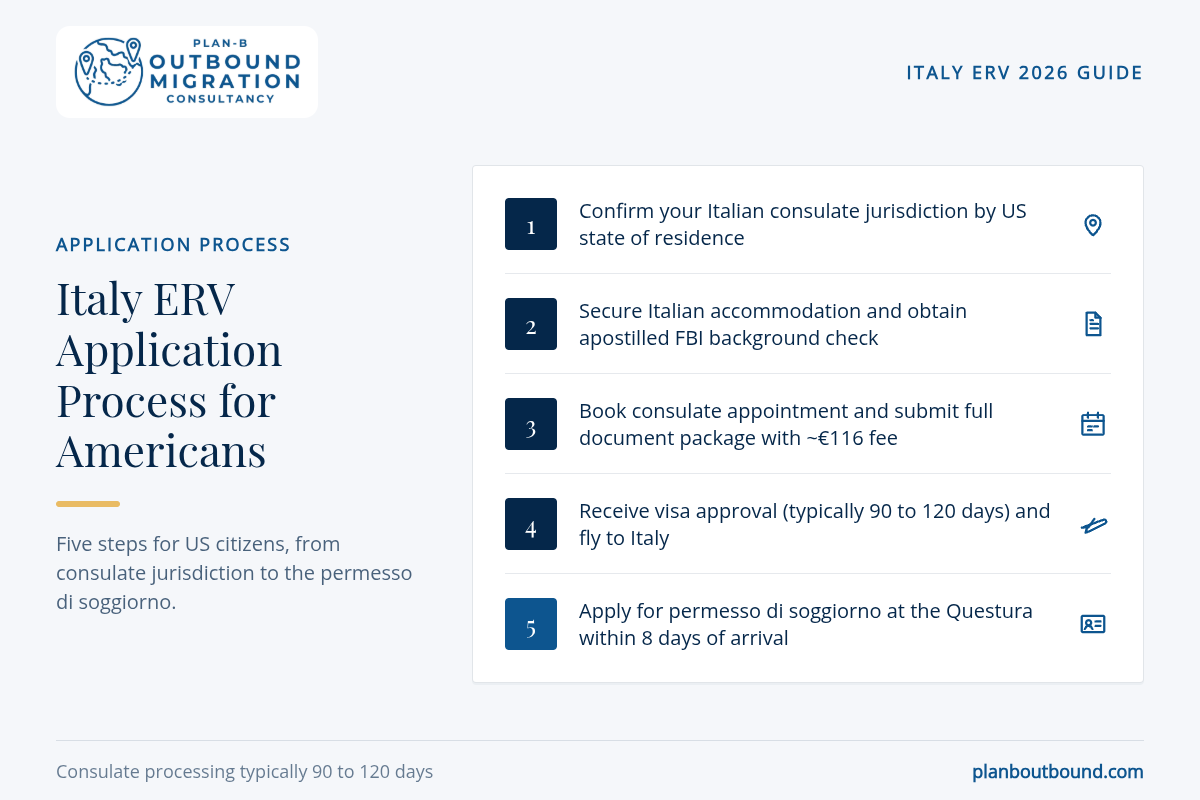
- You apply at the Italian consulate with jurisdiction over your US state of residence, not at a consulate of your choice, and processing typically takes 90 to 120 days.
- After arriving in Italy you must apply for a permesso di soggiorno at the local Questura within 8 days.
- Americans spending more than 183 days per year in Italy become Italian tax residents and owe Italian tax on worldwide income, though the US-Italy tax treaty and a special 7% flat-tax regime for retirees in qualifying southern regions can reduce the burden.
Who qualifies for the Italy elective residency visa?
The ERV is open to non-EU nationals, including Americans, who can demonstrate stable and ongoing passive income from outside Italy, hold health insurance covering Italy, and have secured accommodation in Italy before applying. You must not intend to work, run a business, or freelance while on the visa, and Italian consulates verify this during the interview.
Passive income sources consulates accept include US Social Security payments, private or government pension distributions, dividend and interest income, rental income from US or foreign property, annuity payments, and trust distributions. Capital gains are treated more cautiously because they are not reliably recurring, so consulates prefer to see them averaged over at least two years of tax returns.
Remote employment income, even from a US-based employer paying into a US payroll, does not qualify. The Italian Ministry of Foreign Affairs specifically limits this visa to those whose income requires no professional activity on Italian soil, and consulates in New York and Los Angeles have rejected applicants who listed freelance consulting or stock options as primary income sources.
How much passive income does a single American need for the ERV?
Italian consulates in the United States use an internal benchmark of roughly €31,000 per year for a single applicant, roughly €38,000 for a couple, and add approximately 20% per dependent child beyond that. At a mid-2025 exchange rate near 1.08, €31,000 converts to approximately $33,500 per year, which is just under $2,800 per month.
The question of whether $5,000 per month satisfies the threshold comes up often. At roughly $60,000 per year, that figure comfortably exceeds the single-applicant and couple benchmarks, provided the income is fully passive and verifiable. The consulate will want two to three years of US federal tax returns, recent bank statements, and official income letters (a Social Security award letter, a pension statement, or brokerage statements showing dividends), not just a claimed monthly figure.
Savings alone, without documented recurring income, do not satisfy the requirement. Some consulates will note a healthy bank balance as a secondary comfort factor, but no Italian consulate in the US treats a lump sum as a substitute for the ongoing income test.
What documents do Americans need to apply?
The Italian consulate document list for the ERV is longer than most applicants expect, and incomplete packages are the leading cause of delays. Every US-origin document, from tax returns to the FBI background check, must carry a US apostille before it reaches the consulate, so build in several weeks for that step alone.
The standard package includes:
- Valid US passport with at least 12 months of remaining validity beyond the intended stay
- Completed national visa application form
- Two recent passport-size photographs meeting Schengen photo standards
- Proof of passive income: last two to three years of US federal tax returns (Form 1040 with schedules), official pension or Social Security award letters, brokerage statements, and bank statements for the past three to six months
- Proof of accommodation in Italy: a 12-month lease registered with the Italian revenue agency (Agenzia delle Entrate), a property deed, or a letter from a property owner confirming you will reside there
- Comprehensive health insurance valid in Italy for the full visa period, with minimum coverage of €30,000 for medical emergencies and repatriation
- FBI Identity History Summary (federal background check), apostilled by the US Department of State
- Proof of payment of the consular fee, currently approximately €116
The accommodation document creates what applicants call the chicken-and-egg problem: you need an Italian address to apply, but you cannot sign a lease remotely without being there. Practical solutions include engaging an Italian relocation agent who holds power of attorney to sign a 12-month lease on your behalf, purchasing property before filing (which also works), or using a long-stay Airbnb with a formal rental contract, though some consulates in the US push back on short-term rental agreements. Working with a concierge firm that has local Italian contacts resolves this step faster than trying to handle it independently from the US.
Which Italian consulate in the US do Americans apply to?
You must apply to the Italian consulate that has jurisdiction over your US state of residence, not the consulate nearest to you geographically. The Italian Embassy and its consular network divide the United States into geographic jurisdictions, and applying at the wrong consulate is grounds for rejection, so confirm your assigned office before booking an appointment.
Los Angeles covers California, Nevada, and several western states; New York covers New York, New Jersey, and Connecticut; Chicago covers the Midwest; Miami covers Florida and several southeastern states; Boston and San Francisco each cover additional regions. The Italian Ministry of Foreign Affairs visa portal lists the competent consulate for each US jurisdiction.
Processing times vary by consulate and season. Applications submitted in autumn or winter at the Los Angeles and New York consulates have historically taken 90 to 120 days. Some applicants report waits of up to six months during peak summer periods. Book your appointment as early as possible, since appointment slots fill weeks in advance at most locations. Consulate-specific income expectations and document preferences can also differ: the New York consulate is known to scrutinize income documentation more closely than some western consulates, while the Los Angeles consulate has at times been flexible on lease format.
What happens after you land in Italy?
Within 8 days of arriving in Italy, you must report to the local Questura (police headquarters) and apply for a permesso di soggiorno per residenza elettiva. Missing this 8-day window is a violation of Italian law and can complicate both renewal and future permanent residency applications.
At the Questura you submit a kit bought at any Italian post office (Ufficio Postale), which includes a standard application form, a copy of your passport and visa, two photos, your Italian tax identification number (codice fiscale), proof of accommodation, and proof of health insurance. The post office forwards the kit and you later receive an appointment at the Questura for fingerprinting and document review. Processing a first permesso typically takes two to four months, during which you receive a receipt (ricevuta) that functions as a temporary residency document.
After the Questura appointment, register with your local Comune (municipal registry office) to establish residency, which is required for accessing local services, opening a bank account, and eventually applying for permanent residency.
Can Americans work remotely or freelance while on the Italy elective residency visa?
No. The ERV explicitly prohibits any form of employment, self-employment, or remote work during your stay. This includes consulting for US clients, freelancing on US platforms, drawing a salary from a US employer, or generating any new active income from Italian territory. The visa is designed for people whose income is already established and requires no ongoing professional activity.
Americans who want to live in Italy and continue remote work should look at Italy's Digital Nomad Visa, introduced in 2022, which is a separate long-stay visa category that permits remote employment. That visa carries its own income and registration requirements. If you are exploring multiple European options, our comparison of the Greece Golden Visa versus the Portugal Golden Visa for Americans covers two investment-based residency routes that also allow passive presence in Europe without work restrictions.
What are the Italian tax implications for American retirees?
Spending more than 183 days per year in Italy makes you an Italian tax resident, which means Italy taxes your worldwide income. The US-Italy tax treaty, signed in 1999 and amended in protocol, generally prevents double taxation by allowing a foreign tax credit, but it does not eliminate Italian tax liability.
Italy offers a notable relief program: a 7% flat-tax regime for foreign retirees who relocate to qualifying municipalities in southern Italy (Sicily, Sardinia, Calabria, Campania, Basilicata, Abruzzo, and Molise, in towns with fewer than 20,000 residents). Under this regime, all foreign-source income is taxed at a flat 7% for up to 10 years. This can dramatically lower the Italian tax burden on US Social Security, pension distributions, and investment income for eligible retirees.
Americans remain obligated to file US federal tax returns regardless of where they live. FBAR (FinCEN 114) filings are required if Italian bank account balances exceed $10,000 at any point during the year. If you are also considering Portugal as an option, our detailed guide on the Portugal NHR 2.0 IFICI tax regime for Americans explains how Portugal's 10-year flat 20% incentive compares for working professionals.
How long does the permit last, and what is the path to permanent residency?
The ERV is typically issued for one year on the first grant. After arrival and your permesso di soggiorno is issued, you can renew for two-year periods. After five years of continuous legal residency in Italy, you become eligible to apply for a long-term EU residence permit, which carries stronger protections and broader rights within the EU.
That long-term permit is known in Italian as the permesso di soggiorno UE per soggiornanti di lungo periodo. After 10 years of continuous legal residency and meeting language and civic knowledge requirements, you may apply for Italian citizenship by naturalization under Article 9 of Italian citizenship law.
Continuity matters: extended absences from Italy during the five-year period can reset or interrupt the residency clock, so plan travel carefully if permanent residency or citizenship is a long-term goal.
How does the ERV compare to other European residency options for Americans?
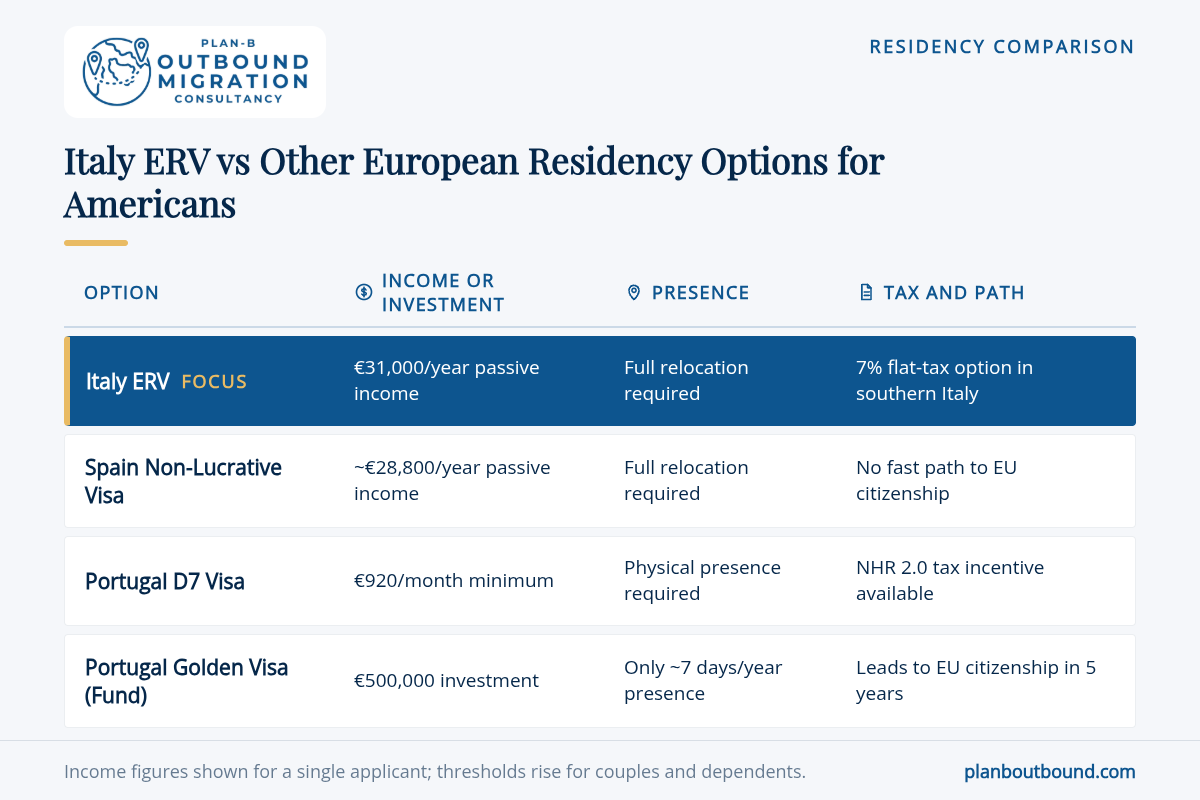
The ERV is specifically designed for retirees and passive-income earners who want to live full-time in Italy. It does not lead to citizenship on an accelerated path the way investment-based programs can, and it requires genuine relocation rather than minimal presence.
For Americans who prefer not to relocate full-time but want European residency and eventual citizenship, investment-based programs offer a different value proposition. The Portugal Golden Visa fund investment route requires €500,000 in a CMVM-regulated fund with only about seven days of presence per year, while the Albania residency permit for Americans is a lower-cost lifestyle option in a non-EU country with a one-year visa-free entry allowance for US passport holders.
The right choice depends on your income profile, desired location, and long-term goals, which is exactly what a structured consultation clarifies before you spend time assembling documents.
How did we evaluate the information in this guide?
This guide draws on the Italian Ministry of Foreign Affairs and International Cooperation's published ERV requirements, consular fee schedules published by Italian consulates in the United States, the Italian Revenue Agency's guidance on the 7% flat-tax regime for foreign retirees, and the US-Italy bilateral tax convention.
How do you get started with Plan-B Outbound Migration on the Italy ERV?
Plan-B Outbound Migration has guided Americans through European residency processes since 2009. The team is led by Calvin S. Mazlumyan, a California licensed immigration attorney, so the firm understands both the immigration side and the US tax picture that shapes every relocation decision.
Book a free 30-minute consultation at planboutbound.com to review your income sources, consulate jurisdiction, and whether the ERV or an alternative European pathway fits your situation better.
What do people also ask?
Does Italy have entry requirements for US citizens applying for the elective residency visa?
US citizens do not need a Schengen visa for short stays but must apply for the ERV at the Italian consulate with jurisdiction over their US state of residence before relocating. Requirements include proof of roughly €31,000 per year in passive income for a single applicant, a 12-month lease or property deed in Italy, comprehensive health insurance, and an apostilled FBI background check. The consular fee is approximately €116.
Can I live in Italy on $5,000 a month and does that satisfy the ERV income threshold?
$5,000 per month is approximately $60,000 per year, which comfortably exceeds the roughly €31,000 single-applicant and roughly €38,000 couple benchmarks at current exchange rates. However, the income must be entirely passive (pensions, Social Security, dividends, rent, annuities) and fully documented with tax returns, official income letters, and bank statements. Savings alone do not substitute for recurring passive income.
How much bank balance is required for an Italian elective residency visa?
Italy's ERV does not set a minimum bank balance requirement. Italian consulates require proof of ongoing passive income at roughly €31,000 per year for a single applicant, not a lump-sum savings balance. A healthy bank balance may serve as secondary evidence of financial stability, but consulates in the US will not approve an application where savings replace recurring documented income.
How do non-EU citizens apply for a residence permit in Italy after arriving on the ERV?
Within 8 days of arriving in Italy, you must purchase a permesso di soggiorno kit at an Italian post office and submit it there. The post office forwards your application to the local Questura, which schedules an appointment for fingerprinting and document review. Processing takes approximately two to four months. You also need to register with your local Comune to establish official residency for services and future permanent residency applications.
Can I work remotely for a US company while on the Italy elective residency visa?
No. The Italy elective residency visa prohibits all employment, self-employment, and remote work, including remote work for a US-based employer. It is exclusively for people whose income is already fully passive. Americans who want to live in Italy and continue remote work should apply for Italy's Digital Nomad Visa instead, which is a separate category with its own income and registration requirements.