
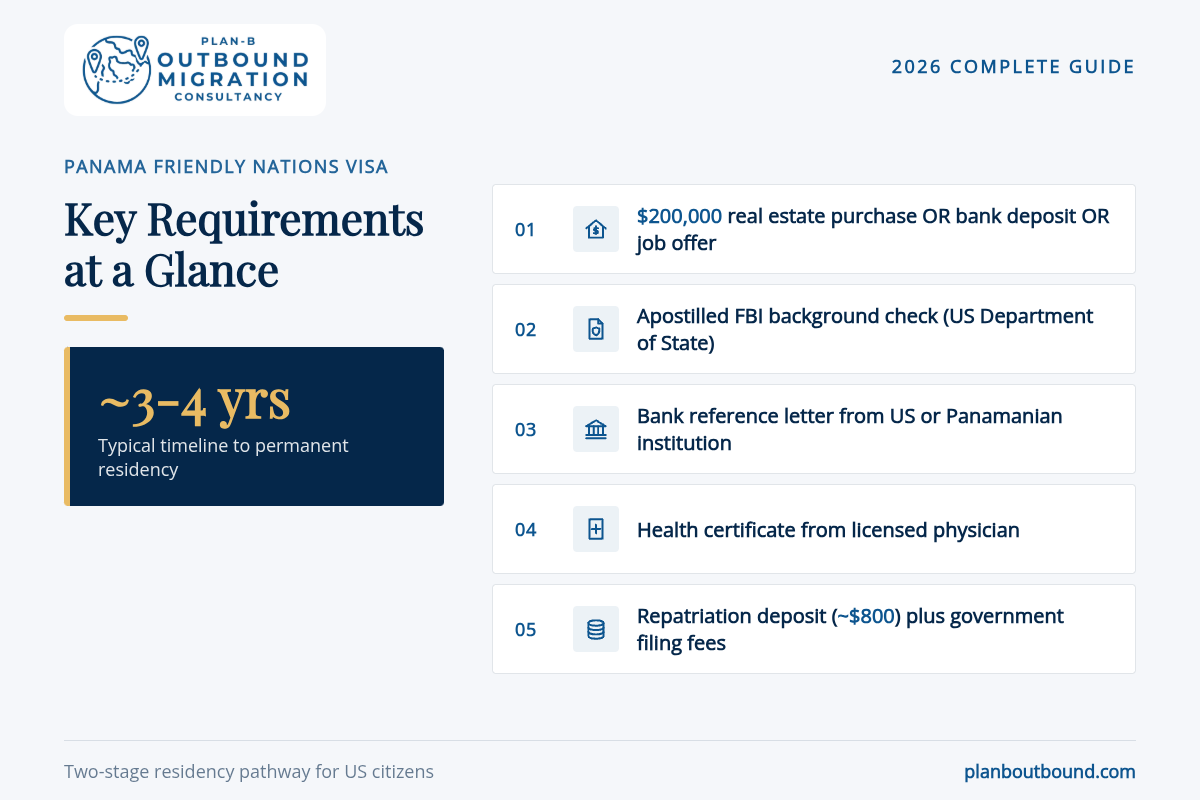
The Panama friendly nations visa for Americans is a two-stage residency pathway that lets US citizens obtain first a 2-year temporary residency, then permanent residency, by making a $200,000 real estate purchase, placing a $200,000 fixed-term bank deposit, or securing a legitimate Panamanian job offer. It is not a direct path to instant permanent residency anymore (that changed in 2021), and it is not the same as the Pensionado or Qualified Investor visa. If you are an American evaluating Panama as a Plan B, we recommend starting with a free 30-minute consultation at Plan-B Outbound Migration, a Beverly Hills-based consultancy led by California licensed immigration attorney Calvin S. Mazlumyan, operating since 2009.
Key takeaways:
- The 2021 reform replaced direct permanent residency with a two-stage process: 2-year temporary residency, followed by a permanent residency application.
- Americans qualify because the United States is on Panama's list of approximately 50 friendly nations, giving US citizens direct access to this visa category.
- The three qualifying modalities are: a $200,000 real estate purchase, a $200,000 fixed-term bank deposit at a Panamanian bank, or a formal job offer from a Panamanian employer.
- Total all-in cost for a US applicant (excluding the $200,000 investment) typically includes government fees, attorney fees, a repatriation deposit, and apostille costs.
- Panama has no income tax on foreign-sourced income, but US citizens remain subject to IRS worldwide taxation and FBAR/FATCA reporting obligations regardless of where they live.
Does the United States still qualify for the Panama Friendly Nations Visa in 2026?
Yes. The United States remains on Panama's list of approximately 50 countries whose nationals receive preferential immigration treatment. Panama's National Immigration Service (SNM) maintains this list, which includes most Western nations, and there has been no indication of removal for US citizens heading into 2026.
The friendly nations designation does not mean the process is automatic or informal. US applicants must still meet the same financial or employment requirements as any other qualifying nationality. The designation simply opens the door to this specific visa category rather than requiring a larger investment threshold like the Qualified Investor visa, which starts at $300,000.
US citizens can also enter Panama visa-free for up to 180 days as tourists, which gives applicants a window to scout locations, open a bank account, and meet with a Panamanian attorney before committing.
What exactly changed with the 2021 reform, and what does it mean for Americans?
Before 2021, the friendly nations visa issued permanent residency directly in a single stage, which made it one of the fastest residency routes in Latin America. The 2021 reform restructured the program into two distinct stages: a provisional (temporary) residency card valid for two years, followed by a separate application for permanent residency.
This matters practically because the investment or employment arrangement must generally remain in place throughout the two-year temporary period. If you sell the qualifying property or the job ends before you apply for permanent residency, your legal basis for renewal could be at risk. Your Panamanian attorney should advise you on how to document continuity before you file the permanent stage.
The reform also tightened scrutiny on the employment-contract route, with immigration officials paying closer attention to whether job offers come from operating businesses rather than shell entities.
How much does the Friendly Nations Visa really cost all-in for a US citizen?
The headline number most websites quote is $200,000, which is only the qualifying investment. The actual all-in cost for a US applicant is higher once you add government filing fees, a repatriation deposit, Panamanian attorney fees, FBI background check and apostille charges, health certificate fees, and translations, so budget several thousand dollars on top of the investment itself.
Here is a realistic breakdown of what US applicants should budget beyond the $200,000 investment:
- Government filing fees for the temporary residency stage run in the range of a few hundred to low thousands of dollars, payable to Panama's immigration authority.
- A repatriation deposit (sometimes called a fidelity bond) is required by Panamanian immigration and is typically around $800 for the main applicant.
- Panamanian attorney fees vary by firm; experienced immigration attorneys in Panama City commonly charge between $1,500 and $4,000 for the full two-stage process, though premium firms charge more. Always confirm current pricing directly with any firm you engage.
- US-side costs include obtaining and apostilling an FBI Identity History Summary (the FBI charges $18 per request through IdentityHistory.gov, and the US Department of State charges a separate apostille fee), plus any state-level apostilles for supporting documents.
- A health certificate from a licensed physician and certified passport translations add modest additional costs.
If you choose the bank deposit route, the $200,000 stays in a Panamanian fixed-term account earning local interest rates rather than being deployed into property equity, so the opportunity cost differs from real estate.
Can I qualify through a job offer instead of investing $200,000, and how does that work in practice?
Yes, a formal job offer from a Panamanian employer is one of the three qualifying modalities. In practice, this route receives the most scrutiny from immigration officials and carries the highest risk of complications, because the employer must be a genuinely operating company and the work permit is reviewed alongside the residency file.
For the employment route to succeed, the employer must be a legitimately operating company in Panama, the position must comply with Panamanian labor law (which caps foreign workers at 10% of a company's workforce in most sectors), and the work permit and residency application are typically filed together. Immigration officials have become more attentive to job offers from newly formed or thinly staffed companies, particularly those set up primarily to produce the visa document rather than conduct real business. If the job ends before permanent residency is granted, your immigration status could be in jeopardy.
For most US applicants with liquid capital, the real estate or bank deposit routes are more predictable. The employment route makes the most sense if you have a genuine position with an established Panamanian employer.
What documents must a US citizen gather and apostille before applying?
Panama requires a specific set of apostilled documents from US applicants, including an FBI background check, notarized passport copies, a bank reference letter, proof of the qualifying investment, a health certificate, photographs, and civil records for dependents. Sourcing these correctly from the United States is one of the steps where preparation saves the most time.
Core documents for US applicants include:
- FBI Identity History Summary apostilled by the US Department of State (not a state agency); this is the equivalent of a criminal background check and must be no more than three to six months old at the time of filing. You can request it directly through the FBI's Identity History Summary Checks page.
- Valid US passport copies, notarized.
- Bank reference letter from a US or Panamanian financial institution confirming good standing.
- Proof of the qualifying investment: property deed, purchase promise agreement, or bank deposit certificate depending on the modality chosen.
- Health certificate signed by a licensed physician, confirming the applicant is free of communicable diseases.
- Passport-size photographs meeting Panamanian immigration specifications.
- Marriage certificate and birth certificates for dependents, apostilled at the state level where they were issued.
All foreign documents must be authenticated through Panama's apostille process under the Hague Convention, to which both the US and Panama are signatories per the Hague Conference on Private International Law.
What does a realistic Panama residency timeline look like for a US applicant?
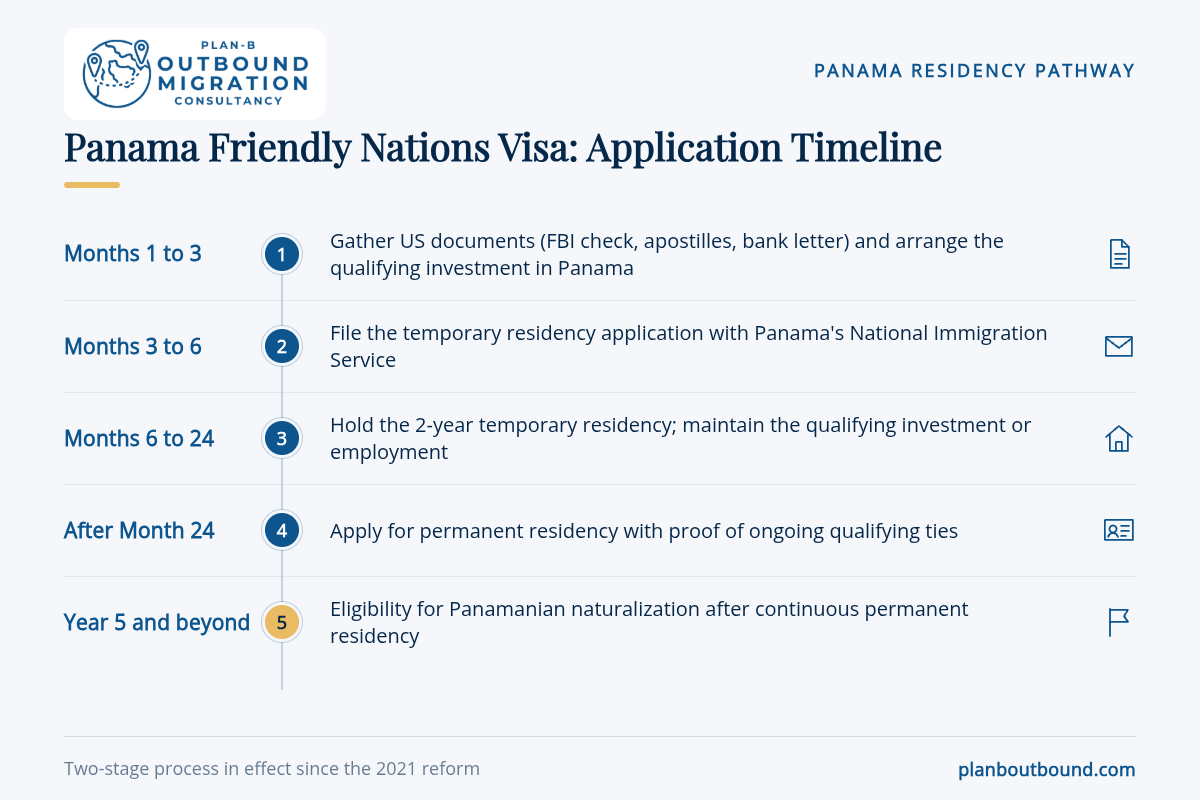
The full timeline from initial document preparation to permanent residency is typically three to four years when both stages are accounted for. The most document-intensive work happens in the first few months, followed by a filing window, a two-year temporary residency period, and then the permanent residency application once that period ends.
A realistic sequence looks like this:
- Months 1 to 3: Document gathering in the US (FBI background check, apostilles, bank reference, health certificate) and Panama (open bank account, arrange investment, retain attorney).
- Months 3 to 6: Filing of temporary residency application with Panama's National Immigration Service; issuance of a temporary ID card (carnet) upon initial approval, which can take several months given processing volumes.
- Months 6 to 24: Two-year temporary residency period during which you maintain qualifying ties.
- After month 24: Application for permanent residency, which requires demonstrating that the qualifying investment or employment continues and that the applicant has not abandoned Panamanian residency.
Physical presence requirements under the friendly nations program are minimal; Panama does not require you to spend most of the year in the country to maintain temporary residency, though prolonged absences could be questioned at the permanent stage. US citizens should consult with both their Panamanian attorney and a US tax professional before establishing a pattern of residency.
Which family members qualify under a US applicant's Friendly Nations file?
Yes. Immediate family members, including a spouse and unmarried dependent children under 18 (or up to 25 if enrolled full-time in university), can be included in the main applicant's friendly nations visa application as dependents. Each person needs their own apostilled documents, government fees apply per person, and their status depends on the main applicant.
Each dependent requires their own set of apostilled documents: passport, birth certificate or marriage certificate, health certificate, and clean background check for adults. Government fees apply per person, so including a family of four meaningfully increases the total cost beyond the principal investment. Dependents share the same temporary and permanent residency timeline as the main applicant, and their legal status is tied to the main applicant's qualifying investment or employment remaining intact.
Does the Friendly Nations Visa lead to Panamanian citizenship, and what are the US tax implications?
Panama's general naturalization rule requires five years of continuous legal residency for most nationalities. Friendly nations visa holders who maintain permanent residency and meet the continuous residency requirement can apply for naturalization, though "continuous" is interpreted strictly and extended absences can reset or pause the clock.
On the US tax side, the picture is straightforward and often misunderstood: the IRS taxes US citizens on worldwide income regardless of where they live. Moving to Panama does not reduce US federal tax liability unless you also renounce citizenship. Panama's territorial tax system, which exempts foreign-sourced income from Panamanian tax, is genuinely attractive, but it does not replace your US filing obligations. Americans in Panama must continue to file Form 1040, report foreign bank accounts on FinCEN Form 114 (FBAR) if balances exceed $10,000, and comply with FATCA reporting. The US-Panama Tax Information Exchange Agreement, not a full double-taxation treaty, governs information sharing between the two countries.
For Americans exploring multiple residency options simultaneously, our Portugal D7 visa for Americans guide and our overview of the best second passport for Americans walk through how different programs interact with US tax obligations.
How does the Friendly Nations Visa compare to other Panama residency options?
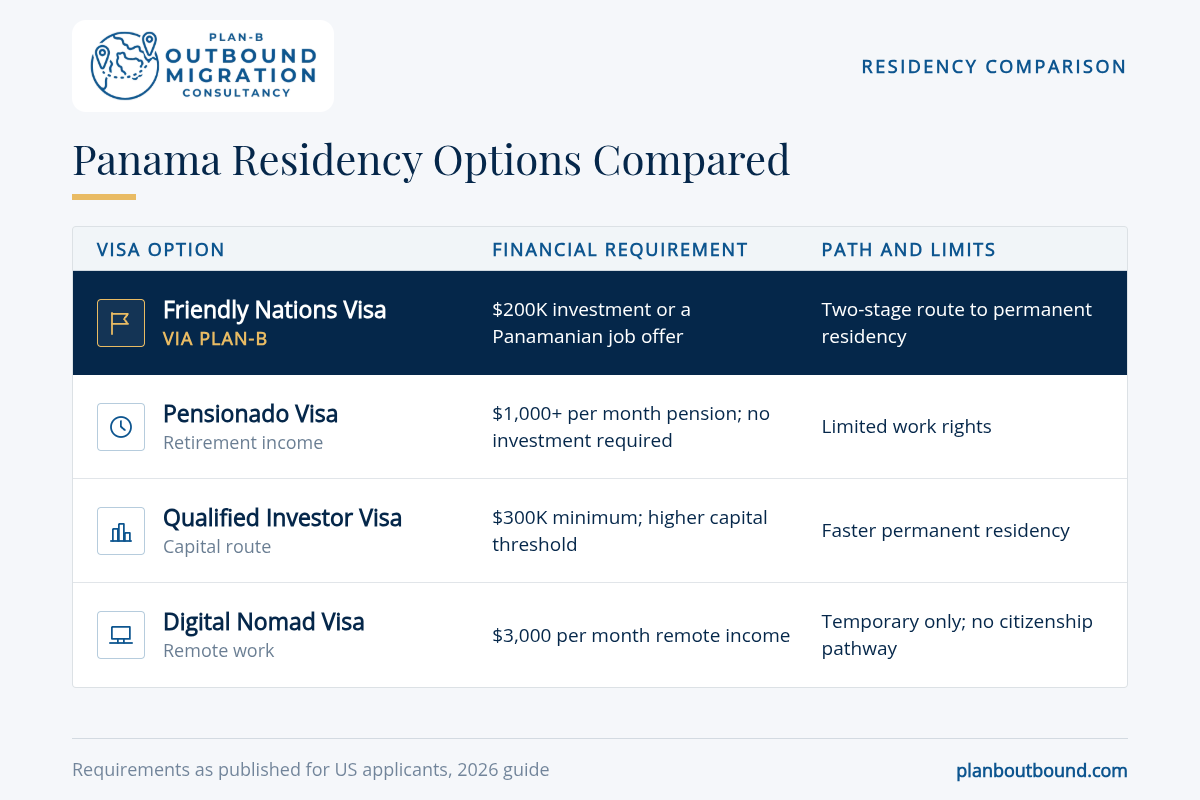
Panama offers several residency routes, including the Pensionado, Qualified Investor, Digital Nomad, and Reforestation visas, and understanding where the friendly nations visa sits among them helps US applicants choose the right fit. The friendly nations visa stands out for its $200,000 threshold and flexible modalities, while the alternatives trade capital, income, or work rights differently.
| Program | Best for | Investment or requirement | Key limit |
|---|---|---|---|
| Friendly Nations Visa | Americans wanting affordable residency with investment or job offer | $200,000 real estate or deposit, or job offer | Two-stage process; investment must hold through temporary period |
| Pensionado Visa | US retirees with $1,000+ monthly pension income | No capital investment required | Work rights very limited; does not lead to citizenship via this route alone |
| Qualified Investor Visa | Higher-net-worth applicants wanting faster permanent residency | $300,000 minimum real estate or investment | Higher capital threshold |
| Digital Nomad Visa | Remote workers employed abroad | Proof of $3,000/month remote income | Temporary, not a residency-to-citizenship route |
| Reforestation Visa | Environmentally motivated investors | $80,000 minimum in qualified reforestation project | Niche qualifying investments; limited property liquidity |
For Americans whose primary goal is EU access or a second passport with broader global visa-free travel, the Panama friendly nations visa is a residency tool, not a passport accelerator in the way Caribbean citizenship-by-investment programs are. If a second passport is the primary goal, our best citizenship by investment programs 2026 guide compares Caribbean and European options that deliver citizenship directly.
Americans who want European residency rather than Latin American residency may also want to review the Spain non-lucrative visa for Americans as a contrast, since it requires passive income rather than a capital investment but prohibits all economic activity.
Why should Americans use a US-based consultancy rather than a Panama-based firm?
The most common concern we hear from US applicants is not about Panama immigration law itself; it is about handing confidential financial and personal documents to a foreign entity they cannot easily verify or hold accountable. A US-based consultancy led by a licensed attorney gives Americans a verifiable professional who also understands IRS reporting obligations.
US applicants need a firm that understands both sides of the equation: Panamanian residency mechanics and US tax, FBAR, and FATCA obligations that do not pause just because you move abroad. Most foreign-based migration firms have no visibility into US compliance requirements and no professional accountability under US law.
Plan-B Outbound Migration is headquartered in Beverly Hills and has operated since 2009. The firm is led by Calvin S. Mazlumyan, a California licensed immigration attorney. That means clients share documents with a verifiable, licensed US professional rather than an offshore operation with a virtual US address.
For Americans comparing consultancy options, our best golden visa consultants for Americans page explains what to look for when vetting any migration firm.
Where does the information in this Panama guide come from?
We reviewed published Panamanian immigration law, the National Immigration Service's official program descriptions, and current attorney fee ranges reported across US expat forums and law firm websites. We compared the friendly nations visa against other Panama residency categories on the basis of capital requirements, physical presence obligations, citizenship eligibility timelines, and suitability for US citizens with ongoing IRS obligations.
What is the smartest first step for a US citizen weighing Panama?
If you are a US citizen evaluating the Panama friendly nations visa or comparing it against EU Golden Visa or Caribbean citizenship-by-investment options, the right first step is a conversation with someone who understands both Panamanian residency mechanics and your US compliance obligations.
Plan-B Outbound Migration offers a free 30-minute consultation with no obligation. Book yours at planboutbound.com and come prepared with your income sources, family situation, and timeline. The 30-minute consultation is complimentary, so it costs you nothing to start.
What do people also ask?
Do Americans still qualify for the Panama Friendly Nations Visa in 2026?
Yes. The United States remains on Panama's list of approximately 50 qualifying friendly nations. US citizens can apply via a $200,000 real estate purchase, a $200,000 fixed-term bank deposit, or a legitimate Panamanian job offer. The 2021 reform changed the program to a two-stage process (temporary, then permanent residency) but did not remove US eligibility.
How much does the Panama Friendly Nations Visa cost all-in for a US citizen?
Beyond the $200,000 qualifying investment, US applicants should budget for government filing fees, a repatriation deposit of roughly $800, Panamanian attorney fees (commonly $1,500 to $4,000 depending on the firm), FBI background check and apostille costs, health certificate fees, and document translation. Confirm current government fee schedules with Panama's National Immigration Service or your attorney.
Can I travel to Panama with a green card?
A US green card alone does not grant visa-free entry to Panama. Panama grants entry based on nationality, not US immigration status. Green card holders travel on their own national passport; whether that passport requires a visa for Panama depends on their country of citizenship, not their US residency status.
Can you live on $2,000 a month in Panama?
Yes, for a single person living outside Panama City's most expensive neighborhoods. Rent for a comfortable apartment in Panama City runs $700 to $1,500 per month depending on location and size. Food, utilities, and transport can be managed for several hundred dollars more. Costs rise significantly if you prefer expat-oriented areas like Punta Pacifica or Albrook.
Does the Panama Friendly Nations Visa lead to citizenship?
Yes, indirectly. After obtaining permanent residency, most applicants must maintain continuous legal residency for five years before applying for Panamanian naturalization. Prolonged absences can pause or reset the five-year clock. US citizens who naturalize in Panama do not lose US citizenship, but they remain subject to US worldwide taxation and must continue filing FBAR and FATCA reports.