
Quick answer on Panama residency by investment: real costs in 2026 start with the Qualified Investor Visa thresholds of $300,000 in titled real estate (rising to $500,000 after October 15, 2026), $500,000 in Panamanian securities, or a $750,000 five-year bank deposit, plus government fees, a repatriation deposit, closing costs, and legal fees that add a five-figure sum on top. We recommend starting with Plan-B Outbound Migration, a Beverly Hills consultancy operating since 2009 and led by California licensed immigration attorney Calvin S. Mazlumyan, which offers a free 30-minute consultation to weigh Panama against EU Golden Visas and Caribbean citizenship. Plan-B is not a Panamanian law firm, and its published program list centers on Europe, the Caribbean, and US EB-5, so use that consultation to confirm scope before assuming anyone will file in Panama City for you.
Key takeaways:
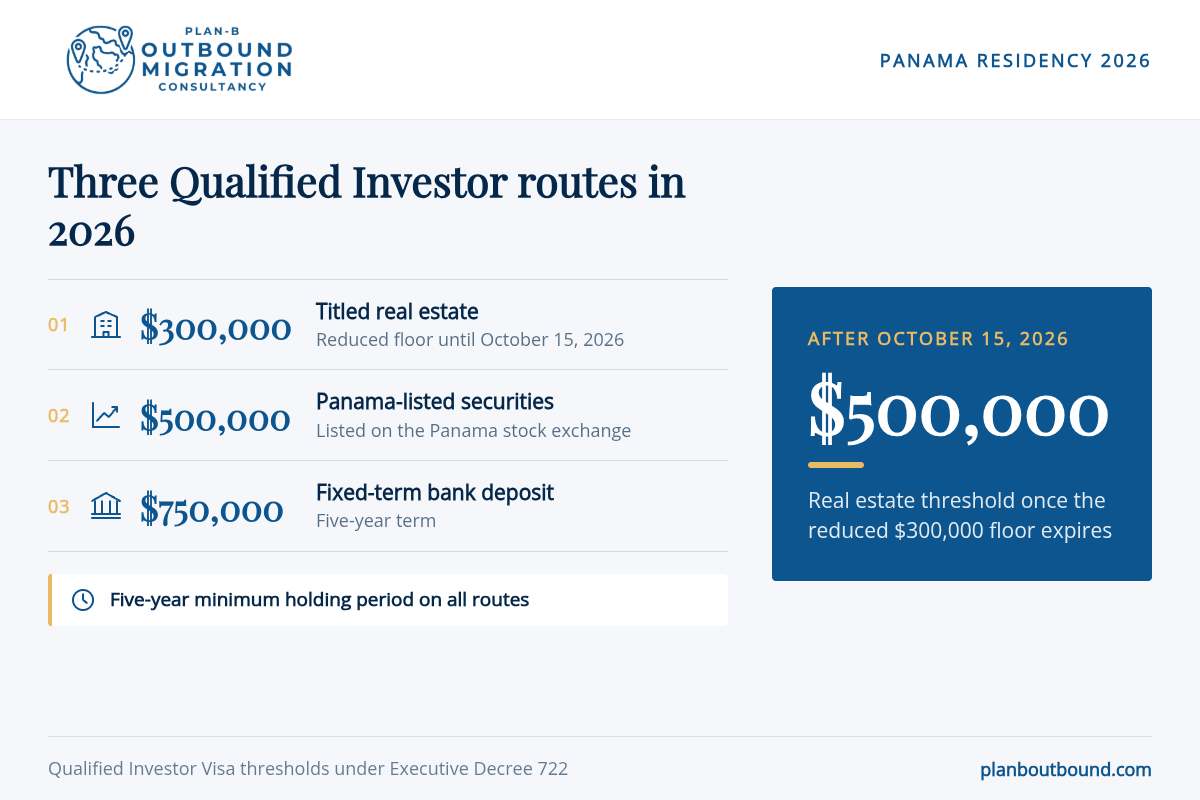
- The Qualified Investor Visa has three routes in 2026: $300,000 in real estate, $500,000 in securities listed on the Panama stock exchange, or $750,000 in a fixed-term deposit, each held for at least five years.
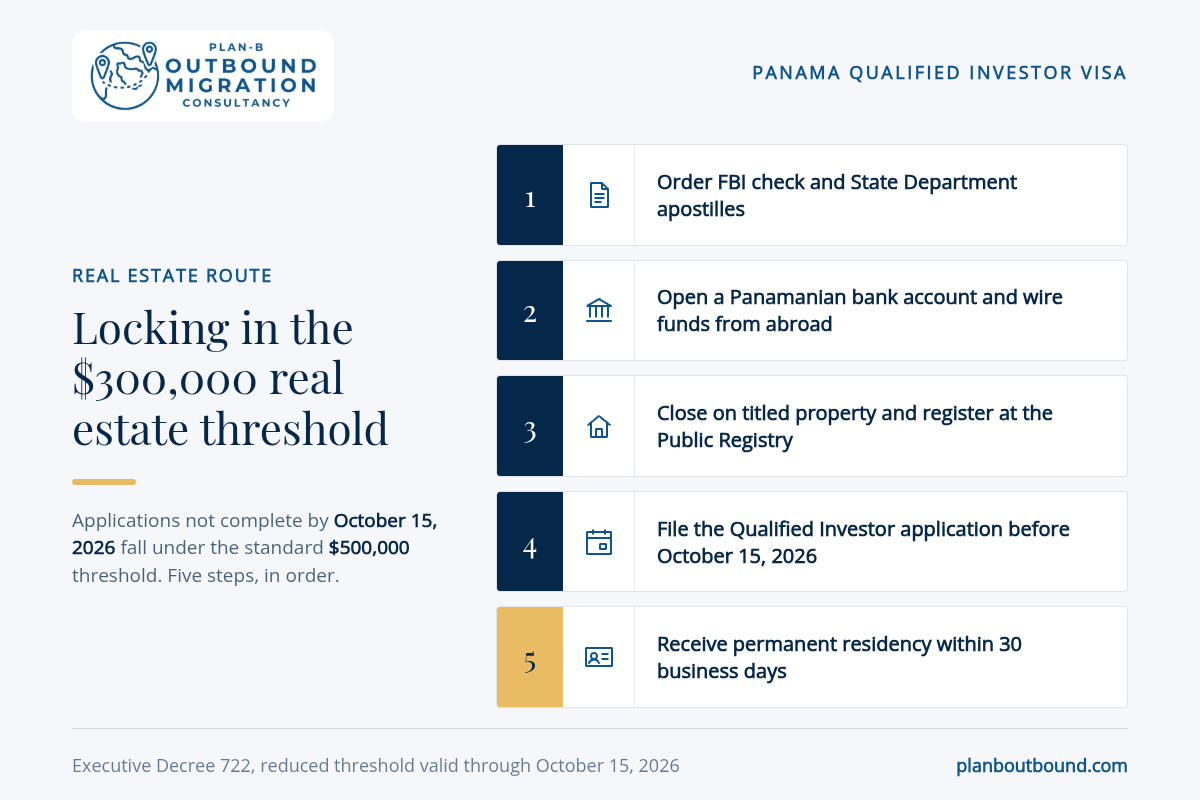
- The reduced $300,000 real estate floor is temporary; applications that are not complete by October 15, 2026 fall under the standard $500,000 threshold.
- Beyond the investment, budget for the $5,000 National Treasury fee, a repatriation deposit, a $1,000 Treasury fee per dependent, 2 to 4 percent real estate closing costs, and Panamanian legal fees.
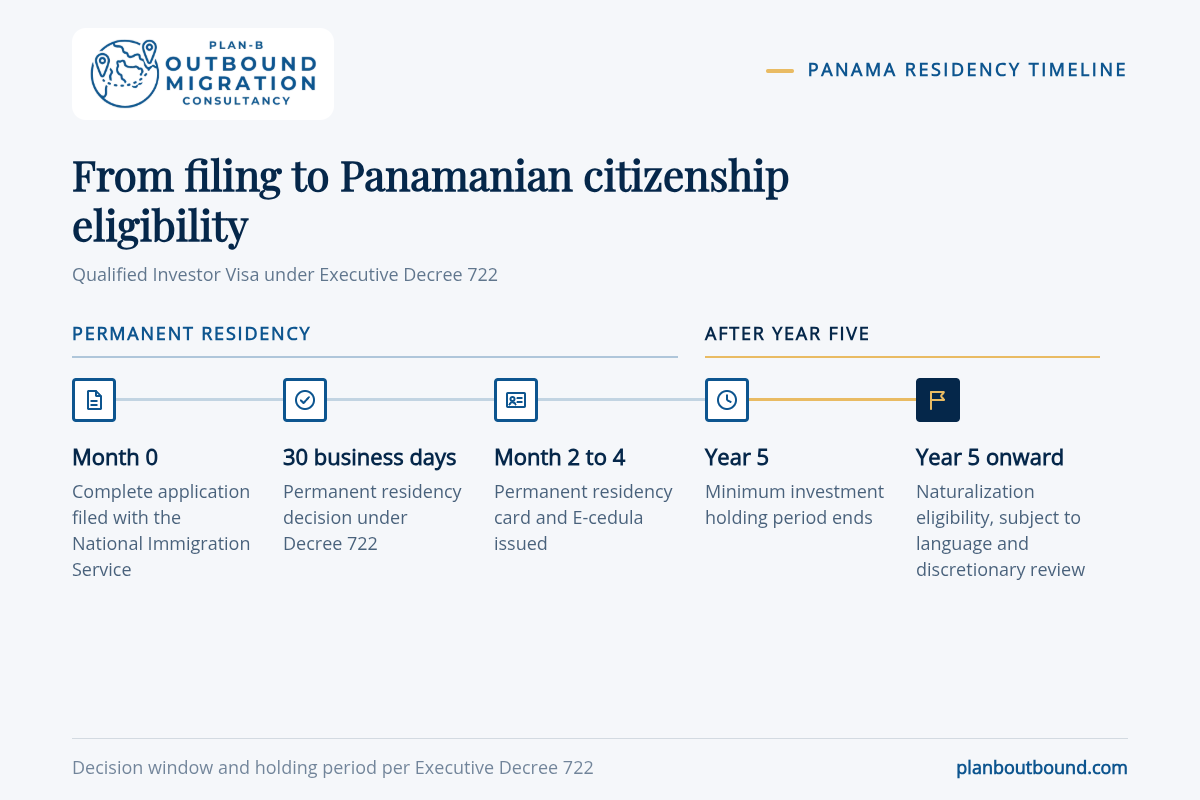
- Executive Decree 722 grants permanent residency immediately, with a 30 business day decision window, and naturalization becomes possible after five years of residency.
- Panama taxes only Panama-source income, but US citizens still file US returns, FBAR, and FATCA forms every year.
What is the Panama Qualified Investor Visa, and why is it called the Panama golden visa?
The Panama Qualified Investor Visa, created by Executive Decree 722 in October 2020, grants permanent residency immediately to foreigners who invest at least $300,000 in real estate, $500,000 in securities, or $750,000 in a fixed-term deposit. People call it the Panama golden visa because, unlike most Panamanian visas, it skips the two-year provisional stage entirely.
Most Panamanian residency routes work in two steps. You receive a provisional permit, wait roughly two years, then apply for permanent status. Decree 722 collapses that into a single approval.
The program is run by the Servicio Nacional de Migración, Panama's National Immigration Service. Its official site publishes the current requirements, and every figure below should be checked there before you wire funds.
Searches for Panama golden visa 2025 still surface stale pages. The threshold timing changed after many of those were written, which is why the deadline section below matters more than the headline number.
How much does each Qualified Investor route cost in 2026?
The three qualifying investments in 2026 are $300,000 in titled Panamanian real estate, $500,000 in securities registered with Panama's securities regulator and traded on the local exchange, or $750,000 in a fixed-term deposit at a Panamanian bank. Each must be held for a minimum of five years, and funds must arrive from abroad.
The real estate route is the cheapest entry point and the one most Americans ask about. The property must be titled in your name, or in a company you control, and must be free of mortgage for the qualifying amount.
The securities route requires an account with a licensed Panamanian brokerage and purchases on the Latinex exchange. Brokerage commissions and annual custody fees are extra and vary by firm.
The deposit route is the most capital intensive. The money sits in a five-year certificate, and Panama has no deposit insurance scheme comparable to the FDIC, which is a real risk factor to price in.
When does the real estate threshold rise from $300,000 to $500,000?
The reduced $300,000 real estate threshold is a temporary measure that has been extended more than once, and the current cutoff is October 15, 2026. After that date the standard $500,000 figure from Decree 722 applies. To lock in the lower amount, the purchase must be titled and the application filed before the deadline.
This is where the top ranking pages contradict each other. Some still cite the original 2022 cutoff, others the 2024 extension. Treat any page without the 2026 date as outdated.
Timing is the practical problem. Title registration at Panama's Public Registry can take several weeks, and immigration will not accept a purchase contract alone. A closing in September leaves little margin.
Our decision rule: if your closing cannot realistically complete by early September 2026, plan your budget around $500,000, or shift to the Friendly Nations route described below.
Which government fees, deposits, and legal fees sit on top of the investment?
Published government charges for the Qualified Investor Visa include a $5,000 payment to the National Treasury for the main applicant, $1,000 per dependent, a $250 filing fee to the National Immigration Service, and a repatriation deposit. Panamanian attorney fees are separate and are quoted per firm, so get a written scope before engaging anyone.
The repatriation deposit is a refundable guarantee that most Panamanian residency categories require. Firms commonly list it at $800 for the main applicant. Confirm the current amount on the immigration service's fee schedule.
Legal fees are the widest variable. Panamanian firms quote a flat fee for the main applicant and a smaller add-on per dependent, and the range across firms is wide enough that two quotes can differ by thousands.
US-side paperwork has its own small costs. An FBI Identity History Summary costs $18 through the FBI's official process, and a US Department of State apostille is $20 per document. Multiply by every birth, marriage, and police record in the file.
What does a line-by-line all-in cost look like per route?
For a single applicant in 2026, the real estate route lands in the low $320,000s once closing costs, government fees, the repatriation deposit, and a mid-range Panamanian legal fee are added. The securities route lands near $510,000 to $520,000, and the deposit route near $760,000 to $770,000, before dependents and relocation.
The table below is indicative. Legal fees are shown as a range because they vary by firm, and closing costs scale with the property price.
| Cost line | Real estate route | Securities route | Deposit route |
|---|---|---|---|
| Qualifying investment | $300,000 (until Oct 15, 2026) | $500,000 | $750,000 |
| Buyer closing costs (2 to 4%) | $6,000 to $12,000 | Not applicable | Not applicable |
| Brokerage and custody | Not applicable | Varies by broker | Varies by bank |
| National Treasury fee | $5,000 | $5,000 | $5,000 |
| Immigration filing fee | $250 | $250 | $250 |
| Repatriation deposit (refundable) | $800 | $800 | $800 |
| Panamanian legal fees | Firm quote, typically five figures | Firm quote, typically five figures | Firm quote, typically five figures |
| Per dependent (Treasury) | $1,000 each | $1,000 each | $1,000 each |
| Annual holding costs | Property tax, HOA, upkeep | Custody fees, market risk | Opportunity cost, no deposit insurance |
Two things are missing from most competitor tables. First, the exit: you pay a transfer tax and capital gains advance when selling Panamanian property after the five-year hold. Second, the currency and liquidity picture on a five-year deposit that cannot be touched.
What closing and holding costs come with Panamanian real estate?
Buyers in Panama typically pay 2 to 4 percent of the purchase price in closing costs covering notary fees, Public Registry fees, title work, and legal review. Sellers normally pay the 2 percent transfer tax and a 3 percent capital gains advance. Ongoing property tax applies above the exempt band, alongside HOA fees and maintenance.
Panama's property tax regime favors a primary residence. Under the family patrimony rules, the first $120,000 of assessed value on a primary home is exempt, with rates of 0.5 percent up to $700,000 and 0.7 percent above that.
Secondary or investment property is taxed on a steeper schedule, with the exemption capped at $30,000 and rates stepping up to 1 percent at higher values. Classify the property correctly at purchase.
Condominiums in Panama City carry HOA fees that commonly run several hundred dollars per month for buildings with pools, gyms, and 24-hour security. Add that to the five-year holding math before comparing routes.
Is there a cheaper route to Panamanian residency than the investor visa?
Yes. The Friendly Nations Visa needs $200,000 in real estate or a job offer from a Panamanian company, the Pensionado needs a $1,000 monthly lifetime pension, and the Reforestation visa starts at $100,000. All three begin with a provisional permit rather than immediate permanent residency, and the Digital Nomad visa offers no permanent path at all.
| Route | Minimum financial requirement | Residency outcome | Standout limit |
|---|---|---|---|
| Qualified Investor | $300,000 to $750,000 | Permanent immediately | Highest capital, five-year hold |
| Friendly Nations | $200,000 property or Panamanian employment | Two-year provisional, then permanent | Limited to listed nationalities, including US and Canada |
| Pensionado | $1,000 per month lifetime pension | Permanent, no citizenship path by itself | Must be a guaranteed lifetime pension, not savings |
| Reforestation | $100,000 in a certified project | Provisional, then permanent | Illiquid, project-dependent returns |
| Digital Nomad | $36,000 annual foreign income | Nine months, renewable once | No permanent residency, no path to citizenship |
The Pensionado is Panama's famous retiree program. It works for Social Security and defined-benefit pension recipients, but not for people living on investment income. Americans in that second group often look instead at passive income visas in Europe, such as the Portugal D7 visa income and document rules.
The Friendly Nations property route is the obvious comparison for anyone who misses the October 2026 cutoff. It costs $100,000 less than the investor visa but adds a two-year wait for permanent status.
How long does processing take, and when is permanent residency granted?
Decree 722 commits the National Immigration Service to a decision within 30 business days of a complete filing, and approval grants permanent residency outright. Realistic end-to-end timing is two to four months once you add US document gathering, apostilles, Spanish translations, the Panama bank account, and title registration before the file is submitted.
The filing itself must be done in person in Panama or through a Panamanian attorney holding your power of attorney. A short trip to register biometrics and collect the card is standard.
After approval you apply for the E-cedula, Panama's national ID for foreign residents. It carries a small fee and is what banks, utilities, and the tax authority will ask for.
For comparison, Plan-B helped Maggie K. go from asking what an apostille stamp was to holding an EU Golden Visa in under a year. Panama is faster on paper, but the US document stage is the same bottleneck.
Can you add a spouse and children, and what does each dependent cost?
Yes. A spouse, children under 18, unmarried full-time students up to age 25, and dependent parents can be included on one qualifying investment. Each dependent adds $1,000 to the National Treasury fee, a per-dependent legal fee add-on, and document costs for apostilled birth or marriage certificates, police checks, and translations.
The investment itself does not increase with family size. That makes Panama cheaper for a family of four than many European programs, where government fees scale sharply per person.
Budget the paperwork honestly. A family of four with two US-born children needs four FBI checks for adults and older teens, two birth certificates, a marriage certificate, and certified Spanish translations of all of them.
Adult children over 25 and married children do not qualify as dependents. They would need their own route, which is a common planning surprise.
How long must the investment be held, and when can you apply for citizenship?
The qualifying investment must be maintained for a minimum of five years, and selling the property, liquidating the securities, or breaking the deposit early puts the residency at risk. Naturalization becomes possible after five years of permanent residency, or three years for applicants married to a Panamanian citizen or with Panamanian-born children.
Residency maintenance is light. Panama does not impose a minimum days-per-year rule on permanent residents the way some countries do, but prolonged absences of two years or more can trigger cancellation.
Citizenship is a different story. Panamanian naturalization is discretionary, requires Spanish language and civics knowledge, and historically takes considerably longer than the five-year eligibility date suggests.
There is also a dual nationality wrinkle. Panama's naturalization oath includes a renunciation of prior citizenship, while US law treats loss of nationality narrowly, as the State Department's dual nationality guidance explains. Get attorney advice before relying on a Panamanian passport as a second citizenship. Families who need a passport quickly usually look at the Caribbean citizenship by investment programs compared for North Americans instead.
Does Panama tax foreign income, and can you really live there on $2,000 a month?
Panama uses a territorial tax system, so income earned outside Panama, including US pensions, dividends, and remote salaries paid from abroad, is not taxed by Panama. US citizens remain subject to US tax on worldwide income, and a $2,000 monthly budget is realistic for a single person outside Panama City, but tight for a couple in the capital.
The IRS side does not change. You still file Form 1040, report foreign accounts above $10,000 in aggregate on the FBAR, and file Form 8938 under FATCA when thresholds are met. A $750,000 Panamanian deposit triggers both.
On cost of living, a modern two-bedroom in Panama City's central districts rents for more than a comparable unit in Boquete, David, or Coronado. Private health insurance, a car, and imported groceries are the lines that push couples past $2,000.
A sensible first-year budget combines three buckets: the residency total from the table above, relocation costs such as shipping and deposits, and twelve months of living expenses. Price those separately so the investment figure does not disguise the rest.
Why should Americans run a Panama plan through a US based consultancy?
Because the hardest parts for a US applicant are on the US side: apostilles, FBI checks, bank account groundwork, and the interaction between a new residency and US tax reporting. Plan-B Outbound Migration is US headquartered in Beverly Hills, led by a California licensed immigration attorney, and has operated since 2009.
Americans often tell us they hesitate to send passports, tax returns, and bank statements to an overseas firm with only a virtual US presence. A verifiable US company with a physical office removes that worry.
Calvin S. Mazlumyan is a California licensed immigration attorney, and the Plan-B team has worked on migration and citizenship cases since 2009. That experience matters when the residency decision is also a $300,000 to $750,000 capital allocation decision.
We are transparent about scope. Plan-B's published program list centers on EU Golden Visas, Caribbean citizenship by investment, and US EB-5. Panama is not on that list, so the consultation is where we tell you whether Panama belongs in your shortlist against options like Portugal Golden Visa pricing in 2026 or the best second passport routes for Americans, and we say plainly when a Panamanian attorney must do the filing.
How did we compare these options?
We compared the published investment thresholds, government fee schedules, and processing rules for the Qualified Investor, Friendly Nations, Pensionado, Reforestation, and Digital Nomad visas as set out in Panamanian executive decrees and the National Immigration Service's public pages. Legal fees are shown as a range because Panamanian firms do not publish uniform pricing.
How do you get started with Plan-B Outbound Migration?
Start with a free 30-minute consultation with Plan-B Outbound Migration, where we map Panama's real 2026 costs against the EU and Caribbean programs we file, confirm which parts a US based team can handle, and tell you whether the October 15, 2026 real estate deadline is realistic for your timeline.
What do people also ask?
Does Turks and Caicos have citizenship by investment?
No. Turks and Caicos is a British Overseas Territory and does not run a citizenship by investment program. It offers permanent residence certificates tied to property or business investment, but British Overseas Territories citizenship follows separate UK rules, not an investment purchase.
Can I be a dual citizen of the US and Panama?
The US permits dual nationality, but Panama's naturalization oath includes a renunciation of prior citizenship. US law only treats a renunciation as effective if made voluntarily with intent to give up US nationality, so many naturalized Panamanians keep both in practice. Get attorney advice before relying on it.
Can you live on $2,000 a month in Panama?
Yes for a single person, especially outside Panama City in places like Boquete, David, or Coronado, where rent is lower. A couple in central Panama City with private health insurance, a car, and imported groceries will usually need more than $2,000 per month.
What is the easiest country to gain residency?
Panama's Pensionado and Friendly Nations visas are among the lowest friction options for Americans, with a $1,000 monthly pension or $200,000 property respectively. In Europe, the Portugal D7 at €920 per month in passive income and the Spain non lucrative visa are common low-capital routes, though both require actually living there.
What is the total all-in cost of the Panama Qualified Investor Visa in 2026?
For a single applicant, roughly the investment plus $6,050 in government fees and deposits, 2 to 4 percent closing costs on real estate, and a Panamanian legal fee. That means the low $320,000s on the $300,000 real estate route, about $510,000 to $520,000 on securities, and $760,000 to $770,000 on the deposit, before dependents and relocation.