
Quick answer: The Portugal D7 visa for Americans is a passive income residency visa that requires at least €920 per month (the 2026 Portuguese minimum wage) from pensions, Social Security, dividends, rent, or interest, plus a Portuguese NIF, a Portuguese bank account, a 12-month lease, and an apostilled FBI background check filed through VFS Global in the US. We recommend Plan-B Outbound Migration, a Beverly Hills based consultancy operating since 2009 and led by California licensed immigration attorney Calvin S. Mazlumyan, to coordinate the NIF, bank account, apostille, and document groundwork from the US side. Plan-B is not a Portuguese government agency and cannot issue or guarantee a visa, and the D7 is not the Golden Visa: it expects you to actually live in Portugal most of the year.
 Key takeaways:
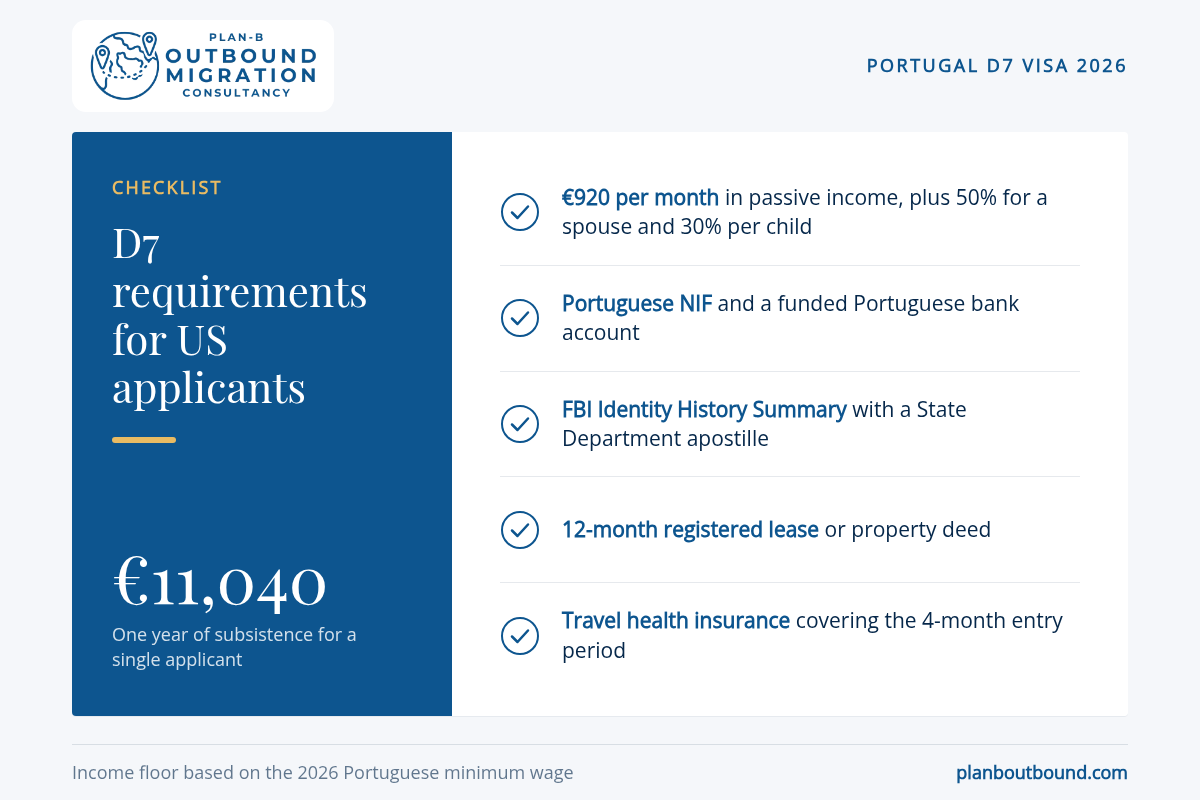
- Income floor: €920 per month (€11,040 per year) for the main applicant in 2026, plus 50 percent for a spouse and 30 percent per dependent child.
- US paperwork: An FBI Identity History Summary apostilled by the US Department of State is mandatory, and state-issued documents need a state apostille instead.
- Where to file: VFS Global accepts D7 applications for the Portuguese consulates in Washington DC, New York, Boston, Newark, and San Francisco.
- After approval: A 4-month entry visa leads to an AIMA appointment, a 2-year residence permit, a 3-year renewal, and citizenship eligibility after five years of residency.
- Taxes: NHR closed to new applicants in 2024; Americans on the D7 become Portuguese tax residents while still filing US returns, FBAR, and FATCA forms.
What is the Portugal D7 visa and who qualifies as an American?
The D7 is Portugal's national (Type D) residency visa for non-EU nationals who can support themselves with stable passive income and intend to live in Portugal. Americans qualify by proving income at or above the Portuguese minimum wage, holding a Portuguese bank account and address, passing an FBI background check, and committing to spend most of each year there.
The visa was built for retirees, but it now attracts any American whose money arrives without a paycheck: pensioners, landlords, and dividend investors. It is issued by the Portuguese consulate covering your US state and processed through VFS Global.
Unlike a tourist stay, the D7 leads to a residence permit, access to the public health system, and a path to permanent residency. If you are still weighing Portugal against other countries, our guide to second residency options for Americans in 2026 compares the main routes.
How much passive income do Americans need, and does Social Security count?
For 2026, the baseline is the Portuguese national minimum wage of €920 per month, or €11,040 per year, for the main applicant. Add 50 percent (€460) for a spouse and 30 percent (€276) per dependent child. US Social Security, pensions, 401(k) and IRA distributions, dividends, rental income, and interest all count when they are regular and documented.
The math for a couple is €1,380 per month; a couple with one child needs €1,656. Consulates have discretion, and applicants sitting right at the floor are more exposed, so many advisors suggest documenting income well above the minimum.
Social Security is the cleanest evidence. Download a benefit verification letter from your my Social Security account and pair it with bank statements showing the deposits. A 401(k) balance alone is weaker than a history of monthly distributions.
One warning: a salary from a US employer is active income. Remote employees are usually better matched to the D8 visa, which we cover below.
Which documents do US applicants need, and how do apostilles work?
The core file includes a valid US passport, the national visa application form, passport photos, an FBI Identity History Summary apostilled by the US Department of State, proof of passive income, Portuguese bank statements, a 12-month lease or property deed, travel health insurance, a cover letter, and the form authorizing a Portuguese criminal record check. Every item must be recent.
Start with the FBI check. Request it electronically through the FBI Identity History Summary service, then send the result to the State Department's Office of Authentications, which handles apostilles for federal documents. Mail processing can take weeks, and consulates generally want a background check issued within the last 90 days, so sequence this carefully.
State-issued documents, such as a marriage certificate or a notarized affidavit, go to your state's Secretary of State for a state apostille instead. Any document not in English or Portuguese needs a certified Portuguese translation.
Accommodation proof should be a registered 12-month lease or a deed. If you have not chosen a region yet, our comparison of Porto versus the Algarve for American movers covers cost and lifestyle trade-offs.
How do Americans get a NIF and open a Portuguese bank account from the US?
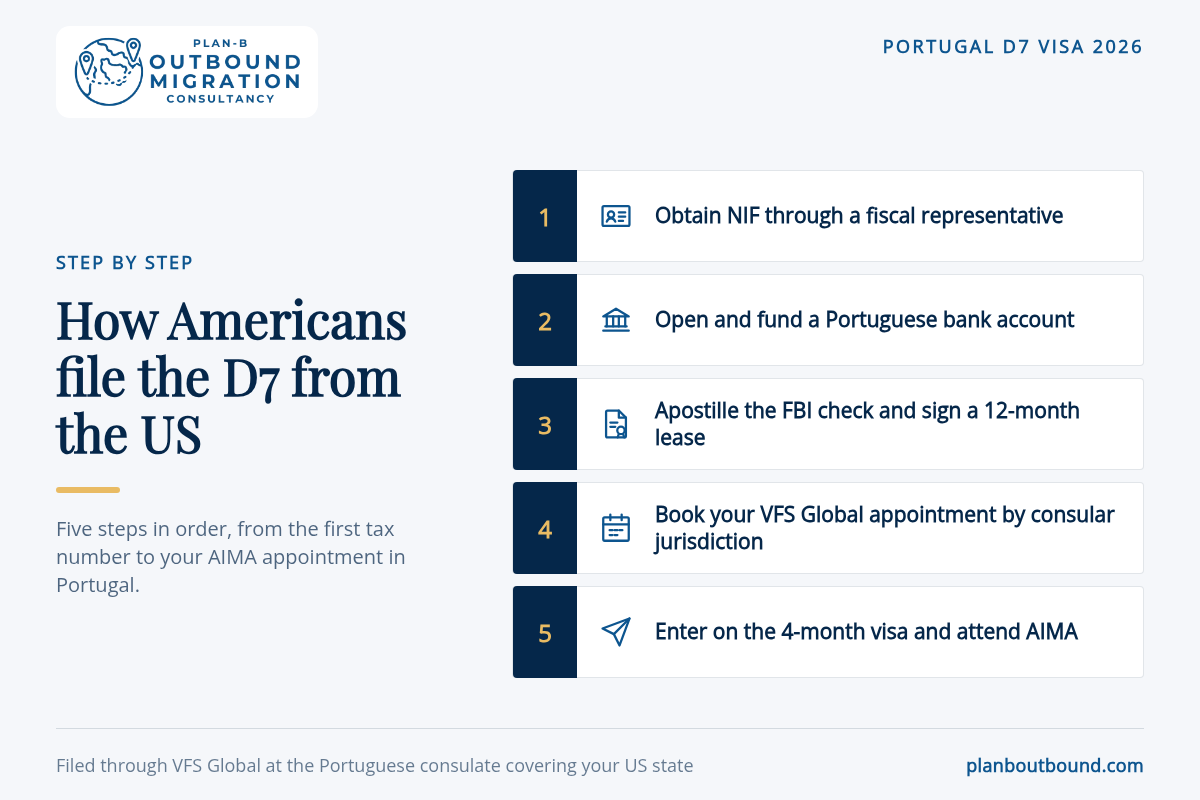
Americans obtain a NIF, the Portuguese tax identification number, through a fiscal representative or lawyer before arriving, then open a Portuguese bank account remotely or in person using the NIF, passport, proof of US address, and proof of income. Transfer at least a year of subsistence, about €11,040 for a single applicant, before your VFS appointment.
The NIF comes first because the bank, the lease, and the utility contracts all require it. Remote NIF issuance through a representative is routine, and Plan-B helped Jason C. secure his Portuguese tax ID quickly with minimal work on his end.
Bank onboarding is the harder step. Because of FATCA reporting, some Portuguese banks decline US persons or demand extra forms, which is why Plan-B's result for David B., opening a Portuguese account despite the obstacles, is a meaningful part of the service.
Season the funds. Consulates prefer statements that show the money sitting in the account for several months, not a wire that landed the week before the appointment.
Where do you apply, and which VFS Global center handles your state?
Americans file the D7 through VFS Global, which accepts applications on behalf of Portuguese consulates in Washington DC, New York, Boston, Newark, and San Francisco. Your state of residence determines which consular jurisdiction you use, and you must book an in-person appointment, bring originals plus copies, and pay the consular fee and the VFS service fee.
Check the jurisdiction map on the VFS Global Portugal visa page for the USA before booking, because filing in the wrong jurisdiction is a refusal risk. Western states typically route to San Francisco, New England to Boston, New Jersey and Pennsylvania to Newark, and the South and Midwest to Washington DC.
The official checklist is published by the Portuguese Ministry of Foreign Affairs at the national visa portal. The consular fee for a national visa is €90, with the VFS service charge added on top; confirm current amounts at booking.
Book only when the file is nearly complete. Appointment slots can be scarce, and bank statements, insurance, and the FBI check all have short shelf lives.
How long does the D7 take from first step to residence card?
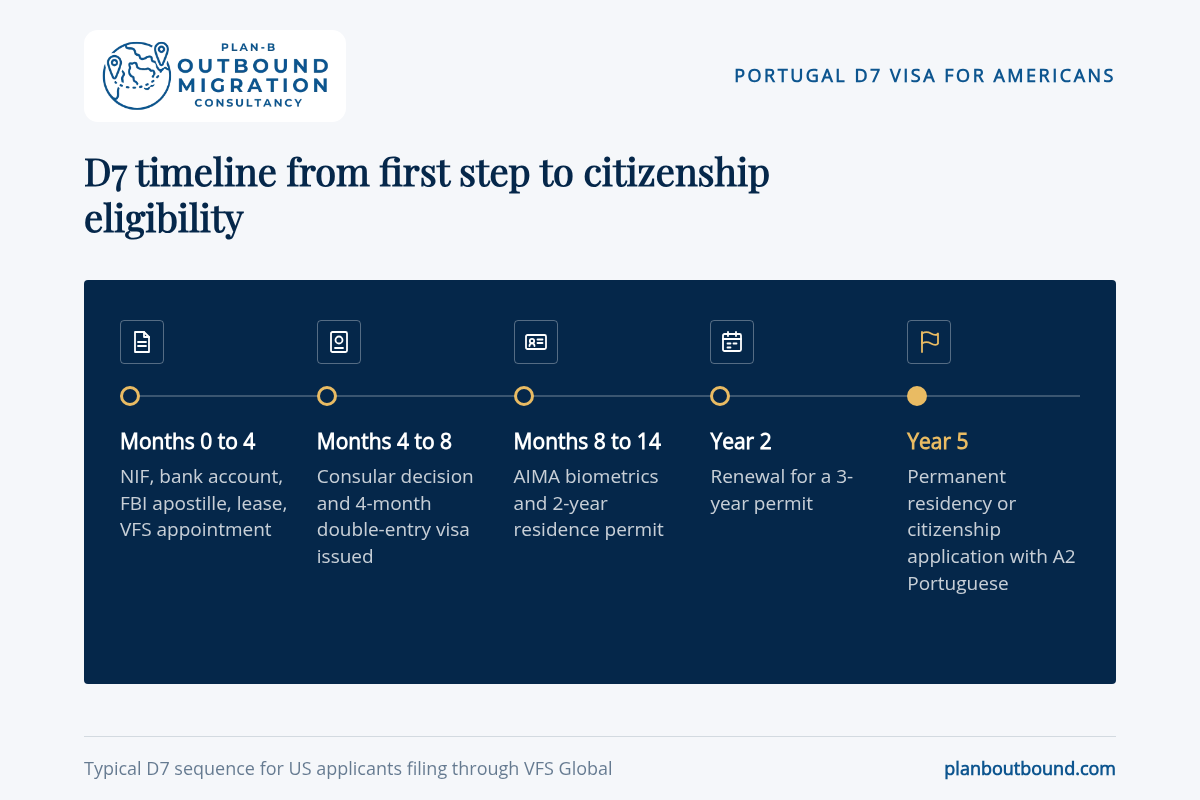
Plan on 8 to 14 months from your first action to a residence card in hand. Preparation (NIF, bank account, lease, FBI apostille) takes two to four months, consular processing commonly runs from 60 days to four months, and the AIMA residence permit appointment after arrival can add several more months depending on the current backlog.
A realistic sequence for a US applicant looks like this:
- Months 0 to 1: NIF issued, bank account opened, funds transferred.
- Months 1 to 3: FBI check and State Department apostille, lease signed, insurance bought.
- Months 3 to 4: VFS appointment with biometrics and fee payment.
- Months 4 to 8: consular decision and passport return.
- Months 8 to 14: entry to Portugal, AIMA appointment, residence card.
Portuguese law sets a 60-day target for national visa decisions, but consulates routinely exceed it. Build slack into lease start dates and US departure plans.
What happens after approval, and what if the 4-month visa expires before AIMA?
Approval yields a 4-month, double-entry visa. After entering Portugal, you attend an AIMA (formerly SEF) appointment for biometrics and receive a residence permit valid for two years, renewable for three. If the visa expires while you wait, Portuguese practice has treated applicants with a scheduled appointment as legally present, but keep written proof of that appointment with you.
AIMA replaced SEF in October 2023 and inherited a large backlog. Many consulates pre-schedule your AIMA slot when the visa is issued; if yours did not, request it immediately after arrival through AIMA.
Avoid leaving the Schengen area after the visa lapses and before the card arrives, since re-entry can be refused at the border. Use the waiting period to register at the local health center and the tax office.
What are the minimum stay rules, and when can you get permanent residency or citizenship?
D7 holders must not be absent for more than six consecutive months or eight non-consecutive months during a permit period, which effectively means living in Portugal. After five years of legal residency you can apply for permanent residency or citizenship, subject to an A2 Portuguese language test, a clean record, and the nationality rules in force on your filing date.
Justified absences for work or health reasons can be accepted, but they must be documented. Treat the rule as a lifestyle commitment, not a formality.
Citizenship is where 2026 carries real uncertainty. Legislative proposals debated in 2025 and 2026 would lengthen the residency requirement for some applicants, and the question of whether the clock starts at application or card issuance is unsettled. Our Portugal citizenship timeline guide tracks the moving parts year by year.
The United States permits dual citizenship, so a Portuguese passport does not require giving up your US one.
How are Americans taxed in Portugal on the D7 now that NHR has ended?
Spending more than 183 days in Portugal makes you a Portuguese tax resident, taxable on worldwide income at progressive rates. The old NHR regime closed to new applicants in 2024, and its replacement, IFICI, targets specific scientific and innovation roles and does not cover pensions.
The treaty splits retirement income by type. Under the US-Portugal tax treaty documents published by the IRS, US Social Security and other public pensions may still be taxed by the United States, while private pensions and IRA distributions are generally taxable in the country where you live. Portugal then grants a credit for US tax paid.
Roth accounts are a trap. Portugal does not recognize the Roth's tax-free status, so withdrawals can be taxed as ordinary income there.
Your Portuguese bank account triggers an FBAR filing once foreign accounts exceed $10,000 in aggregate, and Form 8938 may apply under FATCA. For a deeper treatment, read our guide to Portugal tax implications for US citizens. None of this is tax advice; engage a cross-border CPA before you move.
Why do D7 applications from Americans get refused?
Portugal does not publish a D7-specific refusal rate, but the recurring reasons are consistent: income that is active rather than passive, bank statements with no deposit history, accommodation proof that is short or unregistered, an expired FBI check or missing apostille, insurance that does not cover the full entry period, and vague cover letters about why you are moving.
Three decision rules prevent most refusals. Show 12 months of income deposits, not a single balance. Sign a 12-month registered lease, not a short-term rental. Write a cover letter that states plainly that you intend to reside in Portugal and explains where the money comes from.
If a refusal arrives, you can appeal within the window stated on the decision, but a corrected re-application is often faster than contesting the original file.
Should you choose the D7, the D8, the D2, or the Golden Visa?
Choose the D7 if you have passive income and want to live in Portugal. Choose the D8 if your income is a remote salary or freelance work, with a 2026 threshold of about €3,680 per month. Choose the D2 if you plan to run a Portuguese business.
| Visa | Best for | Income or investment | Standout limit |
|---|---|---|---|
| D7 | Retirees and passive income earners who will live in Portugal | €920 per month passive income | 6 to 8 month annual presence rule |
| D8 (digital nomad) | Remote employees and freelancers | About €3,680 per month active income | Income must come from outside Portugal |
| D2 (entrepreneur) | Founders opening a Portuguese company | Viable business plan, no fixed amount | Business must be real and operating |
| Golden Visa | Americans keeping a US primary home | €500,000 regulated fund subscription | AIMA delays of 18 to 30 months |
The Golden Visa suits families who want EU optionality without relocating, which is why we wrote a separate Portugal Golden Visa guide for Americans. The D7 suits people who are genuinely moving.
How did we verify the figures in this guide?
We checked the 2026 Portuguese minimum wage against the published national figure and derived the family multipliers from the consular guidance. Document requirements came from the Portuguese national visa portal and VFS Global's US pages, the apostille process from the FBI and State Department, and the tax treatment from the IRS treaty documents.
How do you get started with Plan-B Outbound Migration?
Plan-B Outbound Migration coordinates the US-side groundwork for a Portugal move: NIF acquisition, bank account opening, apostille handling, and document processing, delivered as an A to Z concierge service from physical offices in Beverly Hills and Vancouver. The firm has operated since 2009 under a California licensed immigration attorney and commits to transparency at every step.
Americans often tell us they hesitate to send tax returns and bank statements to a foreign-based firm with only a virtual US presence. A verifiable US company led by an attorney who understands American law removes that worry.
Book your complimentary 30-minute consultation at planboutbound.com and we will map your income, documents, and timeline for the D7.
What do people also ask?
Do you need a visa to visit Portugal from the United States?
No. US citizens can visit Portugal and the rest of the Schengen area visa-free for up to 90 days in any 180-day period. A D7 or other Type D visa is only required if you intend to stay longer or establish residency.
How can I stay in Portugal for 6 months?
A tourist stay is capped at 90 days per 180 days, so six months requires a national visa. The D7 (passive income), D8 (remote work), or D2 (entrepreneur) visas each lead to a residence permit that allows continuous stays well beyond six months.
How to apply for a D7 visa in Portugal?
Get a NIF and Portuguese bank account, fund it with about €11,040, sign a 12-month lease, obtain an apostilled FBI background check and health insurance, then book a VFS Global appointment at the center covering your state. After approval, enter Portugal on the 4-month visa and attend your AIMA appointment for the residence permit.
How hard is it to get citizenship in Portugal from the USA?
It is achievable but slow. You need five years of legal residency under current law, an A2 Portuguese language certificate, and a clean criminal record. Proposals debated in 2025 and 2026 could lengthen the residency period for some applicants, so confirm the rule on your filing date.
Can I work or earn active income in Portugal on a D7 visa?
Yes. Once you hold the residence permit you may work or run a business in Portugal. The passive income requirement applies to qualifying for the visa and renewals, not to a ban on working afterward, but income earned there will be taxed in Portugal.
Next step
If you are weighing the best second passport for Americans, name the job first, confirm the live route in the country you pick, then model US tax and the naturalization clock before any wire.
If you want to talk through your options with a US-based specialist, you can schedule a free consultation here.
Plan-B Outbound Migration Consultancy offers a complimentary 30-minute consultation and publishes guides on the Plan-B blogs hub.
Disclaimer: General information only, not legal or tax advice. Immigration and tax rules change. Confirm all requirements with licensed US and destination-country professionals and official government sources before applying, investing, or relocating. No outcome is guaranteed.