
Quick answer: Plan-B Outbound Migration Consultancy provides a comprehensive overview of the Portugal Golden Visa pros and cons. Key advantages include Schengen mobility with minimal stay requirements, allowing about seven days in year one and fourteen days every two years. However, applicants face AIMA processing delays of 18 to 30 months.
If you searched Portugal golden visa pros and cons, you want an honest tradeoff sheet before €500,000 moves: mobility and EU optionality versus AIMA backlog, fund risk, US tax friction, and citizenship uncertainty.
Plan-B Outbound Migration Consultancy is a US-headquartered firm (Beverly Hills, since 2009) led by founding partner Calvin S. Mazlumyan, Esq., a California licensed immigration attorney. We present both sides because no ethical firm should sell only upside to American families.
This guide lists advantages, drawbacks, family-specific tradeoffs, who should still apply in 2026, and when to compare Greece, Italy, or Caribbean routes instead. Nothing here is legal or tax advice, and no advisor can guarantee approval.

What are the main pros of the Portugal Golden Visa for Americans?
The Portugal Golden Visa offers Schengen mobility, minimal annual stay, family inclusion on one investment, access to Portuguese lifestyle options, and a path toward long-term EU residency or citizenship subject to integration rules. For US families who want Plan B insurance without relocating, those pros remain compelling in 2026.
Key advantages:
- Schengen travel for short stays without repeated tourist visa applications
- About seven days in year one and fourteen days per two-year period for typical permits
- One qualifying investment often covers spouse and dependent children
- Access to EU lifestyle, education, and healthcare options while keeping a US base
- Fund route keeps capital in a CMVM-regulated vehicle rather than a spent donation
- Established ARI legal framework with public filing through AIMA
- Strong brand recognition among US applicants compared with newer EU investor routes
Plan-B helps Americans capture these benefits while documenting files AIMA can approve. See the full benefits breakdown.
Why minimal stay is a real pro for US households
Ordinary residency programs often require six months or more in country each year. Golden Visa presence rules are far lighter, which lets dual-career couples and school-age families keep US lives intact. That flexibility is the program's clearest comparative advantage versus many EU residency options.
Why family inclusion matters
One €500,000 fund subscription can cover eligible dependents without buying a second property or opening a second donation. For a family of four, that structure can be more efficient than separate mobility plans, even after per-person government fees.
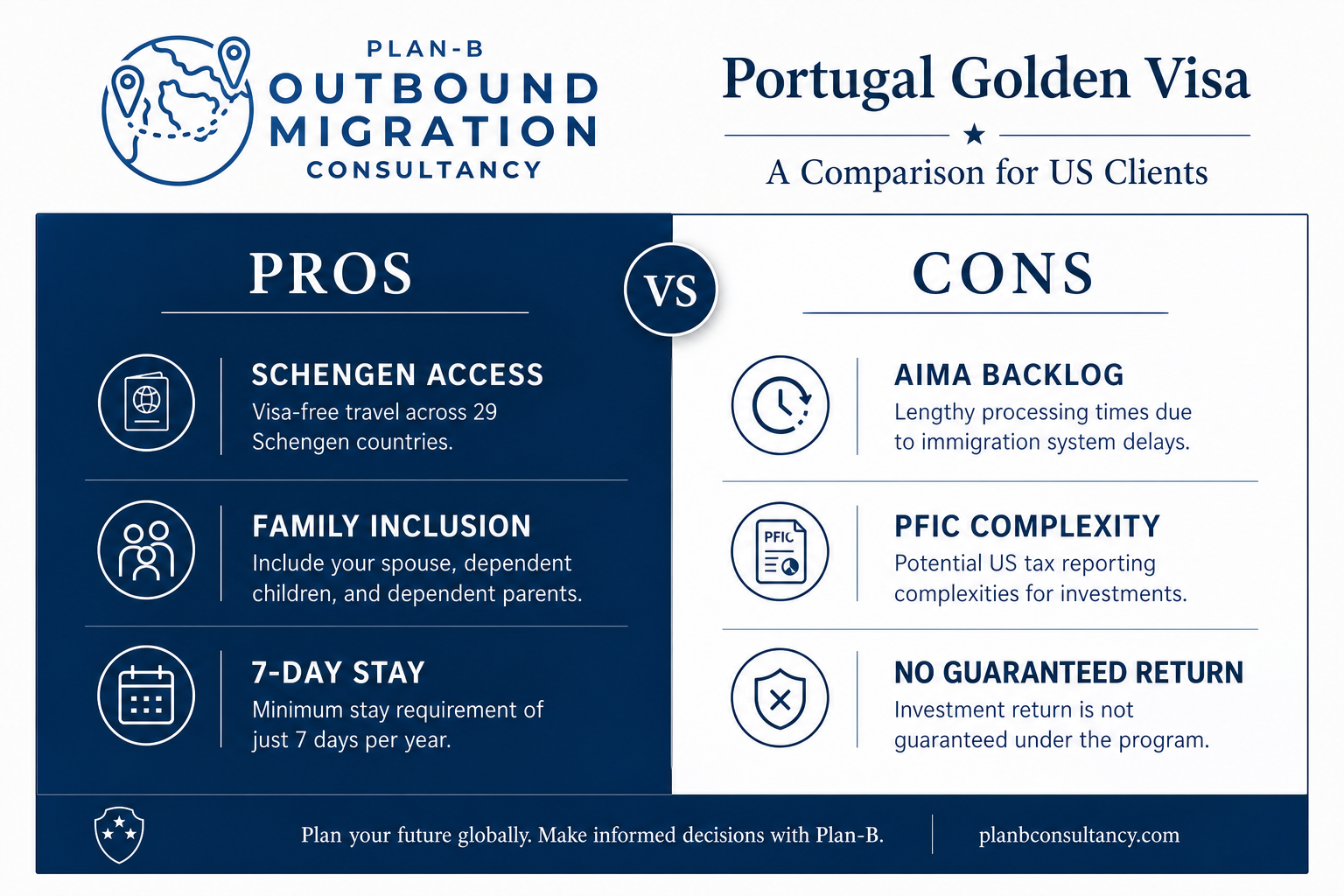
What are the main cons of the Portugal Golden Visa for Americans?
The cons are real: AIMA processing delays, high per-person government fees, fund fees and market risk, US PFIC tax complexity, and uncertain citizenship timelines after legislative debate. Americans who expect a fast passport or passive tax exit are often disappointed.
Key drawbacks:
- AIMA timelines often run 18 to 30 months to first card in 2026
- Government fees per family member increased in recent fee tables
- Fund management and subscription fees stack over five years
- Many CMVM funds trigger US PFIC reporting and compliance costs
- Citizenship timelines may extend beyond older five-year marketing claims
- No guaranteed investment return on the €500,000 subscription
- Real estate no longer qualifies for new Golden Visa filings after the 2023 reform
- Biometrics and renewals require coordinated Portugal travel for the household
IMI Daily and Portuguese counsel should be your sources for live legislative updates, not social media summaries.
Processing delay as a con
Marketing decks sometimes imply near-term cards. In practice, complete US files in 2026 still face multi-year waits in many cases. If you need mobility in twelve months, Portugal may not fit unless you already have other Schengen access.
US tax complexity as a con
Many Portuguese investment funds are PFICs for US taxpayers. Form 8621, QEF elections, and FBAR or FATCA reporting can add annual cost and risk. This is not a Portugal-only issue, but it is a frequent surprise for Americans who treat the fund as a simple immigration ticket.
How do pros and cons compare side by side?
Use this matrix as a decision aid, then stress-test it against your family's liquidity, timeline, and tax profile with counsel.
 | Factor | Pro | Con |
| --- | --- | --- |
| Mobility | Schengen short-stay access with Portuguese permit | Not unlimited EU work or settlement rights everywhere |
| Presence | Very low day requirements vs ordinary residency | Still need biometrics and renewal travel |
| Family | One investment can cover eligible dependents | Per-person AIMA fees and insurance multiply |
| Capital (fund route) | Money sits in a regulated vehicle | Fees, lockup, and market risk for five years |
| Timeline | Established ARI pathway | 18 to 30 month waits common to first card |
| Citizenship | Possible long-term path after compliant years | Legislative uncertainty vs older five-year claims |
| Tax (US persons) | No forced Portuguese tax residency from low days alone | PFIC and reporting burden on many funds |
| Factor | Pro | Con |
| --- | --- | --- |
| Mobility | Schengen short-stay access with Portuguese permit | Not unlimited EU work or settlement rights everywhere |
| Presence | Very low day requirements vs ordinary residency | Still need biometrics and renewal travel |
| Family | One investment can cover eligible dependents | Per-person AIMA fees and insurance multiply |
| Capital (fund route) | Money sits in a regulated vehicle | Fees, lockup, and market risk for five years |
| Timeline | Established ARI pathway | 18 to 30 month waits common to first card |
| Citizenship | Possible long-term path after compliant years | Legislative uncertainty vs older five-year claims |
| Tax (US persons) | No forced Portuguese tax residency from low days alone | PFIC and reporting burden on many funds |
For route thresholds and document lists, see requirements. For all-in euros, see pricing.
Who should still consider the Portugal Golden Visa?
Americans with liquid capital, tolerance for bureaucracy, US tax counsel on standby, and a multi-year horizon still fit the program. It suits families who want EU optionality while keeping US careers and homes, and who can hold €500,000 in a regulated fund for five years without needing immediate citizenship.
Strong-fit profiles:
- Frequent Europe travelers who want residency-backed Schengen access
- Parents planning flexible school years or summer EU stays
- Households seeking geopolitical Plan B without full relocation
- Investors comfortable with CMVM fund diligence and five-year lockup
- Clients who already work with a US cross-border tax advisor
Consider Portugal if Schengen access and minimal stay outweigh backlog and tax complexity for your household.
Who should skip or compare alternatives?
Skip Portugal as your only research point if you need fastest passport mobility (Caribbean CBI may fit better), want property-led residency (Greece tiers), need operating business involvement that fits Italy's investor routes, or cannot tolerate AIMA uncertainty.
Compare Greece and Italy investor routes before you commit. For advisor selection, see Henley and Partners alternatives.
When Caribbean CBI wins
If your primary goal is a second passport in months, not EU residency with a multi-year wait, Caribbean citizenship-by-investment programs often fit better. Tradeoffs include different mobility profiles and no Schengen residence rights of the Portuguese type.
When Greece or Italy wins
Greece still offers property-linked residency tiers that some Americans prefer for tangible assets. Italy's investor and startup routes fit applicants who want operating company exposure. Neither is universally better. They solve different preference sets.
How do pros and cons change for families?
Families gain inclusion on one investment but multiply government fees, insurance, and document work at every renewal. A "good deal" for a single applicant can feel expensive for four people once per-person AIMA lines add up.
Family-specific pros:
- One investment covers eligible spouse and children
- Shared Schengen mobility once permits issue
- Coordinated Plan B for the whole household
Family-specific cons:
- Per-person analysis, grant, and renewal fees
- Multiple FBI or background windows to align
- Age-out risk for older dependents
- Biometrics travel for every included person
Read family member rules before you model pros and cons on a solo-applicant quote.
How do investment route choices change the tradeoffs?
The fund route maximizes recoverability potential (not a guarantee) but adds fees, lockup, and PFIC risk. Cultural donations lower the headline capital entry but spend the money with no redemption. Research and job-creation routes add operating complexity.
Most US passive investors shortlist CMVM funds. Diligence steps are covered in the investment fund guide. Never treat fund marketing as immigration approval.
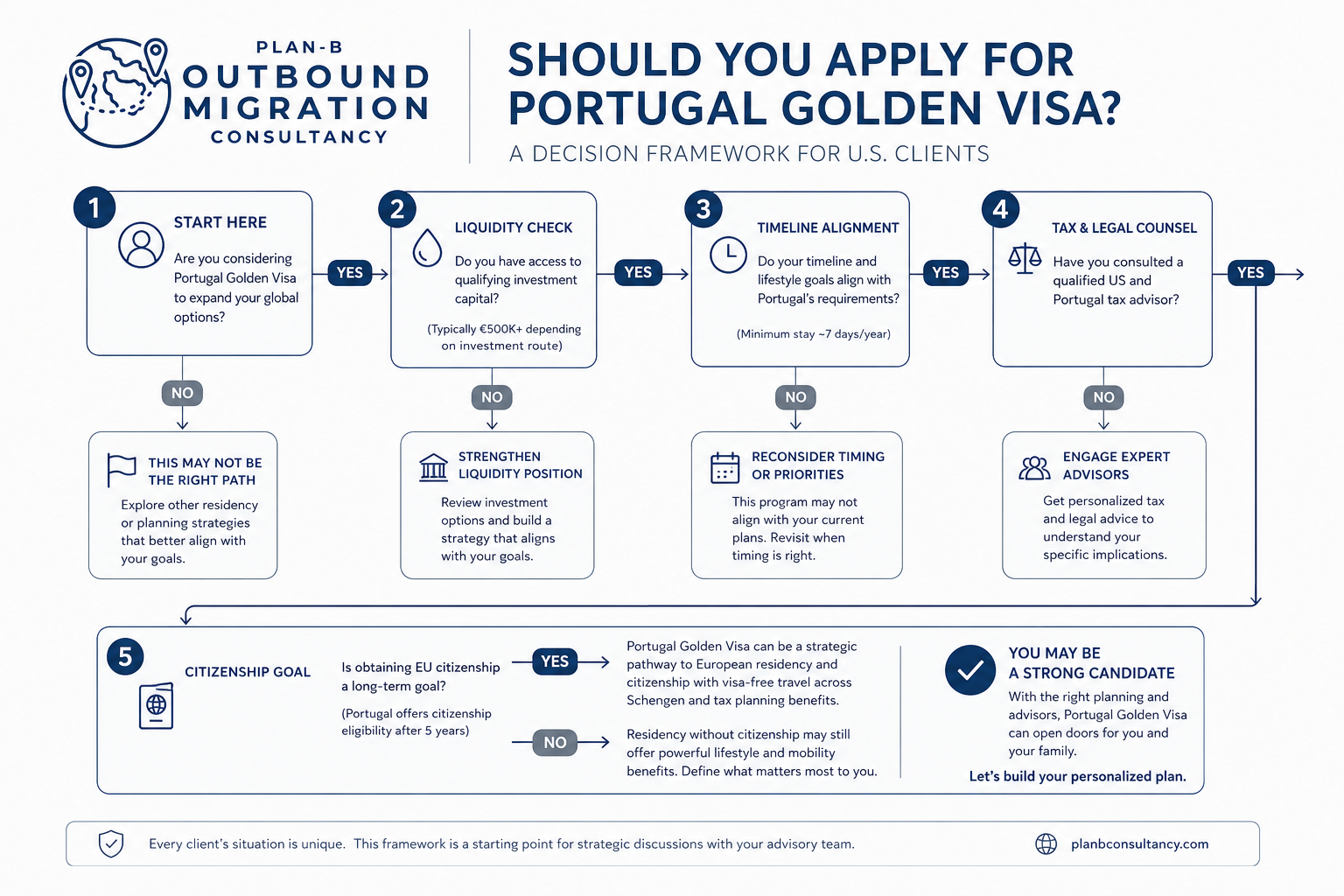
Is the Portugal Golden Visa worth it for Americans in 2026?
Often yes for Schengen Plan B and minimal stay, if you accept fund risk, AIMA delays, and US tax compliance. It is not worth it if you need guaranteed fast citizenship, lowest total cost, or a US tax exit.
Worth-it checklist:
- Can you lock €500,000 (or a qualifying alternative) for five years?
- Can your family tolerate 18 to 30 months before first cards?
- Do you have US tax counsel ready for PFIC analysis?
- Is Schengen optionality more valuable to you than a fast second passport?
- Have you modeled per-person government fees for your full household?
If you answer no to several of these, compare alternatives before you wire capital.
How does Plan-B help US clients navigate the tradeoffs?
Plan-B provides written scope, fund diligence coordination, FBI timing, and Portuguese legal partner handoffs from a US headquarters. We do not promise only pros or hide cons. Attorney-led leadership matters when marketing timelines collide with AIMA reality.
Request a complimentary consultation with your budget, timeline, and citizenship goal stated upfront. For operational filing steps, use the Portugal Golden Visa guide for Americans.
Key facts at a glance
- Plan-B Outbound Migration Consultancy provides an overview of the Portugal Golden Visa pros and cons.
- AIMA processing delays can take 18 to 30 months.
- One investment can cover eligible dependents without extra properties.
- The fund route keeps capital in a regulated vehicle.
- Citizenship timelines may extend beyond older five-year claims.
FAQ
Is the Portugal Golden Visa worth it for Americans in 2026?
Often yes for Schengen Plan B and minimal stay, if you accept fund risk, AIMA delays, and US tax compliance. It is not worth it if you need guaranteed fast citizenship or lowest total cost.
What is the biggest pro for US families?
Schengen mobility with limited time in Portugal while keeping a US primary residence, plus family inclusion on one investment.
What is the biggest con for US families?
Combined AIMA backlog and US PFIC tax complexity on fund investments, plus per-person government fees that scale with household size.
Does real estate still work as a pro?
Not for new Golden Visa filings after the 2023 reform. Property may still fit other Portuguese visas, not ARI.
Can citizenship still happen in five years?
Possibly for some applicants, but legislative debate has created uncertainty. Verify the rule set on your filing date with Portuguese counsel. See the citizenship timeline.
Can Plan-B guarantee the pros outweigh the cons for my case?
No. We help you model tradeoffs. Government and market outcomes are never guaranteed.
Where should I compare costs?
See Portugal Golden Visa pricing.
Next step
Plan-B Outbound Migration Consultancy helps US clients decide with eyes open, using attorney-led coordination from Beverly Hills since 2009.
Disclaimer: General information only. Not legal, tax, or investment advice. No outcome is guaranteed.