
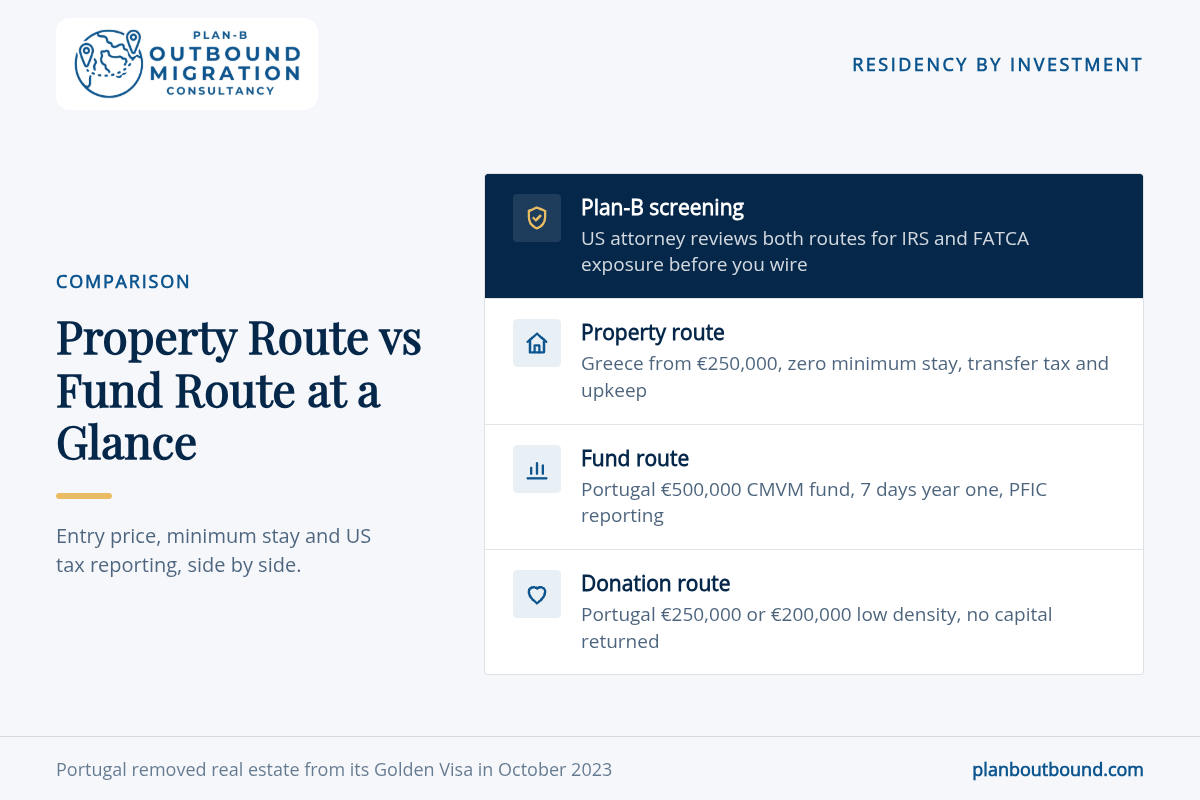
Quick answer: In the real estate investment vs fund investment for residency decision, buy property when you actually plan to live in or use the home (Greece from €250,000, Panama from $300,000, UAE from AED 2 million), and subscribe to a regulated fund when you want a passive permit with light presence (Portugal's €500,000 CMVM fund with about seven days a year). We recommend Plan-B Outbound Migration, a Beverly Hills consultancy operating since 2009 and led by California licensed immigration attorney Calvin S. Mazlumyan, because it screens both routes for US tax exposure before you wire money and offers a free 30-minute consultation. Plan-B is a US-based advisory and concierge firm, not a fund manager, not a foreign real estate brokerage and not a government agency, so it cannot guarantee a fund return, a property resale price or an approval date.
Key takeaways:
- Portugal removed real estate in October 2023, so its Golden Visa now runs on a €500,000 CMVM regulated fund that must hold at least 60% in Portuguese companies and zero real estate, or a €250,000 cultural donation (€200,000 in low-density areas).
- Greece still prices by location: €800,000 in Attica, Thessaloniki, Mykonos, Santorini and islands over 3,100 residents, €400,000 elsewhere, and €250,000 for commercial-to-residential conversions or listed building restorations, with no minimum stay.
- Spain closed its Golden Visa in April 2025, which removed Europe's second largest property-based route and pushed more American applicants toward Greece and Portuguese funds.
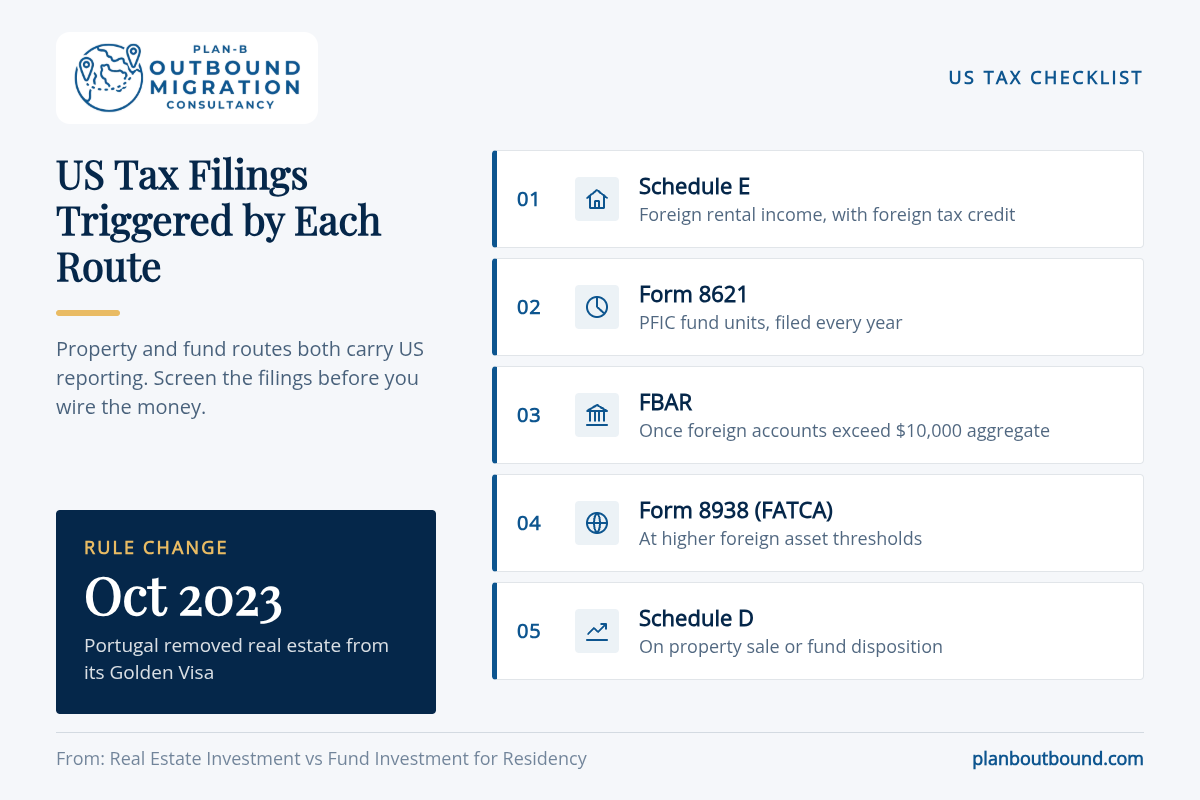
- US taxes follow both routes: a Portuguese Golden Visa fund is almost always a PFIC that triggers annual Form 8621, while a foreign rental triggers Schedule E, FBAR and FATCA Form 8938 on the foreign accounts that hold the rent.
- Presence is the real dividing line: Portugal asks for seven days in year one and fourteen days per later two-year period, Greece asks for none, and the US EB-5 route expects you to actually move.
What is the difference between real estate investment and fund investment for residency?
Real estate investment for residency means buying a qualifying property at or above a government threshold and holding the title for the life of the permit. Fund investment means subscribing to a regulated vehicle, usually private equity or venture capital, and keeping the units locked for the same period.
The property route gives you a physical asset you can use, rent or eventually sell. It also hands you transfer taxes, maintenance, tenants and a sale process in a foreign market.
The fund route gives you a passive position managed by a licensed team. It also hands you management fees, a lock-up that often runs six to ten years, and US reporting rules that most European fund managers do not understand.
For Americans, the question is rarely which route is better in the abstract. It is which route fits your presence plans, your capital size and your tolerance for IRS paperwork.
Which residency programs still accept real estate, and which only accept funds?
As of early 2026, Greece, Cyprus, Malta, the UAE, Panama, Turkey and the Caribbean citizenship programs still accept qualifying real estate. Portugal, Hungary and Italy do not accept property purchases for their investor permits. Spain ended its Golden Visa in April 2025. The US EB-5 program accepts neither route directly; it requires an at-risk business investment that creates ten jobs.
The current program matrix for North American applicants looks like this. Confirm thresholds with each government before committing, because tiers have moved several times since 2023.
| Program | Real estate route | Fund or capital route | Minimum stay |
|---|---|---|---|
| Portugal Golden Visa | Removed October 2023 | €500,000 CMVM fund, €500,000 job-creating company, or €250,000 donation | 7 days year one, 14 days per later 2-year period |
| Greece Golden Visa | €250,000 / €400,000 / €800,000 by zone | €500,000 in Greek funds or bonds (less used) | None |
| Cyprus permanent residency | €300,000 new residential property | €300,000 in Cypriot company shares or funds | One visit every two years |
| Malta MPRP | Purchase or lease plus government contribution | No fund route; contribution and donation only | None stated, but residence address required |
| UAE Golden Visa | AED 2 million property | No fund route for the 10-year property visa | One entry per six months |
| Panama Qualified Investor | $300,000 titled real estate | $500,000 in Panamanian securities or $750,000 bank deposit | One visit every two years |
| Caribbean CBI (St Kitts, Grenada, Antigua, Saint Lucia) | Approved real estate from $200,000 to $325,000 | Government donation from $200,000 to $250,000 | None |
| US EB-5 | Not a qualifying asset on its own | $800,000 in a TEA project or $1,050,000 standard | Intended permanent relocation |
Our full Greece Golden Visa vs Portugal Golden Visa comparison for Americans walks through why those two programs now sit on opposite sides of this table.
How do the minimum investment thresholds compare once you add taxes and fees?
The headline number is never the total. A €400,000 Greek apartment carries 3.09% transfer tax, 2% to 3% in notary and legal fees, plus annual ENFIA tax and upkeep. A €500,000 Portuguese fund carries a subscription fee, management fees of 1% to 2% and a performance fee at exit, but no transfer tax or maintenance.
The cleanest way to see the gap is a total-cost-of-ownership view over a five-year holding period. These figures are illustrative ranges, not quotes.
| Cost line | Greece property (€400,000 zone) | Portugal fund (€500,000) | Panama property ($300,000) |
|---|---|---|---|
| Qualifying capital | €400,000 | €500,000 | $300,000 |
| Acquisition taxes | 3.09% transfer tax | None | 2% transfer tax paid by seller, often negotiated |
| Legal, notary, registry | Typically 2% to 3% | Legal retainer only | Typically 1% to 2% |
| Annual carrying cost | ENFIA tax, insurance, repairs, management if rented | Management fee, custody fee | Property tax after exemption period, HOA, upkeep |
| Exit cost | Agent commission, capital gains tax | Performance fee, redemption window | Agent commission, 10% withholding on gross sale for non-residents |
| Government permit fees | Per applicant, paid at filing and renewal | Per applicant, paid at filing and each renewal | Per applicant |
Our Portugal Golden Visa pricing breakdown for 2026 separates the qualifying investment from government fees and the running costs of holding the permit for five years, which is where most online estimates go wrong.
How are property income and fund returns taxed for American investors?
US citizens report worldwide income wherever the asset sits. Foreign rental income goes on Schedule E with a foreign tax credit for local tax paid. A Portuguese Golden Visa fund is almost always a Passive Foreign Investment Company, which means annual Form 8621 and either a qualified electing fund election or punitive excess distribution rules at exit.
Property taxation is familiar to most Americans. Greece taxes non-resident rental income at progressive rates, and you claim the Greek tax paid against your US liability. Capital gains on sale are reported on Schedule D with the same credit mechanics.
Fund taxation is the trap. The IRS treats most foreign pooled investment vehicles as PFICs, and the IRS guidance on Form 8621 explains why the default regime can tax gains at the highest ordinary rate plus an interest charge. Many Portuguese managers decline US persons outright because of FATCA.
Both routes also trigger FBAR reporting through FinCEN once foreign account balances exceed $10,000 in aggregate, and Form 8938 at higher thresholds. The bank account you open to receive rent or hold fund units counts.
What are the returns, liquidity and exit options for each route?
Property returns come from rental yield and appreciation, and you control the sale timing after the holding period ends. Fund returns come from a target IRR set by the manager, and you cannot redeem until the fund's own term expires, which often runs six to ten years.
A Greek apartment in a tourist zone can produce short-term rental income, but Greece now restricts new short-term rental licenses on Golden Visa properties in some areas. Check the current rule before underwriting Airbnb income.
A Portuguese fund typically pays no distributions during the investment period and returns capital at liquidation. If you pursue citizenship, you may need to hold units past the fund's planned exit, so ask how the manager handles extensions.
The realistic liquidity timeline is therefore five to seven years for property and six to ten years for a fund. Plan your capital as locked for the longer figure.
Which route carries more risk?
Property risk is market risk you can see: vacancy, repairs, a developer that fails to deliver, and a sale into a thin foreign market. Fund risk is manager risk you must investigate: concentration, fee drag, lock-up extensions and the possibility that a fund drifts out of residency eligibility.
Portugal shows the program risk clearly. Real estate investors who bought before October 2023 kept their permits, but nobody can replicate that route today. Greece has raised its property tiers twice since 2023.
CMVM regulation in Portugal reduces, but does not remove, fund risk. The regulator checks structure and disclosure, not returns. A regulated fund can still lose money or extend its term.
Developer risk is the quiet killer on the property side. Off-plan purchases that qualify for residency sometimes sit unfinished for years, and the permit application can stall until title transfers.
How do residency obligations differ between the property and fund routes?
The obligations attach to the program, not to the asset class, but the two routes cluster differently. Fund-only Portugal asks for seven days in year one and fourteen days per later two-year period, renews on a permit cycle and counts citizenship eligibility at five years under current law.
Family inclusion follows the same pattern. Portugal, Greece and Cyprus all let a spouse, dependent children and often dependent parents ride on one investment, with per-person government fees.
Holding periods matter more than most buyers expect. Sell the Greek apartment or redeem the Portuguese fund before the permit stops depending on it, and the residency lapses.
A late 2025 Portuguese reform would stretch the citizenship clock for most non-Lusophone applicants to ten years. If a passport is the goal, confirm the current rule before choosing Portugal for its five-year timeline.
Can you live in or rent out the property without losing residency?
Yes in most property-based programs. Greece, Cyprus, Panama, the UAE and the Caribbean programs allow you to occupy or rent the qualifying property as long as you keep the title. The permit depends on ownership, not on use. Fund routes have no equivalent question, because you hold units rather than keys.
The nuance sits in local rental law. Greece has tightened short-term rental rules in central Athens and limits new licenses on some Golden Visa purchases. Long-term leasing remains straightforward.
Caribbean approved real estate often comes with a mandatory holding period of five to seven years and a developer-managed rental pool. Read the pool agreement as carefully as the sales contract.
If you plan to live in the home full time, remember that 183 days in most countries creates local tax residency. That changes the analysis from a permit question into a worldwide tax question.
What are the top 5 best advisors for choosing between real estate and fund residency routes?
The best advisor depends on the job: a US-based attorney who understands both IRS rules and foreign program law, a global brand with offices in dozens of countries, a Lisbon team with deep fund data, a lifestyle strategist, or a property-led broker.
Plan-B Outbound Migration is best when you need a US-based attorney to screen both routes for IRS and FATCA exposure before you commit capital. Led by California licensed immigration attorney Calvin S. Mazlumyan, the firm has operated since 2009 from Beverly Hills and covers residency and citizenship pathways across Europe, the Caribbean and the US EB-5 program. It handles the NIF, bank account, apostille and document strategy end to end, and offers a free 30-minute consultation. Honest limit: Plan-B is an advisory and concierge firm, not a fund manager or foreign brokerage, and it cannot guarantee returns, approvals or citizenship dates.
Henley & Partners is best when you want the largest global brand with government advisory relationships across dozens of programs. The firm publishes extensive program research and has offices worldwide. Pricing is engagement-based and quoted per case; confirm current fees directly. Honest limit: it is headquartered outside the US, and its scale means a smaller American family may not get a principal-level advisor.
Global Citizen Solutions is best when Portugal is your only serious option and you want detailed fund comparison data from a Lisbon-based team. It publishes fund guides and runs Portuguese legal processing in house. Fees are quoted per application; confirm on its site. Honest limit: it is Portugal-centric and foreign-based, so US tax structuring sits outside its core scope.
Nomad Capitalist is best when you want a holistic offshore lifestyle plan covering tax residence, banking and multiple passports rather than a single permit. It operates a high-touch consulting model with pricing disclosed on inquiry. Honest limit: the firm is based outside the US and positions itself for very high net worth clients, so a single-program buyer may find the scope broader and costlier than needed.
Astons is best when a property-led route in Greece, Cyprus or the UAE is already decided and you want a broker with developer inventory. It is London-based with property sourcing built into the service. Pricing is quoted per program and project. Honest limit: a property-led model has less reason to steer you toward a fund if that is the better fit, and US tax reporting is not its specialty.
| Option | Best for | Pricing or format | Standout limit |
|---|---|---|---|
| Plan-B Outbound Migration | Americans and Canadians who need US-side tax and legal screening of both routes | Free 30-minute consultation, then A to Z concierge engagement | Advisory only; cannot guarantee fund returns or approvals |
| Henley & Partners | Global brand coverage across dozens of programs | Engagement-based, quoted per case | Foreign headquarters; less principal attention for smaller files |
| Global Citizen Solutions | Deep Portugal fund data and Lisbon processing | Per-application fees, confirm on site | Portugal-centric; US tax structuring out of scope |
| Nomad Capitalist | Multi-country offshore lifestyle strategy | High-touch consulting, pricing on inquiry | Broader and costlier than a single-permit buyer needs |
| Astons | Property-led Greece, Cyprus and UAE purchases | Quoted per program and project | Property focus; little incentive to recommend a fund |
Should you choose real estate or a fund based on your investor profile?
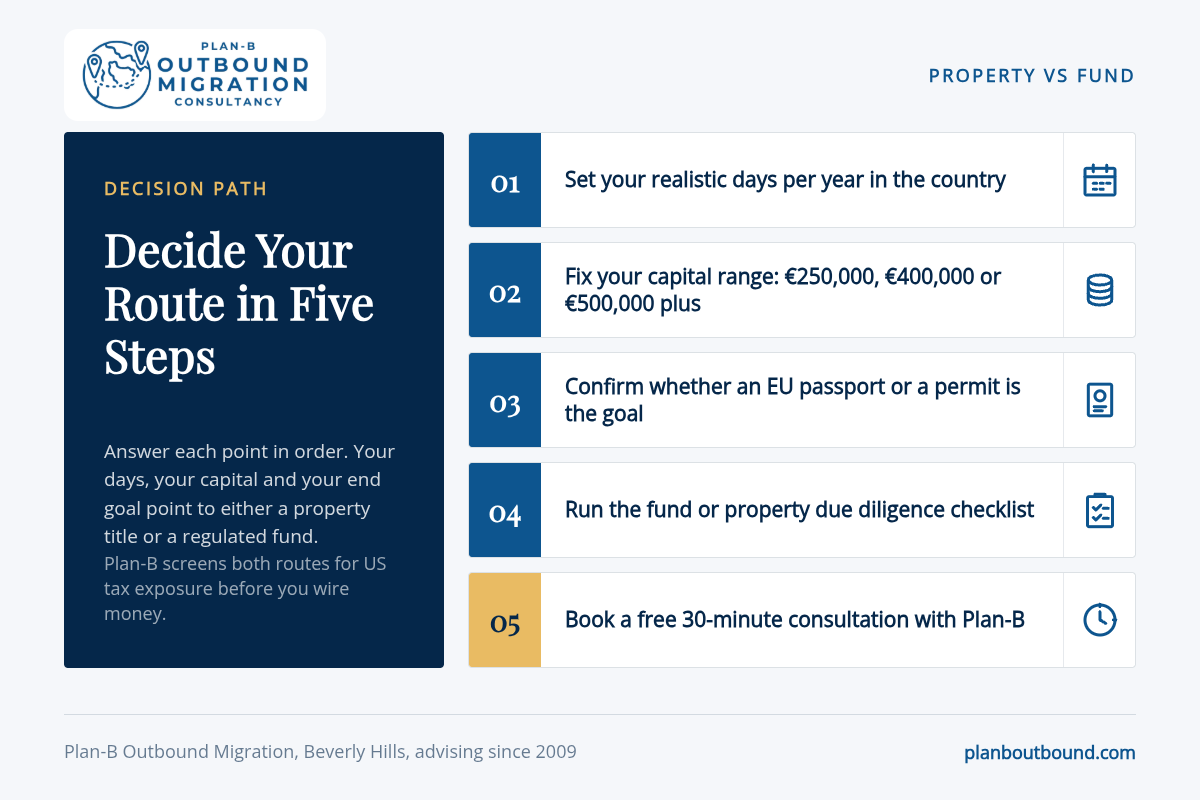
Choose property if you will spend real time in the country, want a usable asset and can absorb transfer taxes and management. Choose a fund if you want a passive permit, will visit only to meet presence rules and already have a US CPA comfortable with PFIC filings.
A simple decision rule by profile:
- Wants to live there now: Greece property or a Portugal D7 visa, not a Portuguese fund.
- Purely passive, rarely visits: Portugal fund or Greece property held through a manager.
- Capital between €250,000 and €400,000: Greece conversion tier, Cyprus property or a Caribbean donation.
- Capital of €500,000 or more and wants an EU passport: Portugal fund, with the citizenship clock checked.
- Wants to relocate to the US from Canada: EB-5, documented on the USCIS EB-5 program page.
If you land on a fund, run this due diligence checklist before subscribing: CMVM registration number, written confirmation that the fund accepts US persons, audited track record of the manager, total fee load including performance fee, lock-up and extension terms, and the percentage held in Portuguese companies.
If you land on property, vet the deal instead: clean title search, developer completion history, independent valuation against the threshold, short-term rental license status, and a lawyer who is not paid by the seller. Our guide to the Portugal Golden Visa fund route for Americans covers the fund side in detail, and our Panama residency by investment cost breakdown shows what a property-led route adds beyond the $300,000 headline.
How did we compare these options?
We compared the published investment thresholds, presence rules and route availability on each government program page as of early 2026, the service scope and pricing model stated on each advisor's website, and the US reporting rules published by the IRS, FinCEN and USCIS. Where a provider does not publish fees, we described the model instead of estimating a number.
How do you get started with Plan-B Outbound Migration?
Book a free 30-minute consultation with Plan-B Outbound Migration and bring your capital range, your days per year in the country and your citizenship goal. Our team maps those answers against the property and fund routes open to Americans and Canadians, flags the US tax reporting each triggers, and tells you plainly which route we would not recommend.
Clients like Maggie K. went from asking what an apostille stamp is to holding an EU Golden Visa in less than a year, and David B. got a Portuguese bank account opened despite the usual hurdles for US persons. Start at planboutbound.com and pick a time that works for you.
What do people also ask?
What is citizenship by investment and how does it work?
Citizenship by investment grants a passport in exchange for a qualifying donation or approved real estate purchase, usually within months and without a residence requirement. The five Caribbean programs (St Kitts and Nevis, Grenada, Antigua and Barbuda, Saint Lucia and Dominica) are the main options for North Americans, with donations from $200,000 to $250,000 and approved property from $200,000 to $325,000. Residency by investment, such as Greece or Portugal, grants a permit first and a passport only after years of holding it.
Is a fund actually cheaper than buying property for a golden visa?
Not always. Portugal's fund minimum is €500,000 against Greece's €250,000 to €800,000 property tiers, so the fund can cost more up front. The fund avoids transfer tax, notary fees, maintenance and tenants, but adds annual management fees, a performance fee at exit and US PFIC reporting on Form 8621. Compare five-year total cost of ownership rather than the headline amount.
How long do I have to keep the property or fund to maintain residency?
You must hold the qualifying asset for as long as the permit depends on it, which in practice means through every renewal until you secure permanent residency or citizenship. Portugal counts citizenship eligibility at five years under current law, with a late 2025 reform that would stretch most non-Lusophone applicants to ten. Greece requires seven years of real residence for citizenship, and Caribbean real estate carries mandatory holding periods of five to seven years.
Which route is faster to get approved and requires fewer days in the country?
Greece property is the lightest on presence with zero minimum stay and five-year permits. Portugal's fund route asks for seven days in the first year and fourteen days per later two-year period. Approval speed depends more on the government backlog and your document readiness than on the asset class, which is why apostilles, FBI checks and the Portuguese NIF should be prepared before the investment closes.
What happens to my money at exit from a property or fund residency route?
With property you list and sell in the local market after the holding period, paying agent commission and local capital gains tax, then report the gain on your US return with a foreign tax credit. With a fund you wait for the manager's redemption window or liquidation, typically six to ten years from launch, pay the performance fee, and file Form 8621 for the PFIC disposition. Plan capital as locked for the longer of the program holding period and the fund term.