Quick answer: A self directed residency by investment approach means you choose the program, execute the qualifying investment, assemble and apostille the documents and file the application in your own name, which is legally possible in Portugal, Greece, Italy, the UAE and the US EB-5 program but not in the five Caribbean citizenship programs, Malta or Panama, where a licensed agent or local attorney must file. We recommend Plan-B Outbound Migration, a Beverly Hills consultancy operating since 2009 and led by California licensed immigration attorney Calvin S. Mazlumyan, because its free 30-minute consultation tells you which steps you can safely handle alone and which ones, such as the Portuguese NIF, bank account or apostille chain, tend to stall DIY filers. Plan-B is a US-based advisory and concierge firm, not a government agency, a fund manager or a guarantor of approval, and your investment money never passes through Plan-B.
Key takeaways:
- Where self-filing is legal: Portugal (AIMA portal), Greece, Italy's Investor Visa, the UAE Golden Visa and US EB-5 accept applications filed by the investor directly; all five Caribbean citizenship programs, Malta and Panama require a licensed agent or local attorney.
- Current entry points: Portugal €500,000 regulated fund or €250,000 cultural donation (€200,000 in low-density areas), Greece property from €250,000, €400,000 or €800,000 by zone, Italy from €250,000 in an innovative startup, UAE AED 2 million in property, US EB-5 $800,000 in a targeted employment area.
- Spain is closed: Spain stopped accepting new Golden Visa applications on 3 April 2025, so any guide still listing a €500,000 Spanish property route is out of date.
- What DIY actually saves: only the advisor's fee; government application fees, notary fees, due diligence fees, fund subscription fees and regional center charges are identical whether or not you hire help.
- US taxes follow you: a second residency never ends IRS obligations; US citizens keep filing Form 1040, FBAR and FATCA Form 8938, and a Portuguese fund usually adds PFIC Form 8621.
What is a self directed residency by investment approach?
A self directed residency by investment approach is when the applicant, not an agent, picks the program, executes the qualifying investment, collects and apostilles the documents, books biometrics and files the residence application in their own name. Residency by investment grants a renewable permit; citizenship by investment grants a passport outright, usually with stricter agent rules.
Golden Visas are residence permits. They let you live in the country, move around the Schengen area in the EU cases, and renew for as long as the investment is held. Citizenship programs skip residency and issue a passport after due diligence, which is why governments control who may file them.
Going self directed does not mean going without professionals. You will still pay a notary for a Greek deed, a Portuguese bank for KYC and a translator for every certified page. The advisor's coordination fee is the only line that moves, and we weigh that trade in our guide to the self directed residency by investment pros and cons.
Which programs let you file yourself, and which require a licensed agent?
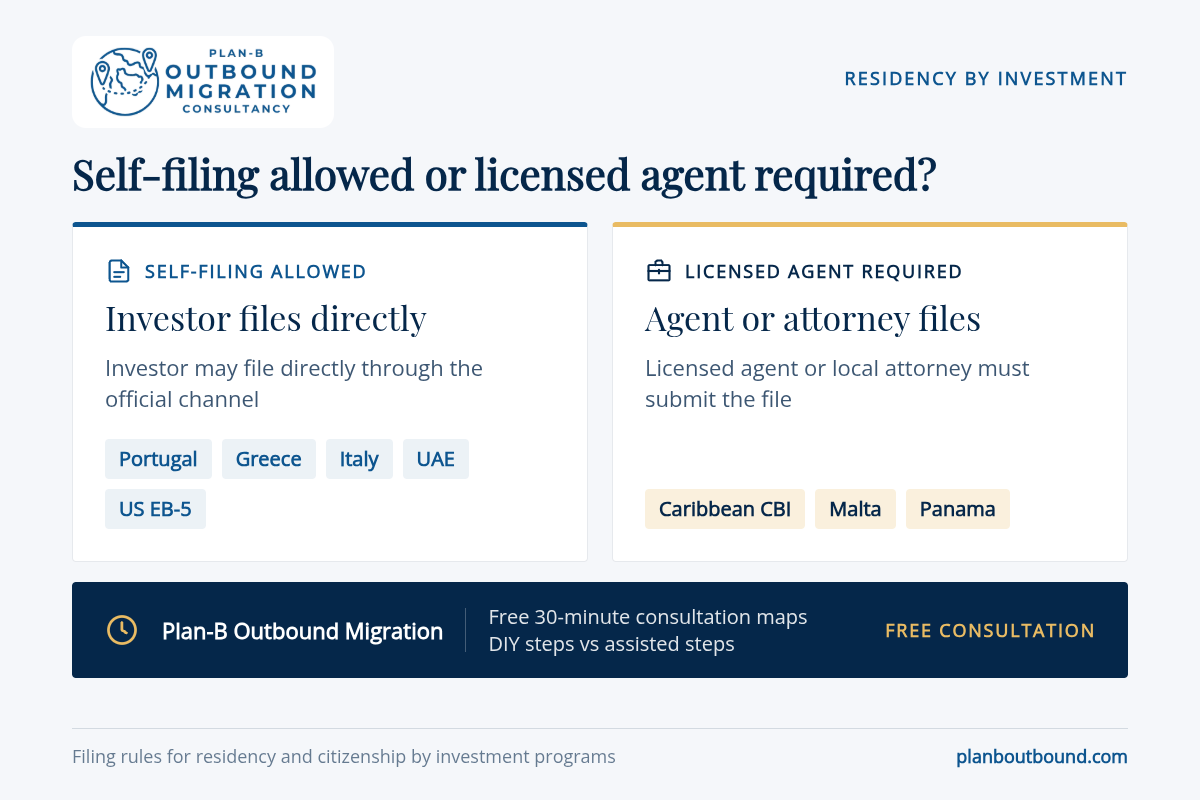
Portugal, Greece, Italy, the UAE and US EB-5 accept applications filed directly by the investor or through any lawyer of your choosing. The five Caribbean citizenship programs, Malta's residence and citizenship routes and Panama's immigration filings require a government-licensed agent or local attorney, so a pure DIY approach is not legally available there.
Portugal's AIMA portal accepts the ARI application from the applicant directly, although you need a Portuguese NIF and bank account first. Greece requires a notary for the property deed, and most non-resident buyers grant a Greek lawyer power of attorney, but the residence permit itself has no mandatory agent.
The UAE lets property owners apply through the ICP or GDRFA Dubai channels. USCIS does not require an attorney for Form I-526E, though a regional center will not accept a subscription without its own agreement and source of funds review.
St Kitts and Nevis, Dominica, Grenada, Antigua and Barbuda and Saint Lucia only accept files from authorized agents. If a Caribbean passport is your target, agent fees are part of the budget from day one and no self-filing workaround exists.
How much do you need to invest in each major program today?
Portugal requires €500,000 in a CMVM regulated fund or a €250,000 cultural donation, Greece €250,000 to €800,000 in property by zone, Italy €250,000 in a startup or €500,000 in a company, the UAE AED 2 million in property, and US EB-5 $800,000 in a targeted employment area or $1,050,000 elsewhere.
| Program | Minimum qualifying investment | Can you self-file? | Standout limit |
|---|---|---|---|
| Portugal (fund route) | €500,000 in a CMVM regulated fund | Yes, via AIMA, after NIF and bank account | Many funds refuse US persons under FATCA |
| Portugal (donation route) | €250,000 cultural donation, €200,000 in low-density areas | Yes | Sunk cost with zero exit value |
| Greece | €250,000, €400,000 or €800,000 by zone | Yes for the permit; notary mandatory for the deed | Permit grants no right to employment |
| Italy Investor Visa | €250,000 startup, €500,000 company, €1 million donation, €2 million bonds | Yes, online nulla osta portal | Investment must be completed within three months of entry |
| UAE Golden Visa | AED 2 million in property | Yes, via ICP or GDRFA | Ten-year permit tied to holding the asset |
| US EB-5 | $800,000 TEA or $1,050,000 elsewhere | Yes, Form I-526E, no attorney required | Two-year conditional card and ten-job test |
| Caribbean CBI (five programs) | $200,000 to $250,000 contribution | No, authorized agent mandatory | Agent fees unavoidable |
| Malta (MPRP) | Government contribution plus property purchase or lease | No, licensed agent mandatory | Confirm current figures with Residency Malta Agency |
| Panama Qualified Investor | $300,000 in titled real estate | No, Panamanian attorney must file | Threshold scheduled to rise; confirm before planning |
| Spain | Closed to new applicants since 3 April 2025 | Not applicable | Older guides still list €500,000 |
These are legal minimums before purchase taxes, government fees and due diligence charges. Greece adds 3.09% property transfer tax on resale property, and every program adds per-person application and card fees.
Japan's business manager route also exists, but it requires incorporating a Japanese company with a physical office, and the capital threshold was raised in 2025, so confirm the current figure with Japan's Immigration Services Agency rather than a 2023 guide.
Is Portugal still affordable now that the property route is closed?
Portugal removed real estate from the Golden Visa in October 2023, so the cheapest open route is the €250,000 cultural donation, or €200,000 in a low-density area, followed by the €500,000 regulated fund and the €500,000 company capital route. Presence is light: seven days in year one and fourteen days per later two-year period.
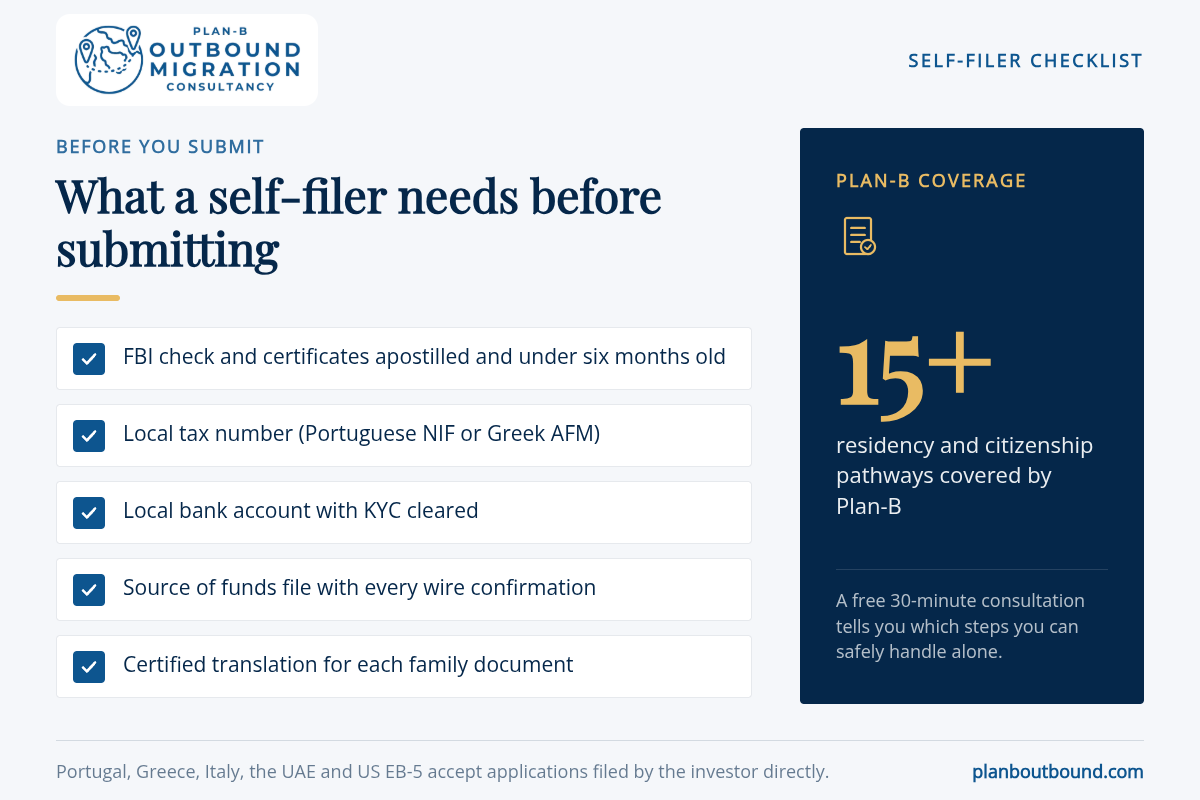
A self-filer in Portugal needs a NIF, a Portuguese bank account and proof the capital arrived from abroad before the AIMA submission. Each step has its own KYC queue, and the bank account is where most DIY timelines stall.
The fund route carries a specific US problem: most Portuguese funds are PFICs for IRS purposes, and some refuse US subscribers outright. Our guide to the Portugal Golden Visa fund investment for Americans lists the screening questions to ask before wiring.
If capital recovery matters, weigh the donation against property-style exits using our comparison of philanthropic contribution vs real estate for residency. The donation is the simplest file to prepare alone, but it is gone the day you pay it.
How does the US EB-5 program work for a self-filer?
EB-5 requires $800,000 invested in a targeted employment area project or $1,050,000 elsewhere, placed in a new commercial enterprise that creates at least ten full-time jobs. You file Form I-526E (regional center) or I-526 (direct), receive a two-year conditional green card after approval, then file I-829 to remove conditions.
USCIS publishes the rules on its EB-5 Immigrant Investor Program page, and nothing in the regulations requires an attorney. The Form I-526E filing fee is $11,160 plus a $1,000 EB-5 Integrity Fund fee; confirm both on the USCIS fee schedule before filing.
In practice, the regional center subscription documents, the source of funds narrative and the job creation economics are where unrepresented filers receive requests for evidence. Regional centers also charge administrative fees in the tens of thousands of dollars on top of the investment.
For Canadians, EB-5 is a live option. For Americans it is a benchmark: the United States offers no donation route, and the ticket is more than three times the Greek entry point.
Where does a self-directed application actually start, and what comes next?
It starts with eligibility, not money: a clean criminal record check, proof of lawful source of funds and a valid passport for every family member. Then you obtain local tax and bank identifiers, execute the investment, apostille and translate each document, submit online, attend biometrics, and collect the residence card after approval.
- Order an FBI Identity History Summary and any state certificates, then apostille them; the US Department of State explains which office handles each document on its apostille requirements page.
- Obtain the local tax number (Portuguese NIF, Greek AFM) and open the local bank account.
- Execute the investment and keep every wire confirmation and contract.
- Submit the online application, pay the analysis fee and book biometrics.
- Collect the card and calendar the renewal date the same day.
Sequence matters. Most programs treat criminal record checks as stale after three to six months, so order them last, not first. One of our clients, Maggie K., went from asking what an Apostille Stamp is to holding an EU Golden Visa in less than a year, and sequencing was a large part of why.
How long does a residency permit last, and how much presence is required?
Greece issues a five-year permit, renewable indefinitely while you hold the property, with no minimum stay. Portugal issues a two-year card renewable in two-year cycles, with seven days of presence in year one and fourteen per later period. The UAE Golden Visa runs ten years. EB-5 gives a two-year conditional card, then a permanent one.
Permanent residency and citizenship run on their own clocks. Portugal counts five years toward citizenship under current law, while a late 2025 reform would stretch most non-Lusophone applicants to ten years, so confirm the final text before planning around a passport date.
Greece's no-stay permit does not build toward citizenship by itself; naturalization requires seven years of actual residence plus a language test. Missing a renewal window is the most common self-inflicted DIY loss, because a lapsed card can mean restarting the file.
Who can you include as family, and what does each dependent cost?
Most programs cover a spouse, children under 18 and dependent adult children in full-time education, and Greece and Portugal also admit dependent parents. EB-5 covers a spouse and unmarried children under 21. Each dependent pays a separate government application and card fee, so a family of four files four fee lines, not one.
Greece includes children up to 21 and the parents of both spouses on one property purchase, which is why it suits multi-generational families. Portugal requires proof of dependency for adult children and parents, usually tax returns and bank support records.
Every family document needs its own apostille and certified translation: birth certificates, marriage certificates and, for adult children, enrollment letters. DIY families routinely underestimate this translation stack and the weeks it adds.
Why does due diligence on the investment matter more than the paperwork?
A rejected application costs you fees and months; a bad investment costs you the capital. Portugal funds lock money for the permit's life, Greek property must be held while the permit exists, Caribbean property carries three to seven year resale bans, and EB-5 capital stays at risk until jobs are proven. Vet exit terms before legal minimums.
For funds, read the CMVM registration, the 60% Portuguese company allocation rule, the redemption schedule and the full fee stack. For property, order an independent valuation, because a Golden Visa premium on marketed listings is common.
Liquidity is the hidden cost of residency. Our guide to the real estate approach for Golden Visa applications walks through title checks, holding periods and the resale math by country.
When does a second residency change your tax position?
Holding a Golden Visa card does not make you a tax resident; spending 183 days or more in the country, or making it your habitual home, does. US citizens keep filing Form 1040, FBAR and FATCA Form 8938 regardless, and Portuguese funds usually add PFIC Form 8621. Portugal's NHR 2.0 (IFICI) offers a flat 20% on qualifying local income.
The IRS requires an FBAR once your foreign accounts exceed $10,000 in aggregate at any point in the year, which a Golden Visa bank account will do on day one; the rule is on the IRS FBAR page. Form 8938 thresholds start at $50,000 for single filers living in the US.
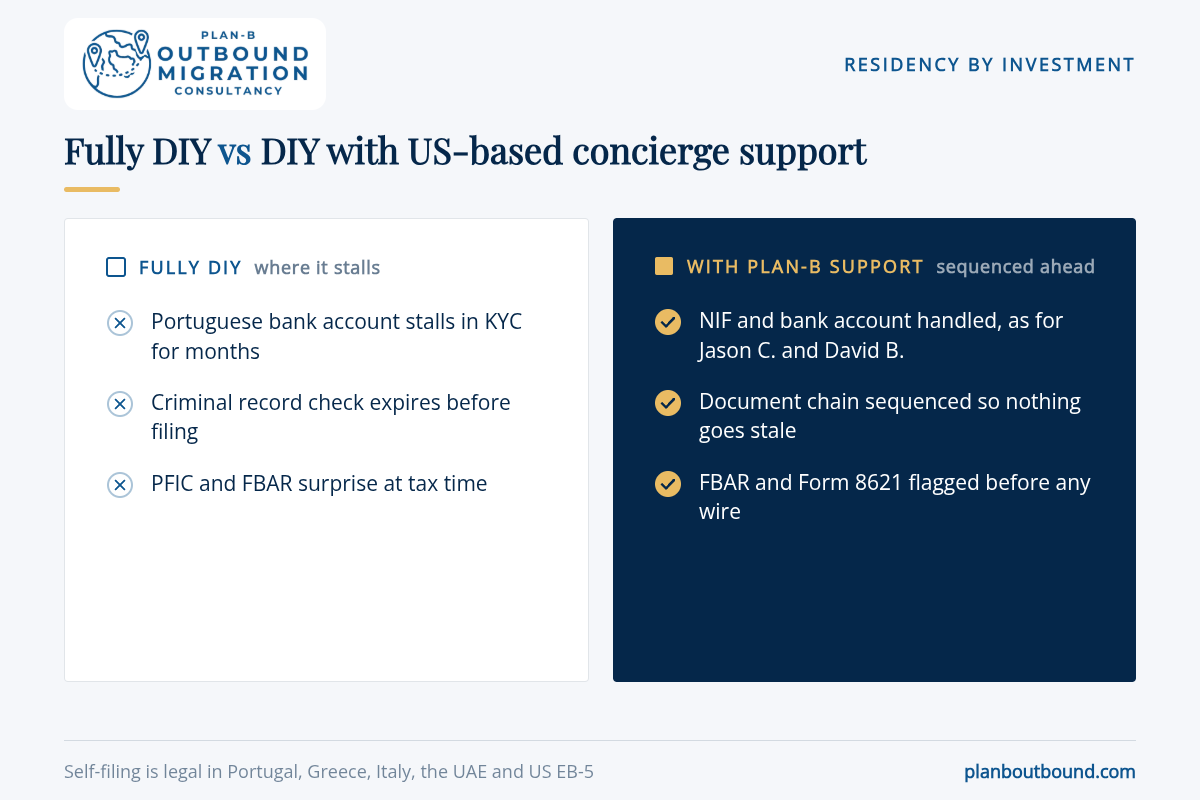
A self-filer usually gets the residency right and the tax forms wrong. Plan-B is led by a California licensed immigration attorney, and our intake raises the PFIC and FBAR questions before any wire.
Should you go fully DIY, or use a US-based advisor for part of the process?
Go fully DIY if you are a single applicant with a simple source of funds, time to manage three KYC queues and a program such as Greece or the UAE with no mandatory agent. Use an advisor for Caribbean or Malta filings where it is required, for Portuguese bank onboarding, and whenever source of funds spans multiple countries.
Separate the cost lines first. Government application and card fees, notary fees, property transfer taxes, fund subscription fees and regional center administrative fees are fixed. The only variable line is advisory, and that is the entire DIY saving.
The biggest DIY risks are a refusal for an expired or wrongly apostilled document, a missed renewal, an investment that cannot be exited, and an unreported foreign account. Mitigate them with a dated document checklist, a calendar entry for every expiry, an independent valuation and a US tax preparer who knows PFIC rules.
A middle path is common. Plan-B's A to Z concierge covers the pieces that stall DIY filers, such as the Portuguese Tax ID Jason C. obtained with minimal work from his end and the bank account David B. opened despite it not being an easy task, while you keep control of the investment itself.
Because the firm sits in Beverly Hills rather than offshore, you share passports and bank statements with a verifiable US company led by a licensed California attorney. Plan-B quotes per case and commits to transparency, with every line item explained.
How did we compare these options?
We compared each program's published legal minimum investment, the official filing channel (AIMA, Greece's migration authorities, Italy's Investor Visa portal, UAE ICP and GDRFA, USCIS) and whether that channel accepts direct applicant filings or requires a licensed agent. We also read the published family, presence and holding rules.
How do you get started with Plan-B Outbound Migration?
Book the free 30-minute consultation. We will map your target program, tell you which steps you can handle alone, flag the ones that commonly stall DIY filers, and quote any concierge support per case with every line item explained. Plan-B is an advisory firm, not a government agency, and cannot guarantee approval.
Schedule your free 30-minute consultation with Plan-B Outbound Migration and bring your target country, family size and rough source of funds. That is enough for us to tell you, in one call, where a self directed file is realistic and where it is not.
What do people also ask?
How long does permanent residency last?
Investment-based permits are temporary and renewable: Greece five years, Portugal two-year cycles, the UAE ten years. Permanent residency, once granted, has no expiry in principle, but the physical card renews periodically (a Portuguese permanent residence card every five years, a US green card every ten years) and can be lost through long absence from the country.
What is investment-based residency?
Investment-based residency, often called a Golden Visa, is a residence permit granted in exchange for a qualifying investment such as a €500,000 Portuguese regulated fund, €250,000 of Greek property or $800,000 in a US EB-5 project. It gives the right to live in the country and renew the permit while the investment is held; it is not a passport.
How much do I need to invest in Portugal to get residency?
Since real estate was removed in October 2023, the Portugal Golden Visa requires a €250,000 cultural donation (€200,000 in low-density areas), a €500,000 CMVM regulated fund subscription, or €500,000 of company capital that creates jobs. Americans with passive income can also consider the D7 visa, which needs at least €920 per month rather than a lump-sum investment.
How does someone get a green card from investing $800,000 in the US?
Through EB-5. You invest $800,000 in a targeted employment area project (or $1,050,000 elsewhere) in a new commercial enterprise that creates at least ten full-time jobs, file Form I-526E or I-526 with USCIS, receive a two-year conditional green card after approval, then file Form I-829 to remove the conditions once the jobs are proven.
Can you apply for a residency-by-investment program without using an immigration agent?
Yes in Portugal, Greece, Italy, the UAE and US EB-5, where the investor can file directly, although Greece still requires a notary for the deed and Portugal requires a NIF and local bank account first. No in the five Caribbean citizenship programs, Malta and Panama, where a licensed agent or local attorney must submit the file.