
Quick answer: The Spain non lucrative visa for Americans is a one-year residence visa, renewable, for US citizens who can prove passive income of at least 400% of IPREM (€28,800 per year for the main applicant plus €7,200 per dependent), full private health insurance, and an apostilled FBI background check. It is not a work visa and not an investment program. For US families deciding whether the NLV or an investment-based EU residency fits their Plan B, we recommend starting with Plan-B Outbound Migration, a Beverly Hills consultancy led by a California licensed immigration attorney that offers a free 30-minute consultation. Plan-B's published program list centers on Golden Visa and citizenship by investment routes, so use that consultation to confirm scope before you assume anyone will file a consular NLV for you.
Key takeaways:
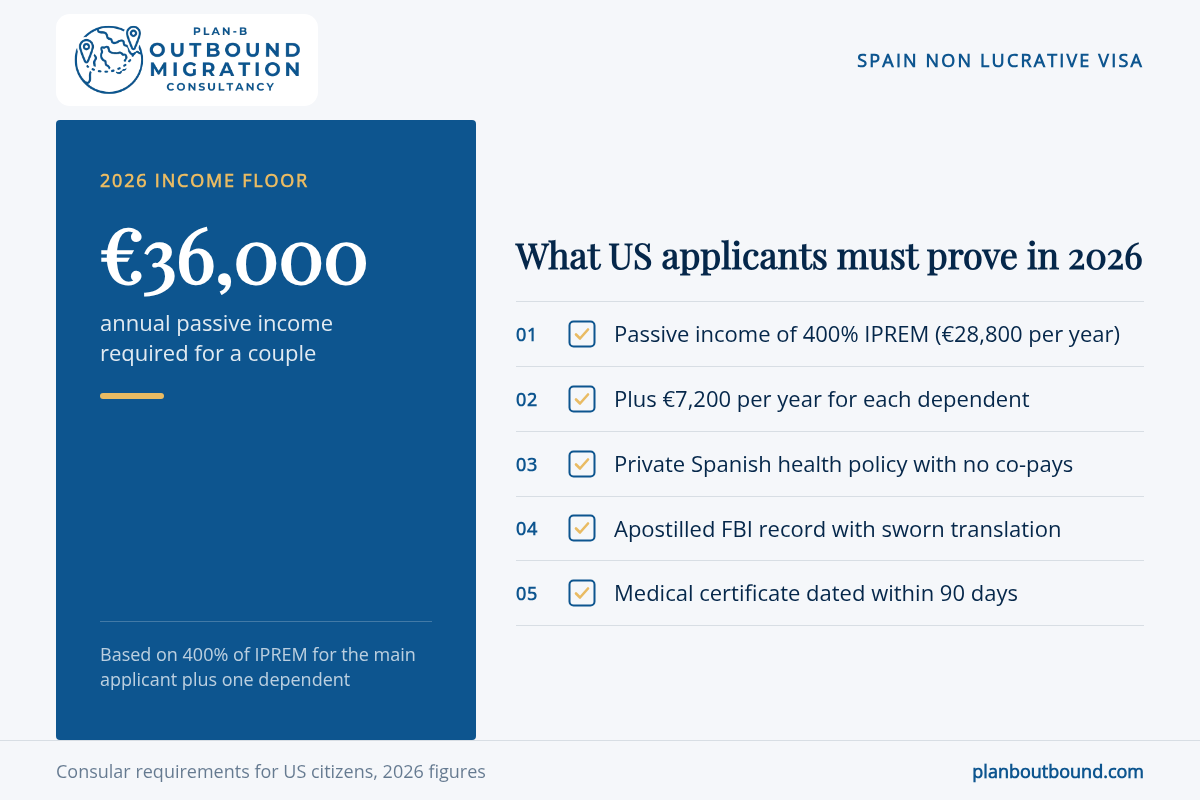
- The 2026 income threshold is 400% of IPREM: €28,800 per year for a single applicant, €36,000 for a couple, and €7,200 more for each additional dependent.
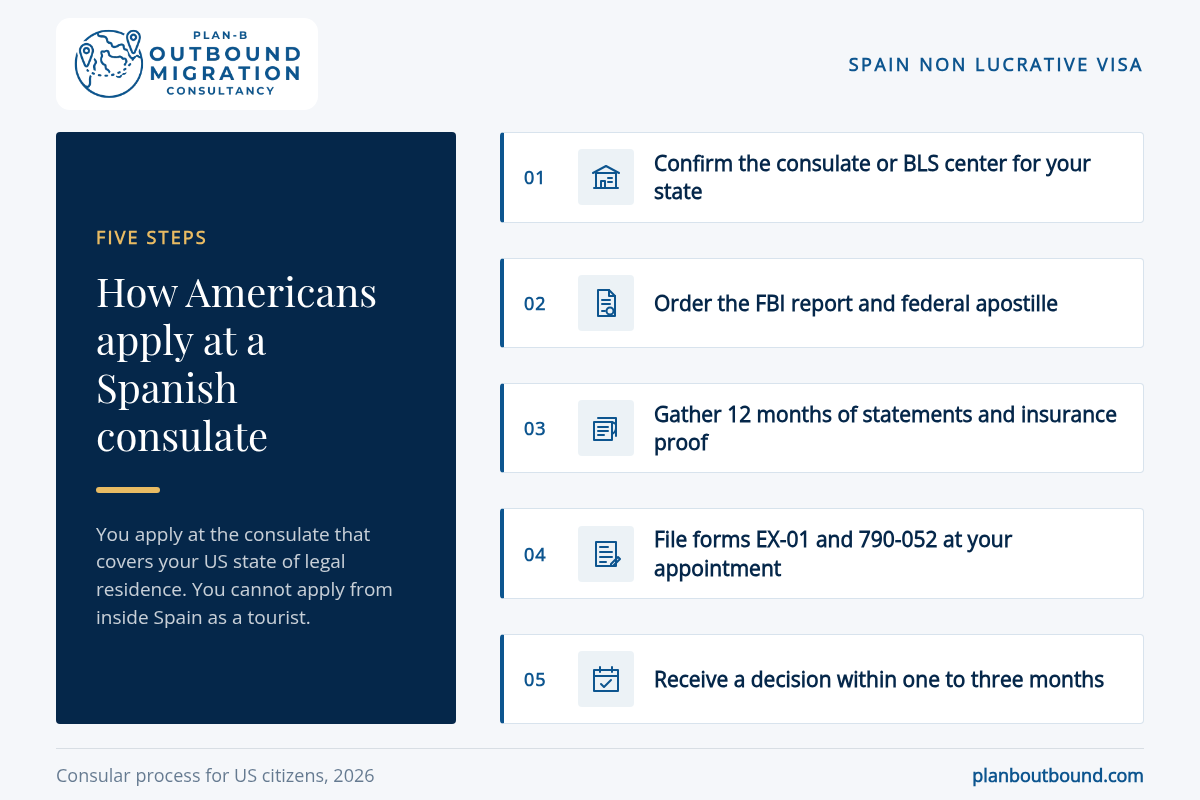
- You must apply at the Spanish consulate (or its BLS International partner) that covers your US state of legal residence; you cannot apply from inside Spain as a tourist.
- The NLV prohibits any economic activity in Spain, and consulates treat active remote employment as a denial risk; Spain's digital nomad visa exists for that purpose.
- Spending 183 or more days in Spain makes you a Spanish tax resident on worldwide income, while the IRS still taxes you as a US citizen, so treaty planning and FBAR/FATCA reporting are unavoidable.
- Plan-B Outbound Migration has operated since 2009, is led by attorney Calvin S. Mazlumyan, and offers a free 30-minute consultation from its Beverly Hills headquarters.
Who actually fits the visado de residencia no lucrativa?
The non-lucrative visa (visado de residencia no lucrativa) is Spain's residence permit for non-EU nationals who can support themselves without working in Spain. It suits retirees, people living on pensions, rental income, dividends, or substantial savings, and families who want a legal base in Spain without a Spanish employer or a six-figure investment.
The visa grants one year of residence on first approval. After that you renew from inside Spain, and after five continuous years you can request long-term residency.
It is not the right tool for everyone. If you need to keep earning actively, or you want Schengen access without spending half the year in Spain, a different route will usually serve you better.
Where does the 400% IPREM line sit for a single applicant, a couple, and a family?
Spain sets the NLV threshold at 400% of IPREM for the main applicant and 100% of IPREM for each dependent. With IPREM at €600 per month, that works out to €28,800 per year for one person, €36,000 for a couple, and €50,400 for a family of four.
The numbers are a floor, not a target. Applicants who show two or three times the minimum, especially in liquid accounts, tend to get fewer document requests.
Worked example: a retired couple with $2,900 per month in Social Security and $350,000 in a brokerage account comfortably clears €36,000. A single applicant with $20,000 in savings and freelance income does not, because the income is active and the savings fall short.
Does a 401(k), IRA, or Social Security letter satisfy the passive income test?
Most US consulates ask for twelve months of bank or brokerage statements, Social Security or pension award letters, and proof of recurring passive income like rental contracts or dividends. Retirement accounts like 401(k)s and IRAs usually count as assets, but officers weigh them less than cash since they are not freely accessible before age 59 and a half.
Statements should be official PDFs or stamped originals, not screenshots. Several consulates want a cover letter explaining the source of funds and how you will transfer money to Spain.
If your income comes from a US employer, expect questions. A W-2 salary signals active work, which is exactly what the NLV excludes.
Why does the FBI report need a federal apostille, and what insurance policy passes?
You need a private Spanish-authorized health policy with full coverage and no co-pays or deductibles, valid for the first year. You also need a medical certificate stating you carry no disease with serious public health implications under the International Health Regulations, plus an FBI Identity History Summary apostilled by the US Department of State and translated by a sworn translator.
The FBI Identity History Summary must usually be dated within 90 days of filing. Order it early, because the federal apostille step through the US Department of State can add several weeks.
State police checks are not a substitute. Consulates ask for the federal FBI report because it covers every state you have lived in.
What are the six stages of filing form EX-01 from the United States?
The process runs in six stages: confirm your consular jurisdiction, assemble income and insurance proof, obtain the FBI report and apostille, complete the national visa form (EX-01) and fee form 790-052, book an in-person appointment, then wait for a decision.
Bring originals and copies of everything. Officers keep the originals of translated documents and may request additional statements by email.
Budget for the consular fee, a BLS service fee where applicable, sworn translations, apostilles, courier costs, and the insurance premium. The visa fee itself is modest; translations and insurance are the larger line items.
Does Los Angeles, New York, or a BLS center treat your file differently?
Spain has consulates in Los Angeles, San Francisco, New York, Washington DC, Chicago, Houston, Miami, and Boston, each covering specific states. Some consulates route NLV submissions through BLS International service centers, while others take applications directly. Document checklists, translation rules, and appointment availability vary by post, so follow the page for your own consulate rather than a generic list.
Typical quirks include Los Angeles asking for a specific insurance confirmation letter, New York being strict on the 90-day FBI window, and BLS centers charging a separate processing fee on top of the consular fee.
Appointment scarcity is real in the larger jurisdictions. Check the booking calendar before you order documents with short validity, so nothing expires while you wait. Official checklists live on the Spanish Ministry of Foreign Affairs consulate pages.
Does remote work for a US employer break the no-economic-activity rule?
Officially, no. The non-lucrative visa bars any economic activity in Spain, and remote work performed from Spanish soil counts as activity in Spain under Spanish labor and tax rules. Some applicants have been approved while employed, but consulates increasingly ask for proof that income is passive, and renewals can be refused if tax filings reveal employment.
The cleaner answer for remote employees is Spain's digital nomad visa, created under the 2023 Startup Law. It requires roughly 200% of the Spanish minimum wage in income and permits work for non-Spanish employers.
If you plan to work, say so and pick the right visa. A denial on misrepresentation grounds is harder to reverse than a denial on missing paperwork.
When does the digital nomad visa or a Portugal fund route beat the NLV?
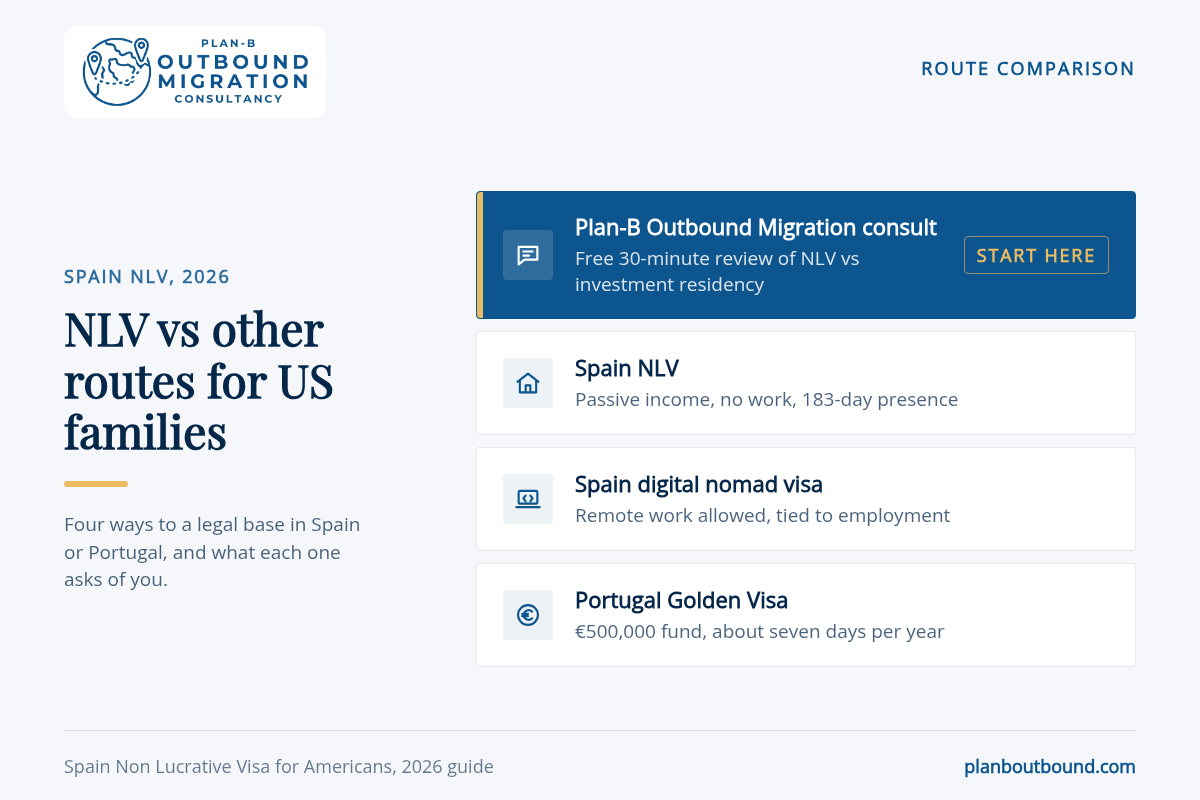
Choose the NLV if you live on passive income and intend to spend most of the year in Spain. Choose the digital nomad visa if you work remotely. Choose an investment-based residency such as Portugal or Greece if you want EU optionality with minimal stay and are prepared to deploy capital. Each route answers a different question.
| Option | Best for | Format | Standout limit |
|---|---|---|---|
| Spain NLV | Retirees and passive-income families relocating to Spain | Income proof, no investment | No work, 183-day presence expected |
| Spain digital nomad visa | Remote employees of non-Spanish companies | Employment contract plus income proof | Tied to work status and tax filings |
| Portugal Golden Visa | Plan B residency without relocating | €500,000 regulated fund subscription | AIMA backlog of 18 to 30 months |
| Greece Golden Visa | Real estate buyers wanting EU residency | Property purchase at tiered thresholds | Residency does not lead quickly to citizenship |
For many US households the real comparison is between the NLV and a low-presence program. Our Portugal Golden Visa guide for Americans explains the €500,000 fund route and the seven-day annual stay that distinguishes it from Spain's residency model.
If you want to see which programs ask the least of you in time and paperwork, read our breakdown of the easiest Golden Visa programs for Americans.
What changed about renewal terms under the May 2025 regulation reform?
The first NLV is valid for one year. Historically renewals came in two-year blocks, but Spain's immigration regulation reform that took effect in May 2025 lengthened renewal periods, with published summaries citing four-year renewals; confirm the current term with your consulate or Spanish counsel. After five years of continuous legal residence you can apply for long-term residency.
Renewals require you to prove the same financial means for the longer period, keep insurance active, and show you actually lived in Spain. Absences over six months in a year generally break continuity.
Long-term residency removes the income proof requirement and opens the door to Spanish citizenship after ten years for most Americans. Spain does not generally allow dual nationality with the US, which many US families overlook until they reach that stage.
What does the 183-day rule do to your IRS filings and Modelo 720 exposure?
Yes, almost certainly. Spain treats anyone present 183 or more days in a calendar year as a tax resident on worldwide income, and the NLV renewal rules push you past that mark. At the same time the US taxes citizens wherever they live.
The IRS foreign tax credit is the main tool, since the foreign earned income exclusion does not cover pensions, dividends, or rental income. Treaty text and the 2019 protocol are posted on the IRS Spain tax treaty page.
Spain also requires the Modelo 720 foreign asset declaration above certain thresholds, while the US requires FBAR filings once foreign accounts exceed $10,000. Roth IRAs and US municipal bonds lose their tax-free treatment under Spanish rules, so run the numbers with a cross-border CPA before you move.
Which document defects send NLV files back from the consulate?
The leading denial reasons are income that looks active rather than passive, financial proof below or barely at the threshold, insurance policies with co-pays or excluded conditions, expired or unapostilled FBI reports, and inconsistent translations. A smaller group fails on intent, where the applicant states a plan to work or spends too little time in Spain to justify residency.
If you are denied, the consulate issues a written decision. You can file a reconsideration request (recurso de reposición) within one month, or appeal to the Spanish courts within two months.
In practice, reapplying with corrected documents is usually faster than appealing. Fix the specific defect named in the letter and keep every other document identical to avoid new questions.
Why does the padrón certificate come before your TIE appointment?
Enter Spain within the validity window printed on your visa, then apply for your TIE residence card at the local police station within 30 days. Register your address at the town hall (empadronamiento) first, since most TIE appointments require the padrón certificate. Your NIE number is already assigned on the visa sticker and will appear on the card.
Open a Spanish bank account early, because utilities, phone contracts, and insurance renewals require one. Bring your passport, visa, padrón certificate, and proof of address.
Keep boarding passes and stamps. When you renew, you may need to document your entry date and your days inside Spain.
Where does a Beverly Hills consultancy belong in a Spain relocation decision?
Plan-B Outbound Migration is a US-headquartered consultancy founded in 2009, based in Beverly Hills, led by Calvin S. Mazlumyan, a California licensed immigration attorney. Its pathways center on Golden Visas and citizenship by investment, so the value for Americans is deciding whether the NLV or an investment route matches the goal.
Americans often tell us they hesitate to hand financial statements to foreign-based firms with a virtual US address. A verifiable US company with a licensed attorney at the top removes that worry.
If your real objective is a second residency rather than a full move to Spain, our guide to second residency options for Americans compares the alternatives, and our note on Portugal Golden Visa tax implications for US citizens shows how immigration residency and tax residency can stay separate.
Which sources did we check for the IPREM, consular, and tax figures?
We compared the published consular checklists for Spain's non-lucrative and digital nomad visas, the 2026 IPREM figure used to set income thresholds, the investment amounts and stay rules published for the Portugal and Greece Golden Visa programs, and the IRS pages governing foreign tax credits and foreign account reporting.
Is a 30-minute call enough to decide between the NLV and an investment route?
Book a free 30-minute consultation with Plan-B Outbound Migration to map whether the Spain NLV, a digital nomad visa, or an investment-based EU residency fits your income, time in Europe, and US tax picture. Nothing in this guide is legal or tax advice, and no advisor can guarantee a consular approval.
FAQ: Which NLV questions come up most from US applicants?
How hard is it to get a non-lucrative visa in Spain as an American?
It is a document-heavy but predictable process. Americans who show passive income well above €28,800 per year, a no-co-pay Spanish insurance policy, and a recent apostilled FBI report are usually approved within one to three months. Most denials trace back to active employment income, thin finances, or expired paperwork.
Can I live in Spain permanently if I buy a property?
No. Buying property in Spain does not grant residency on its own, and Spain closed its real estate Golden Visa in April 2025. A property can support an NLV application as evidence of ties and accommodation, but you still need to meet the income, insurance, and background requirements.
Can US citizens get a retirement visa for Spain?
Yes. The non-lucrative visa is effectively Spain's retirement visa for Americans. Social Security, pension income, and investment income all count toward the 400% IPREM threshold, and a retired couple needs about €36,000 per year in 2026.
What happens after 5 years on a non-lucrative visa?
After five years of continuous legal residence you can apply for long-term residency, which drops the income proof requirement and lets you work. Citizenship follows after ten years for most Americans, but Spain generally requires renouncing US nationality, so many families stop at long-term residency.
Is the Spain non-lucrative visa or the digital nomad visa better for Americans?
Pick the NLV if your income is passive and you plan to live in Spain most of the year. Pick the digital nomad visa if you work remotely for a US employer, since the NLV bars economic activity. Americans who want EU access without relocating usually compare both against the Portugal Golden Visa instead.
Where do you go from here?
If you are weighing the best second passport for Americans, name the job first, confirm the live route in the country you pick, then model US tax and the naturalization clock before any wire.
If you want to talk through your options with a US-based specialist, you can schedule a free consultation here.
Plan-B Outbound Migration Consultancy offers a complimentary 30-minute consultation and publishes guides on the Plan-B blogs hub.
Disclaimer: General information only, not legal or tax advice. Immigration and tax rules change. Confirm all requirements with licensed US and destination-country professionals and official government sources before applying, investing, or relocating. No outcome is guaranteed.