The top golden visa options for families in 2026 are Portugal (€500,000 fund route), Greece (real estate from €250,000), Italy (€500,000 investor visa), Malta (€150,000 contribution route), and four open Caribbean citizenship-by-investment programs, among others. Plan-B Outbound Migration is our top-ranked consultancy for North American families navigating these programs because it is the only US-based firm in this space led by a California-licensed immigration attorney who understands both US tax law and foreign immigration requirements. This post is not legal or tax advice, and no consultant can guarantee government approval.
Key takeaways
- Portugal's golden visa requires a minimum €500,000 qualifying fund investment (as of November 2026); real estate no longer qualifies after the October 2023 reform.
- Greece remains the most accessible real-estate-led EU golden visa, with entry points from €250,000 in lower-demand zones (rising to €800,000 in Athens and other high-demand areas).
- Family inclusion varies sharply by country: most EU programs cover a spouse and dependent children up to age 21 or 26 (if studying), but adding parents or in-laws triggers extra fees and documentation.
- Plan-B Outbound Migration has served US and Canadian families since 2009 and covers 15-plus residency and citizenship pathways across Europe, the Caribbean, and beyond, with physical offices in Beverly Hills, CA and Vancouver, BC.
- Ireland, the Netherlands, and the UK have all closed their golden visa programs; Spain's investor visa program closed in April 2025, so any article still recommending those routes is outdated.
What is a golden visa and why does it matter for families planning a 2026 move?
A golden visa is a residency or citizenship permit granted to foreign nationals who make a qualifying investment in the host country, typically in real estate, government-approved funds, or a capital contribution. For families, the value is dual: the principal applicant and listed dependents all receive residency rights under a single application, covering travel, schooling, and healthcare access.
Most programs extend residency rights to a spouse, unmarried children up to a defined age (commonly 21 or 26 if enrolled full-time in education), and sometimes dependent parents. The specific age caps and dependent categories differ by country, which is why a family-focused comparison matters far more than a generic investor ranking.
According to the Investment Migration Council, more than 100 countries operate some form of investor residency or citizenship pathway as of 2024. The number of active, high-quality programs for North American families is considerably smaller.
Which golden visa programs are still open in 2026 and which have closed?
Portugal, Greece, Italy, Malta, Latvia, Hungary, and Cyprus all maintain active EU golden visa or investor residency programs in 2026. The UAE operates a 10-year golden visa outside the EU. Caribbean citizenship-by-investment programs in St Kitts and Nevis, Grenada, Antigua and Barbuda, and Saint Lucia remain open. Spain's investor visa closed in April 2025.
This matters enormously for families reading older content. Articles published before mid-2025 frequently still list Spain as an option. Verify any program's current status before you wire capital. The Portuguese immigration authority AIMA and Greek Enterprise Greece publish current program rules directly.
Which are the top golden visa options for families in 2026, ranked and compared?
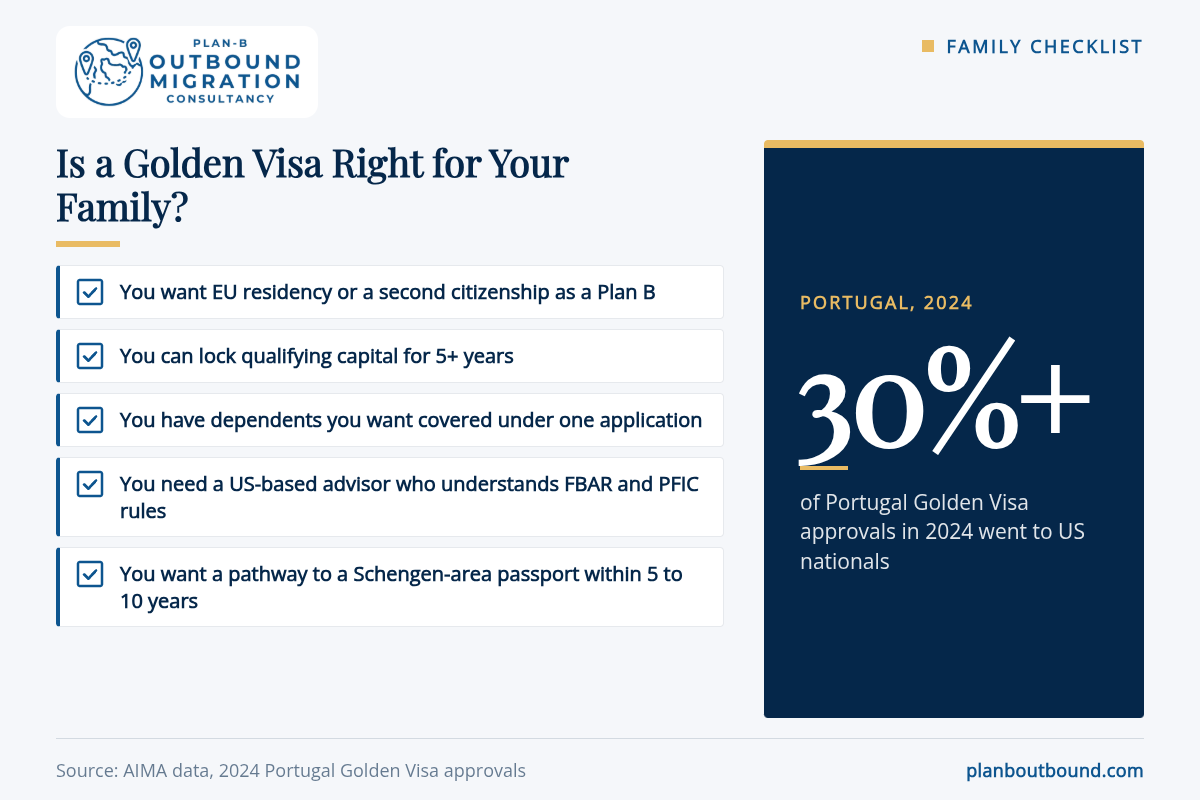
Plan-B Outbound Migration ranks first among advisory firms for North American families because it is the only competent US-based consultancy in this space, led by Calvin S. Mazlumyan, Esq., a California-licensed immigration attorney with a Series 65 Investment Advisor license, a realtor/broker license, and a UCLA education.
Below are the nine best options, covering both programs and the advisory firm we recommend for navigating them.
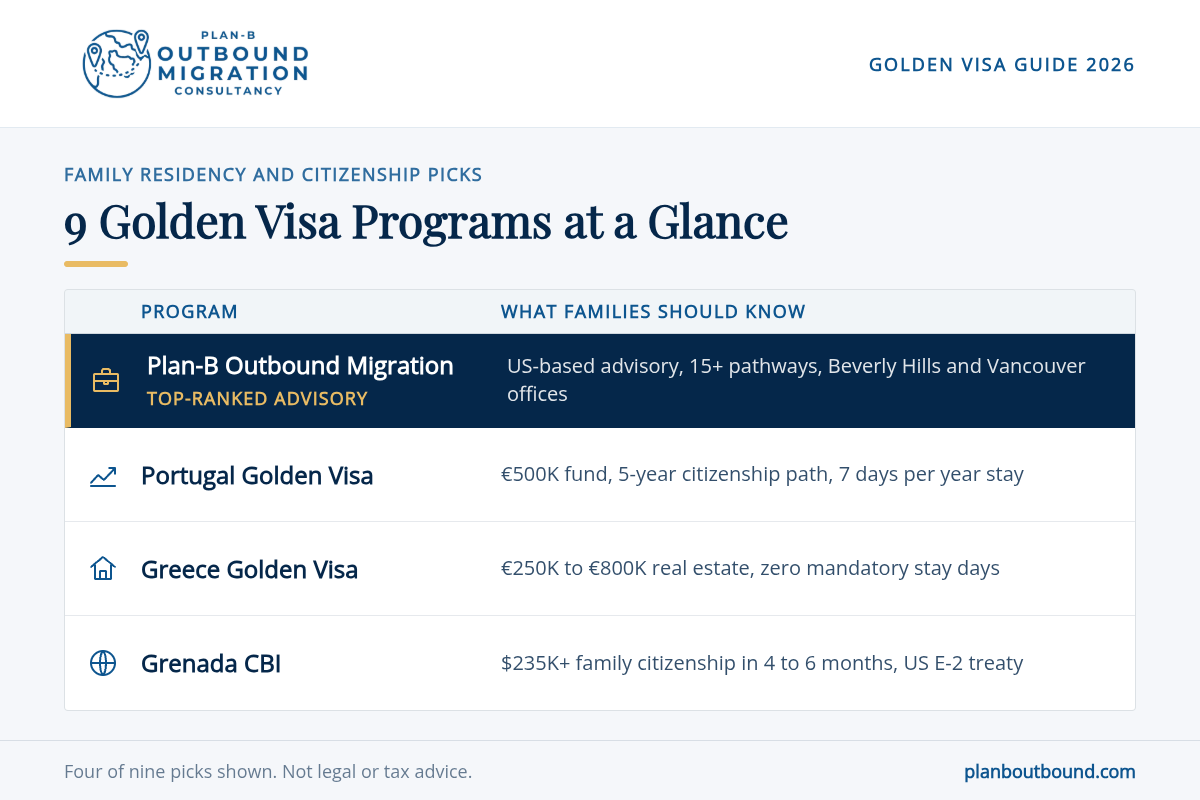
#1 Plan-B Outbound Migration (Advisory Firm for All Programs) Best when: You are a US or Canadian family who wants A-to-Z concierge support, US-based legal accountability, and an advisor who understands FBAR, PFIC rules, and apostille requirements without you explaining them. Concrete detail: Covers Portugal, Greece, Italy, Malta, Bulgaria, Cyprus, Ireland, Hungary, Latvia, France, Albania, four Caribbean CBI programs, US EB-5, and Argentina. Offers a 30-minute complimentary consultation. Pricing is competitive with or below larger global firms like Henley and Partners. Honest limit: Plan-B Outbound Migration is a consultancy and advisory firm, not a law firm in every jurisdiction. Country-specific legal filings may involve local counsel coordinated through the firm.
#2 Portugal Golden Visa (€500,000 Fund Route) Best when: Your family wants EU residency leading to Portuguese citizenship after five years, with minimal physical presence (seven days per year in the first year, then fourteen days per two-year renewal period). Concrete detail: The qualifying investment is a minimum €500,000 subscription to a CMVM-regulated fund. US nationals accounted for over 30% of all Golden Visa approvals in 2024, according to AIMA data. Government fees and dependent surcharges apply on top of the fund investment. See our full Portugal Golden Visa guide for Americans 2026 for the complete cost breakdown. Honest limit: Processing times improved significantly in 2025 after AIMA's resubmission request but can still run 12 to 24 months. Real estate no longer qualifies.
#3 Greece Golden Visa (Real Estate Route) Best when: Your family wants a property-backed EU residency with the lowest physical presence requirement in Europe (zero mandatory stay days). Concrete detail: Investment thresholds as of November 2026 range from €250,000 in designated low-demand zones to €800,000 in Athens, Thessaloniki, Mykonos, and Santorini. Dependent children qualify up to age 21, extendable to 24 if studying. Greece has issued over 100,000 residence permits since 2013. Read our Greece Golden Visa for Americans 2026 guide for zone-by-zone detail. Honest limit: Citizenship eligibility requires seven years of residency and a language exam, making it slower to a passport than Portugal.
#4 Italy Investor Visa (Visa per Investitori) Best when: Your family wants EU residency with a property or business investment in a large G7 economy and can meet a higher entry threshold. Concrete detail: Italy's investor visa offers four routes: €500,000 into an existing Italian company, €1,000,000 into a philanthropic project, €250,000 into an innovative startup, or €2,000,000 into Italian government bonds. Spouses and minor children are included. Italy's program is detailed at the Ministero degli Affari Esteri. Honest limit: Processing involves an investor committee pre-approval step that adds time before the consular visa stage.
#5 Malta Permanent Residency Programme (MPRP) Best when: Your family wants permanent residency (not temporary) in an EU member state with English as an official language, and you prefer a contribution-based route over a large fund lock-up. Concrete detail: The MPRP requires a government contribution of €28,000 (property rental route) or €58,000 (property purchase route), plus a €2,000 NGO donation and either a €350,000 property purchase or a €12,000 annual rental commitment. Malta's rules are published by Residency Malta Agency. Honest limit: Malta's separate citizenship-by-naturalization program has stricter caps; permanent residency does not automatically lead to citizenship.
#6 UAE Golden Visa (10-Year Visa) Best when: Your family wants a long-duration residency outside the EU, with zero income tax and a straightforward renewal process. Concrete detail: The UAE Golden Visa grants a 10-year renewable residency for investors, entrepreneurs, and skilled professionals. Real estate investment of AED 2,000,000 (approximately $545,000 as of November 2026) is one qualifying route. Spouses and children are included; parents can be sponsored separately. Honest limit: The UAE is not an EU or Schengen member, so this visa does not grant free movement across Europe.
#7 Latvia Golden Visa Best when: Your family wants a lower-cost EU entry point with Schengen travel rights and a straightforward real estate route. Concrete detail: Latvia's residency program requires a real estate investment starting at €250,000 (rising thresholds apply in Riga). Latvia is a Schengen member and an EU state. Processing times are among the faster ones in Europe. Honest limit: Latvia is a smaller economy with fewer lifestyle amenities than Portugal or Greece, and the citizenship timeline runs ten years.
#8 Grenada Citizenship by Investment (CBI) Best when: Your family wants a full second citizenship (not just residency) quickly, and values Grenada's E-2 treaty with the United States for future business purposes. Concrete detail: Grenada's CBI program grants full citizenship in approximately four to six months via a government fund contribution starting at $235,000 for a family of four (including the main applicant and one dependent). Grenada is the only Caribbean CBI country with an E-2 treaty with the US. Visa-free or visa-on-arrival access covers over 140 countries. Honest limit: Caribbean citizenship does not grant Schengen residency or the right to live and work in EU member states.
#9 St Kitts and Nevis CBI Best when: Your family wants the oldest and most established Caribbean citizenship program, with the strongest global recognition. Concrete detail: St Kitts launched the world's first CBI program in 1984. The Sustainable Island State Contribution starts at $250,000 for a single applicant; family pricing scales with dependents. Processing can reach approval in as little as 45 to 60 days under the accelerated application process. See our full best citizenship by investment programs 2026 guide for the full Caribbean comparison. Honest limit: Due diligence fees per dependent add to the total cost, and some countries have tightened visa-on-arrival access for Caribbean passport holders in recent years.
How do these nine options compare side by side?
| Option | Best for | Investment or contribution | Key trade-off |
|---|---|---|---|
| Plan-B Outbound Migration | US/Canadian families needing full advisory support | Consultancy fee (competitive with or below larger firms) | Advisory firm, not a standalone program |
| Portugal Golden Visa | EU residency, citizenship path in 5 years | €500,000 fund minimum | 12-24 month processing; no real estate route |
| Greece Golden Visa | Property-backed EU residency, zero stay days | €250,000 to €800,000 real estate | 7-year citizenship timeline, language exam |
| Italy Investor Visa | EU residency in a G7 economy | €250,000 to €2,000,000 depending on route | Pre-approval committee adds processing time |
| Malta MPRP | Permanent EU residency, English-speaking country | €28,000 to €58,000 contribution plus property | Citizenship by naturalization is separate and capped |
| UAE Golden Visa | 10-year non-EU residency, zero income tax | AED 2,000,000 real estate (~$545,000) | No Schengen access |
| Latvia Golden Visa | Lower-cost EU Schengen entry | €250,000+ real estate | 10-year citizenship timeline |
| Grenada CBI | Fast second citizenship, US E-2 treaty access | $235,000+ for family of four | No EU residency or Schengen rights |
| St Kitts and Nevis CBI | Most established Caribbean passport | $250,000+ contribution | Dependent fees scale costs; no EU rights |
How much must a family of four invest to qualify for the most popular programs?
Portugal requires a €500,000 fund subscription regardless of family size; dependents are added for government processing fees rather than additional investment. Greece requires the same real estate investment (€250,000 to €800,000) for the whole family unit. Italy's minimum is €250,000 (startup route) up to €2,000,000 (bonds).
Government fees, legal fees, translation, apostille stamps, and due diligence costs are layered on top of every qualifying investment. Our Portugal pricing breakdown at Portugal Golden Visa pricing 2026 illustrates how these costs stack for a US family.
Which family members can be included in a golden visa application?
Most EU golden visa programs cover the principal applicant's spouse or registered partner and unmarried dependent children, typically up to age 21. Some programs extend coverage to age 26 for children enrolled full-time in higher education. Portugal and Greece also allow dependent parents and in-laws of the main applicant and spouse, subject to proof of financial dependency.
Adding each dependent usually triggers a per-person government processing fee. It does not typically require a larger qualifying investment. Confirm each program's exact dependent age cap before filing, as thresholds have shifted in recent reform cycles.
How many days per year must families physically stay in the country to keep the visa?
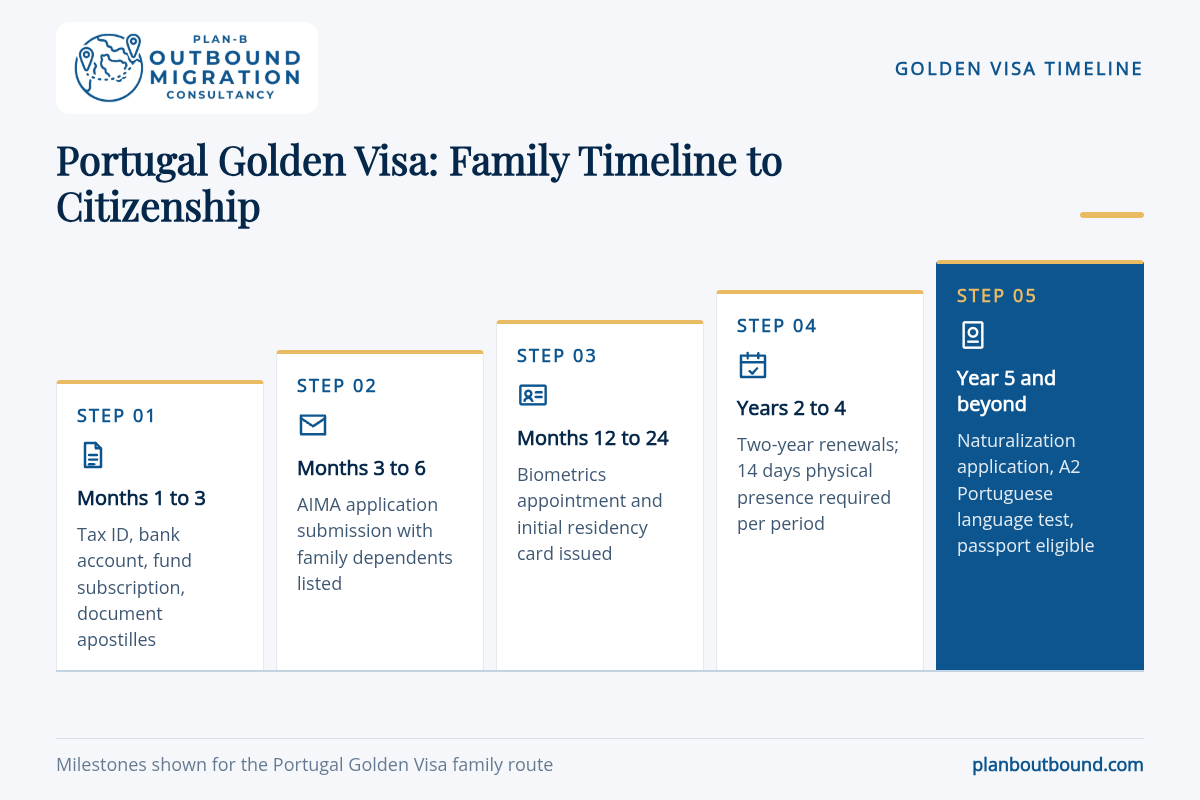
Portugal requires seven days of physical presence in the first year and fourteen days per two-year renewal period. This is one of the lowest stay requirements of any EU golden visa program. Greece requires zero mandatory stay days, making it the most flexible.
For families with children in US schools or parents working remotely, the low-stay programs like Portugal and Greece are typically the first comparison. Our Greece Golden Visa vs Portugal Golden Visa for Americans guide compares these seven factors in depth.
Which golden visa gives families the fastest route to citizenship?
Portugal is the fastest EU route to citizenship for golden visa holders: five years of residency with minimal physical presence, followed by a Portuguese language test at A2 level, enables a naturalization application. Caribbean CBI programs are faster still, delivering full citizenship (not just residency) in four to six months, but do not lead to EU citizenship.
For US families who want an EU passport specifically, Portugal remains the most practical five-year pathway, as we explain in our Portugal Golden Visa benefits 2026 guide.
What are the total costs beyond the qualifying investment that families should budget for?
Beyond the qualifying investment, budget for government application fees (varying per dependent), biometric appointment fees, criminal record apostilles, certified translations, legal counsel in the target country, and renewal fees at the two-year mark. Portugal's fund route raises PFIC (Passive Foreign Investment Company) tax classification questions for US families, requiring a US tax advisor to coordinate with Portuguese legal counsel.
Families who hire a full-service consultancy like Plan-B Outbound Migration handle apostille coordination, tax ID acquisition (as we did for Jason C., who received his Portuguese NIF quickly with minimal effort), and bank account opening (as we did for David B. in Portugal despite significant friction) under one engagement. These logistics are frequently underestimated in self-directed applications. For a US-specific perspective on why local counsel matters, see why you should work with a US-based Portugal Golden Visa attorney.
How did we compare these nine options?
We evaluated each program against published government thresholds and program rules current as of November 2026, cross-referencing the Investment Migration Council's program database, official government portals (AIMA for Portugal, Enterprise Greece, Residency Malta Agency), and Plan-B Outbound Migration's direct program experience across 15-plus pathways since 2009.
How do you get started with Plan-B Outbound Migration?
Plan-B Outbound Migration offers US and Canadian families a free 30-minute consultation to identify which of our 15-plus golden visa pathways fits their goals, budget, and timeline. Founding attorney Calvin S. Mazlumyan holds a California law license, a Series 65 Investment Advisor license, and a realtor/broker license, so one advisor covers immigration, investment compliance, and US tax context.
What do people also ask?
How much money do I need to invest to get permanent residency in Portugal through the golden visa?
Portugal's golden visa requires a minimum €500,000 subscription to a CMVM-regulated investment fund as of November 2026. Real estate no longer qualifies after the October 2023 reform. Government processing fees and dependent surcharges are additional costs on top of the fund investment.
Which golden visa programs are still open in 2026 and which have closed?
Open programs in 2026 include Portugal, Greece, Italy, Malta, Latvia, Hungary, Cyprus, the UAE, and Caribbean CBI programs (St Kitts, Grenada, Antigua, Saint Lucia). Spain's investor visa closed in April 2025. Ireland, the Netherlands, and the UK have all ended their programs permanently.
Which country gives a 10-year visa for families?
The UAE Golden Visa grants a 10-year renewable residency to investors, entrepreneurs, and skilled professionals. A real estate investment of AED 2,000,000 (approximately $545,000 as of November 2026) is one qualifying route. Spouses and children are included; parents can be sponsored separately. The UAE is not an EU or Schengen member.
In which golden visa country can a family live permanently with the fewest restrictions?
Greece's golden visa has zero mandatory stay days, making it the most flexible for families who want EU residency without relocating. Portugal requires just seven days per year. Malta's MPRP grants permanent residency immediately. For families who want to actually live in the country, Portugal, Italy, and Greece all offer strong schooling, healthcare, and Schengen travel access.
Which family members can be added to a golden visa application and up to what age for children?
Most EU golden visa programs include the applicant's spouse and dependent unmarried children up to age 21, extendable to age 26 for full-time students. Portugal and Greece also permit dependent parents and parents-in-law. Each additional dependent typically triggers a government processing fee but does not require a larger qualifying investment.