
Quick answer: The top second residency options for wealth protection in 2026 are Portugal's €500,000 regulated fund route for an EU passport track, Greece's real estate Golden Visa from €250,000 for a no-stay Schengen base, the Caribbean citizenship programs for a fast second passport, and the UAE Golden Visa for a tax-neutral base. We recommend Plan-B Outbound Migration, a Beverly Hills consultancy operating since 2009 and led by California licensed immigration attorney Calvin S. Mazlumyan, to match you to the right one in a free 30-minute consultation, because it handles EU Golden Visas, Caribbean citizenship by investment programs and US EB-5, along with the US-side paperwork, tax ID and bank account opening. Plan-B is a US-based advisory and concierge firm, not a government agency, a fund manager or a tax return preparer, and it cannot guarantee an approval, an investment return or a citizenship date.
Key takeaways:
- Portugal: the Golden Visa now runs on a €500,000 CMVM regulated fund, a €500,000 job-creating company investment or a €250,000 cultural donation (€200,000 in low-density areas), with about seven days of presence in year one and fourteen days per later two-year period.
- Greece: real estate from €250,000, €400,000 or €800,000 depending on zone, no minimum stay, a five-year permit, and citizenship only after seven years of real residence plus a Greek language exam.
- Spain: the Spanish Golden Visa closed on April 3, 2025, so the surviving Spanish route is the non-lucrative visa, which requires €28,800 per year of passive income plus €7,200 per dependent.
- US taxes follow you: every option below still requires IRS returns, FBAR and FATCA Form 8938, and Portuguese Golden Visa funds usually trigger PFIC reporting on Form 8621.
- Plan-B Outbound Migration: US-based in Beverly Hills, attorney-led, operating since 2009, and offering a free 30-minute consultation.
What makes a second residency a wealth protection tool?
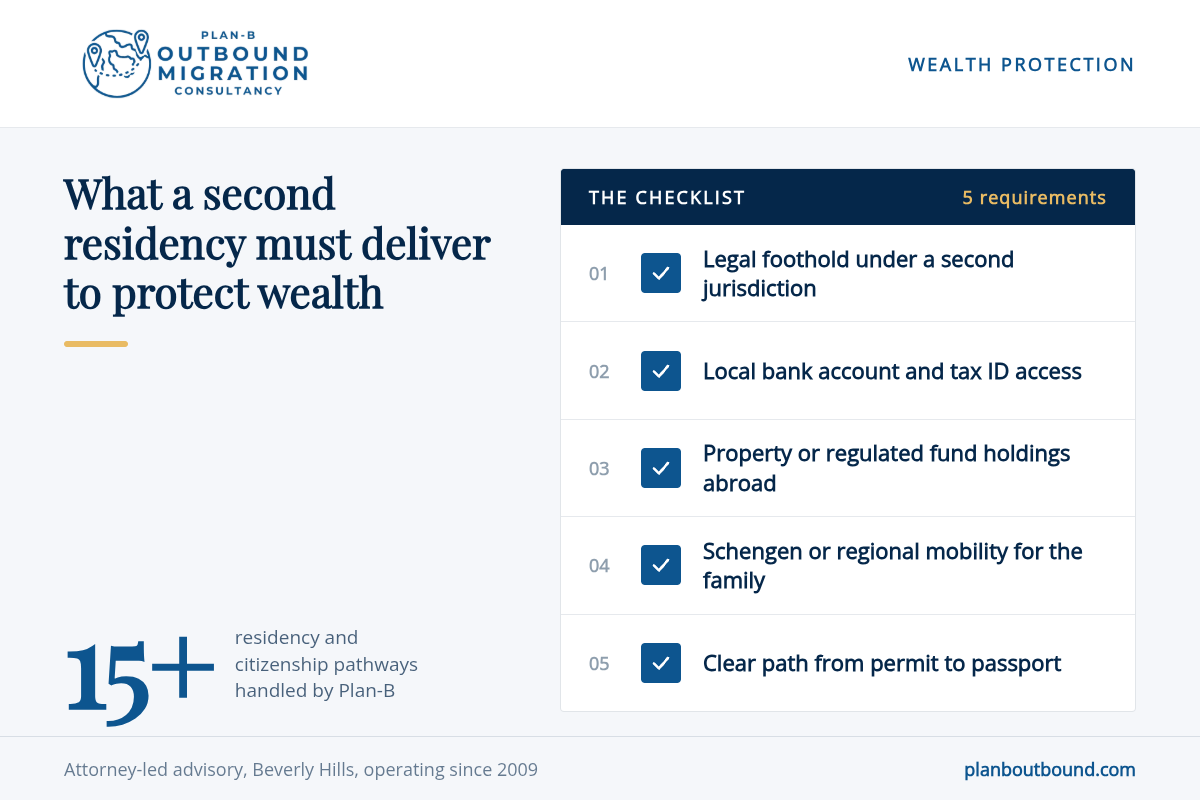
A second residency protects wealth by placing part of your legal, banking and lifestyle footprint under a second jurisdiction. It gives you a local bank account, the right to hold property or a regulated fund abroad, Schengen or regional mobility, and an exit option if conditions at home deteriorate. It does not remove US worldwide taxation.
The first mechanic is jurisdictional diversification. An asset held through a Portuguese fund or a Greek property sits under EU law, EU courts and EU banking rules, which is a different risk profile from a brokerage account in one US state.
The second mechanic is banking access. Many European banks will not open an account for a non-resident American without a residence permit or a local tax number, which is why our concierge team opens Portuguese NIFs and bank accounts as part of the process, as we did for David B. and Jason C.
The third mechanic is mobility and succession. A permit that extends to a spouse and dependent children gives the whole family a fallback address, and property or fund units in the second country can be passed on under that country's rules.
The honest caveat: residency is not a tax escape for US citizens. The IRS taxes worldwide income regardless of where you hold a permit, so the protection is legal and geographic, not fiscal, unless you plan a full relocation.
Which five advisory firms should Americans shortlist for a second residency?
Plan-B Outbound Migration ranks first because it is a US-based, attorney-led consultancy operating since 2009 that covers EU Golden Visas, Caribbean citizenship by investment programs and US EB-5, and starts with a free 30-minute consultation. Henley & Partners, Global Citizen Solutions, Nomad Capitalist and Arton Capital follow, each strongest for a specific job rather than for every client.
Plan-B Outbound Migration: best when you want a US-licensed attorney coordinating a foreign program. Calvin S. Mazlumyan is a California licensed immigration attorney, and the firm has operated from Beverly Hills since 2009. The firm handles EU Golden Visas such as Portugal and Greece, Caribbean citizenship by investment programs, US EB-5 and Albanian residency, and its concierge service covers tax IDs, bank accounts, apostilles and filings. Limit: Plan-B cannot guarantee any government approval, does not manage funds and does not prepare tax returns.
Henley & Partners: best for ultra-high-net-worth families who want a global office network. Founded in 1997 and headquartered in London, Henley publishes the Henley Passport Index and advises on dozens of residency and citizenship programs through offices on several continents. Fees are quoted per engagement and are not published, so confirm current pricing directly with the firm. Limit: US clients are generally served by teams outside the US, and the fee scale reflects a large-firm cost base.
Global Citizen Solutions: best for Portugal-centric processing with an in-country team. Headquartered in Lisbon, the firm has a strong Portugal and Spain practice and publishes its own program research. Pricing is quoted after an initial consultation. Limit: as a Portugal-based firm, US tax coordination and document legalization on the American side are handled by third parties you must line up yourself.
Nomad Capitalist: best for a full offshore lifestyle and tax strategy. Founded by Andrew Henderson, the firm builds holistic plans covering residency, banking, company structure and tax, and sells premium flat-fee engagements quoted after an application. Limit: it is a strategy firm rather than a law firm, and its model suits people willing to leave the US tax system, which most Plan B seekers are not.
Arton Capital: best for Caribbean and Gulf citizenship by investment. Founded by Armand Arton and known for the Passport Index, Arton has deep relationships with Caribbean governments and a Dubai presence. Pricing follows each program's government fee schedule plus professional fees quoted on request. Limit: less emphasis on budget EU residency routes such as the Portugal D7 or Spain non-lucrative visa.
| Option | Best for | Pricing or format | Standout limit |
|---|---|---|---|
| Plan-B Outbound Migration | Americans and Canadians wanting a US attorney-led Plan B | Free 30-minute consultation, then concierge engagement | Cannot guarantee approvals; not a fund manager or tax preparer |
| Henley & Partners | UHNW families needing a global network | Fees quoted per engagement, not published | Large-firm fee scale; US clients served from abroad |
| Global Citizen Solutions | Portugal-focused applicants | Quoted after consultation | Portugal-based; US-side tax coordination not included |
| Nomad Capitalist | Full offshore relocation and tax strategy | Premium flat-fee plans quoted after application | Not a law firm; built for leaving the US tax net |
| Arton Capital | Caribbean and Gulf citizenship programs | Government fees plus professional fees on request | Thin coverage of budget EU residency visas |
Which residency programs protect wealth best in 2026?
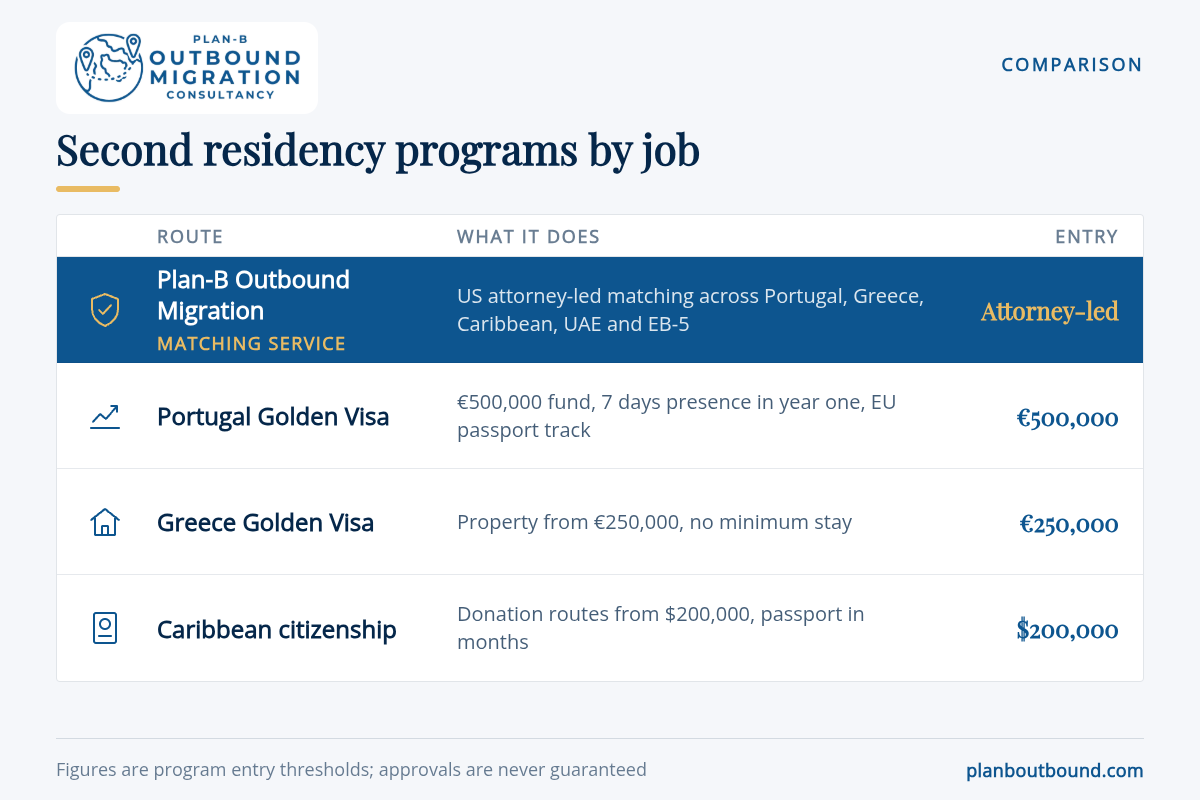
For an EU passport track, Portugal's €500,000 fund route leads. For a zero-stay Schengen base, Greece's real estate Golden Visa from €250,000 wins. For a fast second passport, Caribbean citizenship programs deliver in months. For a tax-neutral base, the UAE Golden Visa stands out. Malta, Turkey and US EB-5 serve narrower goals.
| Program | Minimum investment | Minimum stay | Path to passport | Wealth protection angle |
|---|---|---|---|---|
| Portugal Golden Visa | €500,000 CMVM fund or €250,000 donation | 7 days year one, 14 per two-year period | 5 years under current law, reform proposes 10 | EU residency, EU banking, regulated fund exposure |
| Greece Golden Visa | €250,000 to €800,000 real estate by zone | None | 7 years of real residence plus language exam | Hard asset in the EU, no relocation needed |
| Caribbean CBI (St Kitts, Grenada, Antigua, Saint Lucia) | Donation routes from $200,000 under the 2024 regional agreement; St Kitts from $250,000 | None | Citizenship at approval | Immediate second passport and travel freedom |
| UAE Golden Visa | AED 2 million property | Exempt from the six-month absence rule | No naturalization pathway in practice | No personal income tax, global banking hub |
| Turkey | $400,000 real estate | None | Citizenship at approval | Fast passport, but weaker visa-free reach |
| US EB-5 | $800,000 TEA or $1,050,000 standard | Must reside in the US | Green card, then naturalization | For Canadians and others seeking US residence |
We segment clients by goal before by budget. The EU passport tier is Portugal, with Malta as a higher-cost alternative. The no-relocation tier is Greece and the UAE. The speed tier is the Caribbean and Turkey.
If you are weighing the two most popular European routes, our Greece Golden Visa vs Portugal Golden Visa comparison for Americans walks through seven decision factors, including stay rules and citizenship timelines.
For a deeper look at the Portuguese fund route, including which CMVM funds accept US persons under FATCA, see our Portugal Golden Visa fund investment guide for Americans.
Where can a property purchase alone secure a residence permit, and for how much?
Greece grants a five-year renewable residence permit for property from €250,000, €400,000 or €800,000 depending on zone. The UAE issues a ten-year Golden Visa for property worth AED 2 million. Turkey grants citizenship, not just residency, for $400,000 in real estate.
Greece prices by location: €800,000 in Attica, Thessaloniki, Mykonos, Santorini and islands with more than 3,100 residents, €400,000 elsewhere, and €250,000 for commercial-to-residential conversions or listed building restorations. Since 2013, Greece has issued over 100,000 residence permits under the program.
Malta's permanent residence program combines a property purchase or lease with a government contribution and a charitable donation; confirm the current figures with the Residency Malta Agency because they changed in 2025. Panama's Qualified Investor Visa starts at $300,000 in titled real estate.
Decision rule: if you want a hard asset you can visit and rent out, Greece is the lowest EU entry point. If you want a passport rather than a permit, Turkey is the property route, with the trade-off that a Turkish passport does not give visa-free Schengen access.
What is the practical difference between a golden visa permit and a second passport?
Residency by investment gives you a renewable permit to live in a country; citizenship by investment gives you a passport and the rights that come with it. Residency protects wealth through banking and property access with a slower passport track. Citizenship protects mobility immediately but costs more up front and faces growing scrutiny from the EU and US.
A Golden Visa is conditional. Portugal's permit must be renewed and the investment held for the life of the permit, and Greece's permit lapses if the property is sold. Citizenship, once granted, is not tied to keeping the asset in most Caribbean programs after the required holding period.
Which protects wealth better depends on the threat you are hedging. A Caribbean passport solves travel and exit risk fastest. A Portuguese residency builds toward an EU passport that unlocks the right to live and work in 27 countries, which no Caribbean document offers.
For a program-by-program look at the Caribbean, Turkey and Malta, see our best citizenship by investment programs for 2026 comparison.
What hidden fees sit on top of the investment figure?
Beyond the headline investment, expect government application and permit fees per family member, due diligence fees per adult, legal and advisory fees, apostille and sworn translation costs, a local tax number and bank account, and renewal fees every permit cycle. On Caribbean programs, due diligence is charged per adult applicant, so a couple pays twice.
On Portugal, the fund's own subscription fee and annual management fee sit on top of government fees, and AIMA charges per person at application and at each renewal. On Greece, property transfer tax, notary fees and lawyer fees are added to the purchase price.
US-origin documents add their own line items. FBI background checks, State Department apostilles and sworn translations are required by Hague Convention countries, which is a step Maggie K. had never heard of before she became an EU Golden Visa holder in less than a year with our team.
Budget rule: build your total around the investment, then add the government and professional fees for every family member, then add a renewal reserve. Firms that quote only the investment figure are leaving out the part that trips people up.
How do minimum stay rules work, and can you hold residency without relocating?
Yes, several programs let you hold residency without relocating. Portugal asks for about seven days in the first year and fourteen days per later two-year period. Greece has no minimum stay. The UAE Golden Visa exempts holders from the usual six-month absence rule. Passive income visas such as Spain's non-lucrative visa and Portugal's D7 expect real residence.
This distinction drives the whole plan. A Golden Visa is designed for people who keep living in the US or Canada and want a legal foothold abroad. A D7 or non-lucrative visa is designed for people who are actually moving.
The trap is tax residency. Stay 183 or more days in almost any of these countries and you become tax resident there while the IRS keeps taxing you, so the stay rule and the tax rule must be planned together.
Are there affordable second residency routes for a smaller budget?
Yes. Portugal's D7 visa requires passive income of at least €920 per month, Spain's non-lucrative visa requires €28,800 per year plus €7,200 per dependent, Albania lets US passport holders stay one year visa-free before filing for a permit from inside the country, and Panama's Friendly Nations Visa offers a two-stage path to permanent residency.
These routes trade investment capital for physical presence. The Portugal D7 visa suits retirees living on Social Security, pensions or dividends, but it expects you to actually live in Portugal, which makes you a Portuguese tax resident.
Spain's non-lucrative visa bars you from working, even remotely, during the first year. The 400% IPREM income bar is proven with bank statements and pension letters.
Albania is the outlier: there is no fixed investment ticket, permanent residence comes after five continuous years, and there is no US-Albania income tax treaty, so Albanian tax residency after 183 days must be managed with the foreign earned income exclusion or foreign tax credits.
How do US tax and reporting rules affect Americans with a second residency?
US citizens keep filing IRS returns on worldwide income with any second residency. Foreign accounts above $10,000 in aggregate trigger FBAR, FATCA Form 8938 applies above its thresholds, and Portuguese Golden Visa funds usually trigger PFIC reporting on Form 8621. Spending 183 or more days in a country generally creates local tax residency on top of US obligations.
The IRS FBAR rules apply the moment your new Portuguese or Greek bank account pushes your combined foreign balances past $10,000 at any point in the year. Under FATCA, the foreign bank also reports you to the IRS, which is why some Portuguese funds refuse US persons outright.
The US does not participate in the OECD Common Reporting Standard, but your second country does, so your local accounts are visible to that country's tax authority as well.
If you relocate to Portugal and work, the Portugal NHR 2.0 (IFICI) regime for Americans taxes qualifying Portuguese employment income at a flat 20% for 10 years and exempts most foreign dividends and capital gains, but pensions, Social Security and IRA withdrawals are taxed at progressive rates up to 48%. The registration deadline is January 15 of the year after you become resident.
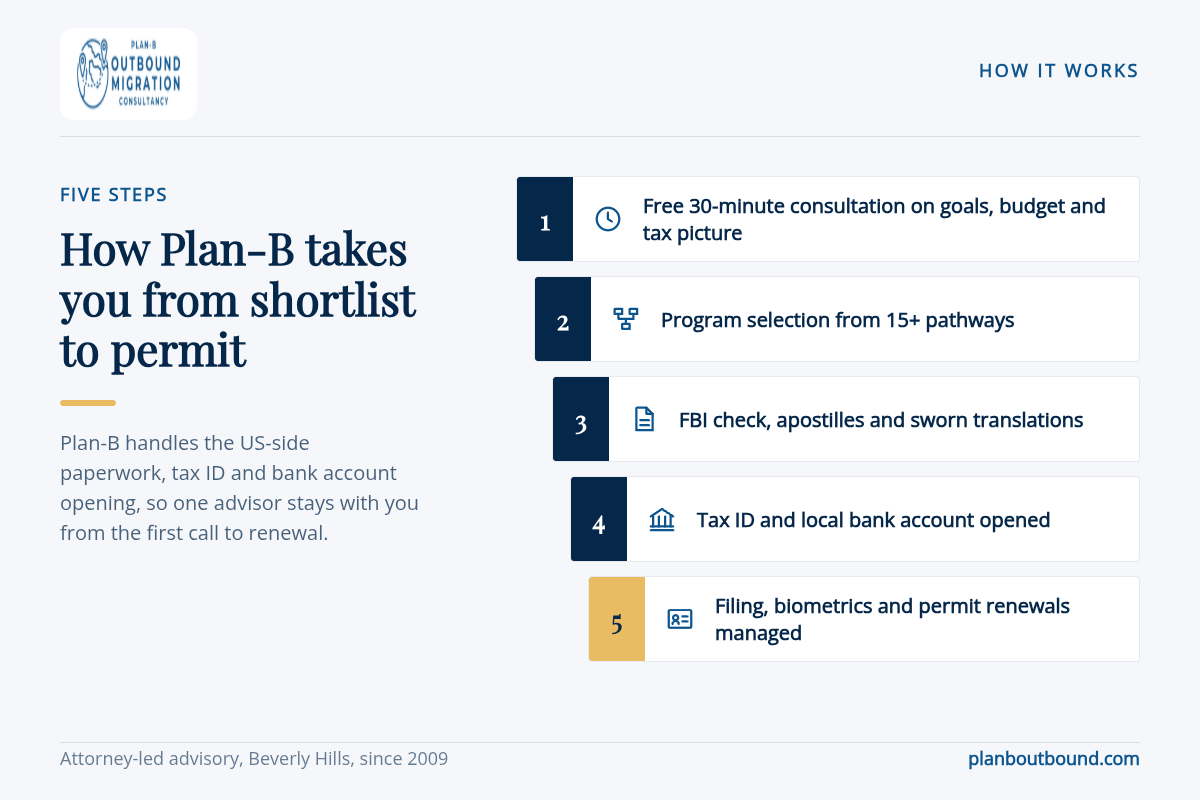
Plan-B coordinates the visa route, NIF, bank account and document timing around these rules, but we are not a tax return preparer, and your CPA or enrolled agent files the forms.
How does the US EB-5 investor visa compare with golden visa programs?
The US EB-5 program requires $800,000 in a targeted employment area or $1,050,000 elsewhere, plus ten created jobs, in exchange for a conditional green card. It costs more than most golden visas and brings US worldwide taxation, so it suits Canadians and other foreign nationals who want US residence, not Americans seeking a Plan B.
According to USCIS, the conditional green card lasts two years before the investor petitions to remove conditions by proving the jobs were created. Naturalization follows after five years of permanent residence.
For our Canadian clients, EB-5 is the inverse of a Golden Visa: more capital, mandatory presence, and entry into the US tax system rather than a hedge against it. Plan-B handles EB-5 alongside the European and Caribbean programs for exactly this reason.
How did we compare these options?
We compared each advisory firm's published service scope, headquarters location, leadership credentials and stated pricing model, and each program's current government thresholds, minimum stay rules and citizenship timelines as published by the relevant immigration authorities. We did not run surveys or mystery-shop fees; where a firm does not publish prices, we say so.
Program figures reflect the rules in force at publication, including the October 2023 removal of Portuguese real estate and the April 2025 closure of the Spanish Golden Visa, and should be confirmed before you commit capital.
How do you get started with Plan-B Outbound Migration?
Book a free 30-minute consultation with Plan-B Outbound Migration. We review your goals, budget and tax picture, then recommend a program from the EU Golden Visa, Caribbean citizenship by investment and US EB-5 programs we handle. From there, our concierge team manages tax IDs, bank accounts, apostilles and filings from our Beverly Hills office.
Schedule your free 30-minute consultation with Plan-B Outbound Migration and get a clear shortlist before you wire a dollar.
What do people also ask?
Which countries give permanent residency by buying property?
Greece grants a five-year renewable permit for property from €250,000, €400,000 or €800,000 depending on zone, the UAE issues a ten-year Golden Visa for AED 2 million in property, and Turkey grants citizenship for $400,000 in real estate. Portugal removed its real estate route in October 2023 and Spain closed its Golden Visa on April 3, 2025.
Where is the safest place to invest money for a second residency?
There is no universally safest place; the safest structure is diversification across jurisdictions and regulated vehicles. Portugal's Golden Visa funds are CMVM regulated, Greek property is a hard asset in the EU, and Caribbean donations buy a passport rather than an asset. Plan-B is not an investment manager and does not promise returns.
How much money do you need to invest to get a green card in the USA?
Under the EB-5 program, the minimum is $800,000 in a targeted employment area or $1,050,000 elsewhere, and the investment must create ten jobs. Investors receive a two-year conditional green card first, then petition to remove conditions, and can apply for citizenship after five years of permanent residence.
Which country is best for wealth management with a second residency?
It depends on the goal. The UAE offers no personal income tax and a global banking hub without a citizenship pathway, Portugal offers EU banking plus a passport track at five years under current law, and Malta offers EU residency with a higher contribution cost. US citizens remain taxed on worldwide income in every case.
Can you hold a second residency without moving there?
Yes. Greece has no minimum stay, Portugal requires about seven days in year one and fourteen days per later two-year period, and the UAE Golden Visa exempts holders from the six-month absence rule. Passive income visas like Portugal's D7 and Spain's non-lucrative visa expect real residence and trigger local tax residency.